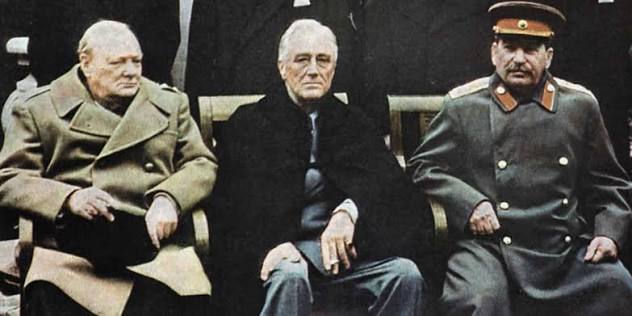
In November 1943, three men sat together in a Soviet embassy in Tehran for the first time. Franklin D. Roosevelt, Winston Churchill, and Joseph Stalin represented the most powerful nations fighting against the Axis. But they shared little in common beyond a common enemy. Roosevelt was a patrician Democrat, Churchill an aristocratic imperialist, and Stalin a revolutionary dictator. Their alliance, forged by necessity, would decide the fate of Europe and the shape of the postwar world.
This is the story of how these three leaders the ‘Big Three’ managed their profound differences to defeat Nazi Germany, and how their fragile partnership sowed the seeds of the Cold War.
The Unlikely Alliance
The Grand Alliance was a marriage of convenience from the start. The Soviet Union, under Stalin, had signed a non-aggression pact with Hitler in 1939, and the United States remained officially neutral until the attack on Pearl Harbor in December 1941. Britain, alone after the fall of France, relied on American aid through Lend-Lease, but it was not until Germany invaded the Soviet Union in June 1941 that the three powers were drawn together.
Stalin’s demands were immediate and relentless: open a second front in Western Europe to relieve the Red Army. Churchill and Roosevelt, wary of a premature invasion that could fail catastrophically, stalled. The delay would become a source of deep resentment for Stalin, who saw the Western Allies as happy to let the Soviets bleed.
The Personal Dynamics
Roosevelt and Churchill shared a warm, almost intimate correspondence. Churchill signed his letters ‘Former Naval Person’ and Roosevelt replied as ‘President.’ They met frequently, from the Atlantic Charter meeting in August 1941 to the Casablanca Conference in 1943. Their strategic visions aligned on many issues, though they clashed over colonialism Roosevelt pushed for decolonization, while Churchill was determined to preserve the British Empire.
Stalin was the odd one out. Suspicious and demanding, he tested his allies’ resolve. At Tehran, he reportedly joked about executing 50,000 German officers, prompting Churchill to storm out of the room. Yet Roosevelt and Churchill recognized that Stalin’s cooperation was essential for victory, so they accommodated his paranoia.
Roosevelt’s health was failing by 1944. He died of a cerebral hemorrhage in April 1945, weeks before Germany’s surrender. His successor, Harry Truman, stepped into the role with little preparation.
The Conferences That Shaped the World
Tehran: First Contact
At the Tehran Conference (November–December 1943), the Big Three met for the first time. They agreed on Operation Overlord the invasion of Normandy which would finally open the second front. They also discussed postwar borders, with Stalin demanding parts of Poland and the Baltic states. Roosevelt and Churchill, needing Stalin’s continued participation in the war, made concessions they would later regret.
Yalta: The High-Water Mark of Cooperation
In February 1945, with Germany’s defeat imminent, the Big Three met at Yalta in the Crimea. They agreed to divide Germany into occupation zones, to allow the Soviet Union to enter the war against Japan, and to create the United Nations. Stalin also pledged to hold ‘free elections’ in Eastern Europe a promise he would break.
Yalta has been called a ‘betrayal’ by some, who argue that Roosevelt and Churchill handed Eastern Europe to Stalin. Others view it as a realistic acknowledgment of military realities: the Red Army already occupied much of the region.
Potsdam: The Changing of the Guard
The Potsdam Conference (July–August 1945) was different. Truman represented the United States, and Churchill was replaced mid-conference by Clement Attlee after Labour won the British election. Only Stalin remained, the wily survivor. They issued the Potsdam Declaration, demanding Japan’s unconditional surrender, and finalized the terms for Germany’s occupation. The alliance was already fraying, and Potsdam set the stage for the Cold War.
Beyond the Big Three: Other Key Allied Leaders
While the Big Three dominated decisions, other leaders played crucial roles. Charles de Gaulle led the Free French Forces, determined to restore France’s honor. Chiang Kai-shek headed the Nationalist government of China, while Mao Zedong led communist forces in a civil war against him both nominally Allied. King George VI symbolized British resistance, and General Dwight D. Eisenhower commanded the Allied forces in Europe.
The Alliance’s Collapse
The alliance that won the war did not survive the peace. Within two years of Germany’s surrender, Churchill was giving his ‘Iron Curtain’ speech, and the world had entered the Cold War. The Soviet Union installed communist governments across Eastern Europe, and the United States responded with the Truman Doctrine and the Marshall Plan.
The seeds of this collapse were planted at Yalta and earlier. The Atlantic Charter’s promise of self-determination was never applied to colonies, and Stalin’s demands for a buffer zone were met with Western suspicion.
Why It Still Matters
The decisions made by the Big Three shaped the world we live in. The United Nations, the division of Germany, the borders of Eastern Europe all trace back to their meetings. Their uneasy alliance demonstrates that, in war, ideology can be set aside for survival. But it also shows that such marriages of convenience rarely last beyond the end of the conflict.
The Big Three were not friends. They were rivals who found a common enemy. Their cooperation was essential to defeating the Axis, but their mutual distrust ensured that the peace would be fragile. Roosevelt’s vision, Churchill’s oratory, and Stalin’s ruthlessness each shaped the outcome. The alliance they forged and its collapse remains a powerful lesson about the limits of wartime unity.
Summary
- The Big Three Roosevelt, Churchill, and Stalin led the US, UK, and USSR during World War II, meeting at Tehran, Yalta, and Potsdam.
- Their alliance was one of convenience, not friendship, with deep ideological differences.
- Key decisions included the second front, German occupation zones, and the creation of the UN.
- Stalin’s broken promises on Eastern Europe contributed to the Cold War.
- Other leaders like de Gaulle and Chiang Kai-shek played important but secondary roles.
FAQ
Q: Who were the Big Three?
A: Franklin D. Roosevelt (US President), Winston Churchill (British Prime Minister), and Joseph Stalin (Soviet leader). They led the three major Allied powers during World War II.
Q: What was the Atlantic Charter?
A: A joint declaration by Roosevelt and Churchill in August 1941, outlining postwar goals such as self-determination and free trade. Stalin was not present.
Q: Why did Stalin want a second front?
A: The Soviet Union suffered enormous casualties on the Eastern Front. Stalin wanted the Western Allies to invade Germany from the west to relieve pressure on the Red Army.
Q: Was Yalta a betrayal of Eastern Europe?
A: Critics say yes, because Roosevelt and Churchill allowed Stalin to control the region in exchange for Soviet help against Japan. Others argue it reflected military reality.
Q: Who attended the Potsdam Conference?
A: Harry Truman (US), Winston Churchill and then Clement Attlee (UK), and Joseph Stalin (USSR).
Leave a Reply