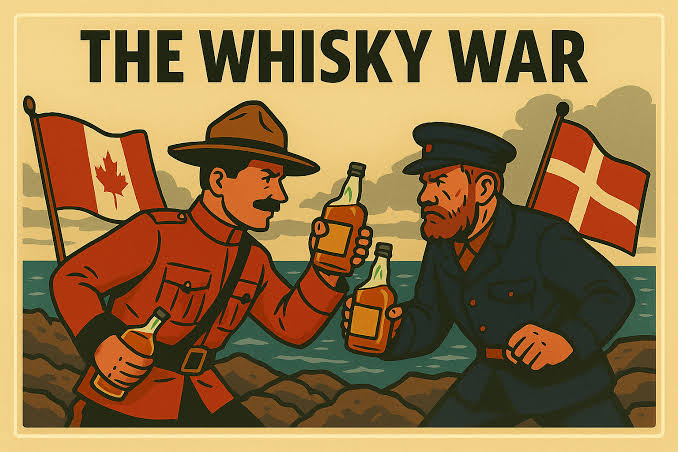
At the top of the world, between Canada’s Ellesmere Island and Greenland, lies a slab of rock barely a kilometer wide. For 50 years, it was the subject of a quirky Cold War between two of the most peaceful nations on Earth. They called it the Whisky War.
The island, named Hans Island (or Tartupaluk in Greenlandic), has no vegetation, no fresh water, and no strategic value. Yet from 1973 to 2022, Canada and Denmark traded flags and spirits on its barren shores. What began as a diplomatic headache ended with a toast that split the island in two—and created a brand-new international border.
This is the story of how a bottle of whisky and a bottle of schnapps turned a territorial dispute into a model for peaceful resolution.
A Rock Worth Fighting For? Not Quite
Hans Island sits in the Nares Strait, a narrow channel separating Ellesmere Island from Greenland. At roughly 1.3 square kilometers—about the size of 12 football fields—it is entirely rocky, with no vegetation, fresh water, or minerals of commercial value. It has no permanent inhabitants and offers no strategic military advantage.
Yet for half a century, Canada and Denmark claimed it. The dispute began in 1973 when the two nations negotiated a maritime boundary treaty for the continental shelf between Greenland and Canada. They successfully delimited about 3,000 kilometers of boundary but left a gap of roughly 1,000 meters around Hans Island. Both sides asserted sovereignty, and negotiations stalled.
The Island’s Namesake
The island is named after Hans Hendrik, a Greenlandic Inuit hunter and interpreter who accompanied Arctic expeditions in the 1850s and 1870s. He was part of American and British missions searching for the lost Franklin expedition. The island was first mapped during the 1871–1873 Polaris Expedition led by American explorer Charles Francis Hall.
Neither Canada nor Denmark had a strong historical claim. Both based their sovereignty on proximity and occasional use. The island’s value was entirely symbolic—a marker of Arctic sovereignty and a precedent for future territorial questions in the region.
The Whisky War Begins
The nickname “Whisky War” came from the unusual tactics both nations employed. In 1984, Danish Minister for Greenland Tom Høyem visited the island, planted the Danish flag, buried a bottle of cognac, and left a note: “Welcome to the Danish island.”
Canadian officials responded by planting their own flag and leaving a bottle of Crown Royal Canadian whisky with a note like “Keep up the good work.” Over the following decades, periodic visits—often during Arctic sovereignty patrols—saw each side replace the other’s flag and swap whisky for Danish schnapps (Gammel Dansk), always in a good-natured spirit.
One notable escalation occurred in 2005 when Canadian Defence Minister Bill Graham visited the island, prompting a formal protest from Denmark. But even that flap was resolved diplomatically. The exchanges were so friendly that the dispute became a running joke in international relations circles.
Why Did It Matter?
Despite the island’s worthlessness, the dispute carried weight. As Arctic ice recedes due to climate change, new shipping lanes and seabed resources are becoming accessible. Under the UN Convention on the Law of the Sea (UNCLOS), islands can generate exclusive economic zones (EEZs). While Hans Island is too small to sustain human habitation—thus not generating a full EEZ under Article 121—the dispute was seen as precedent-setting for other Arctic territorial questions.
Canada and Denmark are both NATO allies, and the dispute was a rare point of friction between them. Managing it without escalating to real conflict was a test of diplomatic skill.
The Path to Resolution
In 2018, Canada and Denmark established a joint task force to resolve the Hans Island question. After years of negotiation, they agreed to partition the island roughly in half along a natural fracture line running north-south. Canada received the larger portion (about 60%), and Denmark/Greenland the remainder.
On June 14, 2022, officials from both nations signed a historic agreement in a ceremony where they toasted with whisky and schnapps. The treaty created the world’s first land border between Canada and the European Union (via Denmark and Greenland). Canada ratified the agreement in June 2022, and Denmark’s parliament ratified it in May 2023.
The Distillery Connection
No distillery exists on Hans Island, and none is planned. The phrase “ended with a distillery” is metaphorical: the spirits that lubricated diplomacy became the symbol of the resolution. The agreement was celebrated as a triumph of “whisky diplomacy,” a reminder that even the most absurd territorial disputes can be resolved with mutual respect and a shared drink.
The island now stands as a monument to peaceful negotiation—a stark contrast to other unresolved territorial conflicts around the world.
The Whisky War ended not with a bang, but with a sip. Hans Island, once a source of diplomatic friction, is now divided between two friendly nations. It serves as proof that even the most trivial disputes can be resolved when both sides approach them with humor and goodwill. The next time you raise a glass of whisky, you might think of that barren rock in the high Arctic—and the unlikely peace it inspired.
Summary
- Hans Island is a barren, uninhabited rock in the Nares Strait between Canada and Greenland, about the size of 12 football fields.
- Canada and Denmark disputed sovereignty over the island for nearly 50 years (1973–2022).
- The “Whisky War” involved officials planting flags and leaving bottles of Canadian whisky or Danish schnapps as good-natured taunts.
- In June 2022, the two nations agreed to partition the island roughly 60/40 along a natural fracture line, creating the first land border between Canada and the EU.
- No distillery exists on the island; the “distillery” is a metaphor for the role of spirits in the diplomatic resolution.
FAQ
Q: Where is Hans Island?
A: Hans Island (Tartupaluk in Greenlandic, Hans Ø in Danish) is located in the Nares Strait between Ellesmere Island (Nunavut, Canada) and Greenland (Denmark), at approximately 80°49′N, 66°27′W.
Q: Why was the dispute called the Whisky War?
A: Because officials from Canada and Denmark visited the island to plant their flags and left bottles of Canadian whisky (Crown Royal) or Danish schnapps (Gammel Dansk) for the other side, with friendly notes.
Q: How was the dispute resolved?
A: In June 2022, Canada and Denmark signed an agreement to partition the island roughly in half along a natural fracture line, with Canada receiving about 60% and Denmark/Greenland the rest. The treaty was ratified by Canada in 2022 and Denmark in 2023.
Q: Is there actually a distillery on Hans Island?
A: No. The phrase “ended with a distillery” is metaphorical, referring to the role of whisky and schnapps in the diplomatic process and the celebratory toast at the signing.
Q: Why did the island matter if it had no resources?
A: It was symbolically important for Arctic sovereignty and as a precedent for other territorial disputes as Arctic ice recedes and new shipping routes and resources become accessible.