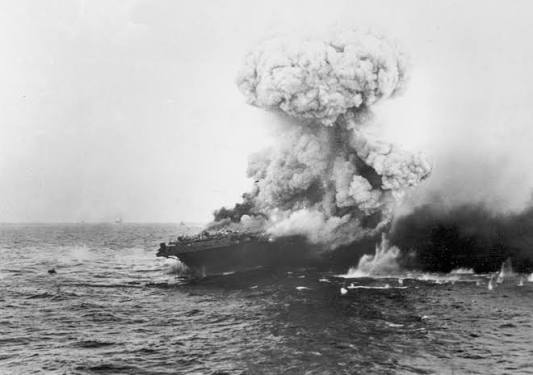
On May 8, 1942, in the waters northeast of Australia, two naval forces fought a battle unlike any before. They never saw each other. No ship fired a shot at an enemy vessel. Instead, aircraft from four carriers two American, two Japanese located and struck their targets from over a hundred miles away. By the end of the day, one American carrier lay sinking, and a Japanese carrier was crippled. The Battle of the Coral Sea was the world’s first carrier-versus-carrier battle, and it changed naval warfare forever.
The fight was not a clear-cut victory for either side. The Americans lost the fleet carrier USS Lexington, while the Japanese lost the light carrier Shōhō and saw Shōkaku heavily damaged. Yet strategically, the outcome favored the United States: Japan’s invasion of Port Moresby was called off, marking the first time a Japanese amphibious operation was turned back. More importantly, the battle blunted Japanese airpower at a critical moment, setting the stage for the decisive Battle of Midway one month later.
The Strategic Chessboard
In the spring of 1942, Japan’s expansion across the Pacific seemed unstoppable. After Pearl Harbor, they had swept through the Philippines, Malaya, and the Dutch East Indies. Their next target was Port Moresby on the southern coast of Papua New Guinea, a stepping stone for threatening Australia. Operation MO, as it was called, aimed to seize Port Moresby and establish a seaplane base at Tulagi in the Solomon Islands.
But the United States had a secret weapon: codebreakers. They had cracked parts of the Japanese naval code, JN-25, and learned of the operation. This allowed Admiral Chester Nimitz to send carriers to intercept, even though his forces were still recovering from the devastating raid on Pearl Harbor.
The Forces Converge
The American side was built around two fleet carriers: USS Yorktown and USS Lexington. Rear Admiral Frank Jack Fletcher commanded the combined Task Force 17. The Japanese side, under Vice Admiral Takeo Takagi, had the fleet carriers Shōkaku and Zuikaku, plus the light carrier Shōhō, which was assigned to support the invasion force.
Both sides had strengths and weaknesses. The Japanese pilots were battle-hardened from victories across the Pacific. The Americans were less experienced but had the advantage of better intelligence and a more concentrated force. The Japanese plan, by contrast, was complex and dispersed, splitting their carriers into separate groups with different missions.
The First Strikes
The battle began on May 3 when Japanese forces occupied Tulagi. The next day, American aircraft from Yorktown launched strikes on the invasion force, sinking a few small ships but failing to find the main carriers. For the next two days, both sides searched for each other, their scouts crisscrossing the Coral Sea.
On May 7, the search paid off in a chaotic series of strikes. American aircraft spotted what they thought was the main Japanese carrier force—it turned out to be the light carrier Shōhō. They attacked with devastating effect, sinking her in minutes. Lieutenant Commander Robert Dixon radioed the famous message: “Scratch one flat-top!” It was the first Japanese carrier sunk in the war.
Meanwhile, Japanese aircraft also found targets—but they were the wrong ones. They bombed and sank the destroyer USS Sims and the oiler USS Neosho, mistaking the latter for a carrier. It was a costly error for both sides: the Americans lost valuable ships, and the Japanese wasted bombs on a tanker.
The Main Event
On May 8, both carrier forces finally located each other almost simultaneously. Each launched full strikes. The American aircraft found Shōkaku and hit her with three bombs, putting her flight deck out of action. But Zuikaku, hidden in a rain squall, escaped undamaged. The Japanese strike found both American carriers. Yorktown took a bomb hit but remained operational. Lexington, however, was struck by two torpedoes and two bombs. At first, she seemed to be in stable condition, and her crew began damage control.
Then, hours later, a massive explosion rocked Lexington. Fuel vapors had ignited, setting off a chain of internal blasts. The fires quickly became uncontrollable. By evening, the order was given to abandon ship. American destroyers scuttled her with torpedoes, sending the great carrier to the bottom.
Aftermath and Consequences
The battle ended with both sides withdrawing. The Japanese had lost Shōhō, and Shōkaku was so damaged she had to return to Japan for repairs. Zuikaku still had her flight deck, but she had lost so many aircraft and pilots that she was effectively out of action. The invasion of Port Moresby was postponed and then canceled.
For the United States, the loss of Lexington was a bitter blow. But the battle had achieved its strategic goal: the Japanese advance on Australia was halted. More importantly, the battle severely weakened Japanese carrier airpower. The experienced pilots lost at Coral Sea were irreplaceable—Japan had no training program to quickly produce new ones. This proved decisive at Midway, where the Japanese would face the Americans with fewer veteran airmen and only three operational fleet carriers.
The Battle of the Coral Sea also validated the new doctrine of carrier-centric warfare. It showed that ships could fight each other without ever coming into visual range, and that airpower was now the dominant factor at sea. For the first time in naval history, the surface fleet had taken a back seat to the aircraft carrier.
The lessons learned were costly. The loss of Lexington highlighted the dangers of fuel vapor and the need for better damage control. The confusion of the searches showed the importance of effective scouting and coordination. These lessons would be applied just weeks later at Midway, where the United States would turn the tide of the Pacific War.
The Battle of the Coral Sea was a turning point, even though neither side could claim a clear tactical victory. It stopped Japan’s expansion and set the stage for Midway. It also marked the beginning of a new era in naval warfare, where the carrier reigned supreme and the battleship became obsolete. In the annals of history, it stands as the first battle where the enemy was only a distant speck on a radar screen, a harbinger of how wars would be fought in the future.
Summary
- The Battle of the Coral Sea (May 4–8, 1942) was the first naval battle where opposing ships never sighted each other.
- The U.S. lost the carrier Lexington, but stopped the Japanese invasion of Port Moresby, achieving a strategic victory.
- The Japanese lost the light carrier Shōhō and suffered heavy aircraft and pilot losses, weakening their carrier force for the Battle of Midway.
- The battle demonstrated the dominance of carrier aviation and the importance of intelligence and scouting.
FAQ
Q: Why is the Battle of the Coral Sea considered a turning point?
A: It was the first time Japan’s expansion was halted, and the first carrier-versus-carrier battle, showing that airpower would decide future naval engagements.
Q: What was the strategic significance of the battle?
A: The U.S. prevented Japan from capturing Port Moresby, which would have threatened Australia, and the attrition of Japanese aircrews contributed to their defeat at Midway.
Q: How did the loss of Lexington affect the U.S. Navy?
A: It was a heavy blow, but it led to improvements in damage control and validated the carrier as the primary offensive weapon.
Q: Did the Japanese achieve their objective?
A: No, they failed to take Port Moresby and had to call off the invasion, marking their first strategic setback in the Pacific.
Q: What happened to the Japanese carriers after the battle?
A: Shōkaku was damaged and out of action for months, while Zuikaku lost so many aircraft and pilots that she could not participate in the Battle of Midway.
Leave a Reply