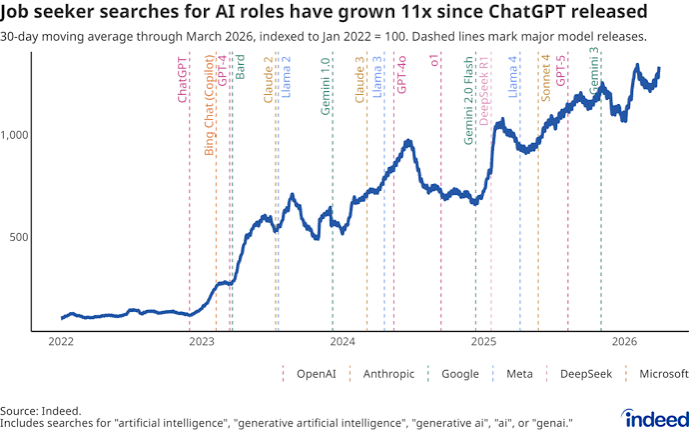
When ChatGPT launched on November 30, 2022, it didn’t just introduce a new tool it triggered a seismic shift in how people think about their careers. Within months, searches for “AI jobs” on major job platforms skyrocketed. According to Indeed’s Hiring Lab, the volume of searches for AI-related terms has grown roughly 11-fold since before ChatGPT’s release. That’s not a small blip; it’s a tidal wave of interest.
But here’s the twist: while interest exploded, the actual number of AI job postings grew far more slowly only about 2 to 4 times in the same period. That gap between what people are searching for and what’s actually available is the real story. It’s a tale of hope, hype, and a workforce trying to figure out its place in an AI-driven world.
The ChatGPT Effect: From Curiosity to Career Change
Before ChatGPT, AI jobs were a niche corner of the tech industry. Data scientists, machine learning engineers, and research scientists held advanced degrees and specialized skills. If you weren’t already in that world, you probably didn’t think about AI jobs at all.
Then ChatGPT made AI tangible. Suddenly, anyone could ask a computer to write a poem, debug code, or summarize a dense report. It was like watching a magic trick that turned out to be real. That moment of accessibility sparked a global “aha” — and with it, a wave of career-related searches.
Indeed’s data shows the spike wasn’t just about “AI jobs” as a phrase. Searches for “AI engineer,” “prompt engineer,” “machine learning engineer,” and even “AI safety” all climbed sharply. LinkedIn reported similar trends, adding “AI” as a top skill tag. Google Trends confirmed the surge was worldwide, with especially high interest in India, the U.S., the UK, and Canada.
But why did search volume grow so much faster than actual job openings? Part of the answer is that ChatGPT arrived during a turbulent time in the labor market. Tech layoffs in 2022–2023 left many workers looking for their next move, and AI seemed like a safe bet. Venture capital poured into AI startups, creating new roles — but not enough to match the flood of searchers.
The Demand-Supply Gap: More Searchers Than Jobs
Here’s a number that puts things in perspective: searches went up 11 times, but postings only went up 2 to 4 times. That’s a huge mismatch. For every AI job listed, there are far more people searching than before.
What does that mean for job seekers? Put simply, it’s competitive. Many searchers don’t yet have the skills employers want — things like Python, PyTorch, or model fine-tuning. That creates a lot of frustration and what some call “AI job search fatigue.” People see the hype, apply to roles, and then discover the bar is higher than expected.
On the employer side, recruiters are drowning in applications, many from unqualified candidates. Some job seekers have started adding “AI” to their resumes without real experience, a kind of keyword inflation that forces companies to rely more on technical tests and practical assessments.
This gap isn’t necessarily bad news. It’s a signal that the workforce is eager to learn. Enrollment in AI courses on platforms like Coursera and Udacity has surged. Universities report record numbers of students in AI and data science programs. The search spike is a leading indicator of a more AI-literate workforce in the making.
Why People Are Searching: Opportunity and Fear
The surge isn’t just about ambition; it’s also about anxiety. A significant chunk of those searches likely come from workers worried that AI might replace their jobs. They’re not necessarily applying — they’re checking the horizon to see if their role is at risk.
That dual motivation — hope and fear — shapes how the trend plays out. On the optimistic side, AI can be a skill multiplier. A marketer who learns to use AI tools can become more productive without becoming a programmer. A writer who understands prompt engineering can offer new services. Many roles are being redefined rather than eliminated.
New job categories have also emerged that didn’t exist before 2022. “Prompt engineer,” “AI ethicist,” “AI trainer,” and “LLM operator” are genuinely new titles. These roles blend technical and non-technical skills, opening doors for people from diverse backgrounds.
On the skeptical side, there’s a risk of a hype bubble. Gartner-style hype cycles suggest that interest might normalize as employers clarify what AI roles actually require. The initial gold rush may settle into a more realistic landscape where the hype fades but the underlying demand for AI skills remains steady.
How Employers Are Responding
Faced with a flood of unqualified applicants, many companies are changing their approach. Instead of hiring externally, they’re investing in internal upskilling programs. They’re training existing employees in AI basics, data literacy, and even model fine-tuning. This approach has two benefits: it builds a loyal, skilled workforce, and it avoids the risk of hiring someone who just looks good on paper.
For job seekers, this means that the path to an AI role isn’t always a new job title. Sometimes it’s about adding AI skills to your current role. An accountant who learns to use AI for data analysis becomes more valuable without needing to switch careers. A customer service manager who understands AI chatbots can improve their team’s efficiency.
A Global Perspective
Interest in AI jobs isn’t uniform around the world. India and Southeast Asia show the highest growth rates, driven by large young populations and strong IT outsourcing industries. In the U.S. and Europe, growth is steadier, with more focus on AI ethics, governance, and applied roles.
Remote work has accelerated this global trend. AI jobs are disproportionately remote-friendly, which makes them attractive to talent in lower-cost regions. A developer in Bangalore can apply for a role at a Silicon Valley startup without relocating. That’s a powerful draw for searchers worldwide.
What This Means for Your Career
So, what should you take away from this 11-fold surge? First, don’t let the hype pressure you into a panic. The search spike doesn’t mean everyone needs to become an AI engineer tomorrow. It means there’s a growing demand for AI literacy across many fields.
Second, focus on skills, not just titles. If you’re interested in AI, start with the fundamentals: understanding what AI can and can’t do, learning basic data concepts, and experimenting with tools like ChatGPT. You don’t need a Ph.D. to get started.
Third, be realistic about the job market. The gap between searches and postings means competition is fierce. But it also means that those who do invest in real, verifiable skills will stand out. Employers are desperate for people who can actually do the work, not just talk about it.
Finally, consider how AI applies to your current job. The most successful workers will likely be those who combine their existing expertise with AI capabilities. That’s a powerful combination that no algorithm can replace.
The 11-fold surge in AI job searches is a reflection of a workforce waking up to a new reality. It’s a mix of excitement and anxiety, opportunity and uncertainty. While the gap between searches and actual openings is real, it also points to a transition period. As the hype settles, the true value will lie in skills and adaptability. Whether you’re a job seeker, an employer, or just someone curious about the future, the message is clear: AI is here to stay, and learning to work with it is one of the smartest career moves you can make.
Summary
- Searches for “AI jobs” have grown 11-fold since ChatGPT launched in November 2022.
- Job postings for AI roles grew only 2-4 times in the same period, creating a demand-supply gap.
- The surge is driven by both opportunity-seeking and fear of automation, especially after tech layoffs.
- Employers are responding with internal upskilling programs rather than relying solely on external hires.
- AI jobs are increasingly remote-friendly, fueling global interest, particularly in India and Southeast Asia.
FAQ
Q: Why did searches for AI jobs grow so much faster than actual job postings?
A: The 11x search growth reflects a surge in curiosity and career exploration triggered by ChatGPT, but the actual number of AI roles grew more slowly. Many searchers are exploring possibilities or upskilling, not all are applying, and employers are also being more selective due to a flood of unqualified applications.
Q: Do I need a technical degree to get an AI job?
A: Not necessarily. While many AI roles require strong technical skills, there are also new positions like prompt engineer or AI ethicist that value non-technical backgrounds. Focus on building practical skills through courses and hands-on projects.
Q: Is the AI job search trend just a hype bubble?
A: There’s some hype, but the underlying demand for AI skills is real and likely to persist. The initial spike may normalize, but AI is becoming integral to many industries, so jobs will continue to evolve.
Q: How can I stand out when applying for AI roles?
A: Employers are skeptical of resume keyword inflation, so demonstrate real skills. Build a portfolio of projects, contribute to open-source, or take certifications from recognized platforms. Show that you can apply AI to solve practical problems.
Q: What should I do if I’m worried AI might replace my job?
A: Instead of panicking, invest in learning AI tools relevant to your field. Understand how AI can augment your work. Upskilling is the best defense against automation.
Leave a Reply