Tag: employment

  • AI Job Searches Have Grown 11-Fold Since ChatGPT: What It Means for Workers and Employers

    AI Job Searches Have Grown 11-Fold Since ChatGPT: What It Means for Workers and Employers

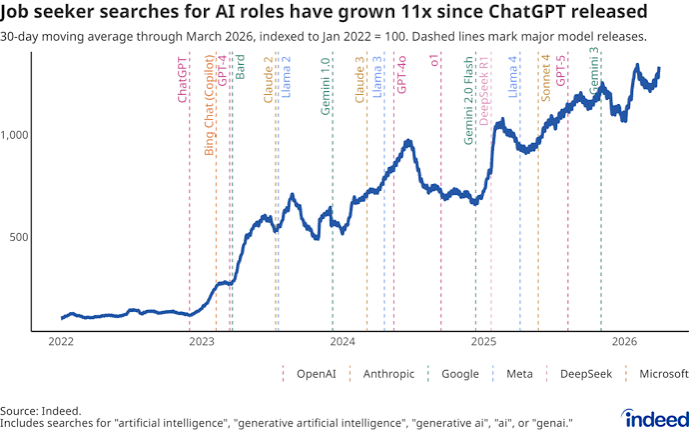
    When ChatGPT launched on November 30, 2022, it didn’t just introduce a new tool  it triggered a seismic shift in how people think about their careers. Within months, searches for “AI jobs” on major job platforms skyrocketed. According to Indeed’s Hiring Lab, the volume of searches for AI-related terms has grown roughly 11-fold since before ChatGPT’s release. That’s not a small blip; it’s a tidal wave of interest.

    But here’s the twist: while interest exploded, the actual number of AI job postings grew far more slowly only about 2 to 4 times in the same period. That gap between what people are searching for and what’s actually available is the real story. It’s a tale of hope, hype, and a workforce trying to figure out its place in an AI-driven world.

    The ChatGPT Effect: From Curiosity to Career Change

    Before ChatGPT, AI jobs were a niche corner of the tech industry. Data scientists, machine learning engineers, and research scientists held advanced degrees and specialized skills. If you weren’t already in that world, you probably didn’t think about AI jobs at all.

    Then ChatGPT made AI tangible. Suddenly, anyone could ask a computer to write a poem, debug code, or summarize a dense report. It was like watching a magic trick that turned out to be real. That moment of accessibility sparked a global “aha” — and with it, a wave of career-related searches.

    Indeed’s data shows the spike wasn’t just about “AI jobs” as a phrase. Searches for “AI engineer,” “prompt engineer,” “machine learning engineer,” and even “AI safety” all climbed sharply. LinkedIn reported similar trends, adding “AI” as a top skill tag. Google Trends confirmed the surge was worldwide, with especially high interest in India, the U.S., the UK, and Canada.

    But why did search volume grow so much faster than actual job openings? Part of the answer is that ChatGPT arrived during a turbulent time in the labor market. Tech layoffs in 2022–2023 left many workers looking for their next move, and AI seemed like a safe bet. Venture capital poured into AI startups, creating new roles — but not enough to match the flood of searchers.

    The Demand-Supply Gap: More Searchers Than Jobs

    Here’s a number that puts things in perspective: searches went up 11 times, but postings only went up 2 to 4 times. That’s a huge mismatch. For every AI job listed, there are far more people searching than before.

    What does that mean for job seekers? Put simply, it’s competitive. Many searchers don’t yet have the skills employers want — things like Python, PyTorch, or model fine-tuning. That creates a lot of frustration and what some call “AI job search fatigue.” People see the hype, apply to roles, and then discover the bar is higher than expected.

    On the employer side, recruiters are drowning in applications, many from unqualified candidates. Some job seekers have started adding “AI” to their resumes without real experience, a kind of keyword inflation that forces companies to rely more on technical tests and practical assessments.

    This gap isn’t necessarily bad news. It’s a signal that the workforce is eager to learn. Enrollment in AI courses on platforms like Coursera and Udacity has surged. Universities report record numbers of students in AI and data science programs. The search spike is a leading indicator of a more AI-literate workforce in the making.

    Why People Are Searching: Opportunity and Fear

    The surge isn’t just about ambition; it’s also about anxiety. A significant chunk of those searches likely come from workers worried that AI might replace their jobs. They’re not necessarily applying — they’re checking the horizon to see if their role is at risk.

    That dual motivation — hope and fear — shapes how the trend plays out. On the optimistic side, AI can be a skill multiplier. A marketer who learns to use AI tools can become more productive without becoming a programmer. A writer who understands prompt engineering can offer new services. Many roles are being redefined rather than eliminated.

    New job categories have also emerged that didn’t exist before 2022. “Prompt engineer,” “AI ethicist,” “AI trainer,” and “LLM operator” are genuinely new titles. These roles blend technical and non-technical skills, opening doors for people from diverse backgrounds.

    On the skeptical side, there’s a risk of a hype bubble. Gartner-style hype cycles suggest that interest might normalize as employers clarify what AI roles actually require. The initial gold rush may settle into a more realistic landscape where the hype fades but the underlying demand for AI skills remains steady.

    How Employers Are Responding

    Faced with a flood of unqualified applicants, many companies are changing their approach. Instead of hiring externally, they’re investing in internal upskilling programs. They’re training existing employees in AI basics, data literacy, and even model fine-tuning. This approach has two benefits: it builds a loyal, skilled workforce, and it avoids the risk of hiring someone who just looks good on paper.

    For job seekers, this means that the path to an AI role isn’t always a new job title. Sometimes it’s about adding AI skills to your current role. An accountant who learns to use AI for data analysis becomes more valuable without needing to switch careers. A customer service manager who understands AI chatbots can improve their team’s efficiency.

    A Global Perspective

    Interest in AI jobs isn’t uniform around the world. India and Southeast Asia show the highest growth rates, driven by large young populations and strong IT outsourcing industries. In the U.S. and Europe, growth is steadier, with more focus on AI ethics, governance, and applied roles.

    Remote work has accelerated this global trend. AI jobs are disproportionately remote-friendly, which makes them attractive to talent in lower-cost regions. A developer in Bangalore can apply for a role at a Silicon Valley startup without relocating. That’s a powerful draw for searchers worldwide.

    What This Means for Your Career

    So, what should you take away from this 11-fold surge? First, don’t let the hype pressure you into a panic. The search spike doesn’t mean everyone needs to become an AI engineer tomorrow. It means there’s a growing demand for AI literacy across many fields.

    Second, focus on skills, not just titles. If you’re interested in AI, start with the fundamentals: understanding what AI can and can’t do, learning basic data concepts, and experimenting with tools like ChatGPT. You don’t need a Ph.D. to get started.

    Third, be realistic about the job market. The gap between searches and postings means competition is fierce. But it also means that those who do invest in real, verifiable skills will stand out. Employers are desperate for people who can actually do the work, not just talk about it.

    Finally, consider how AI applies to your current job. The most successful workers will likely be those who combine their existing expertise with AI capabilities. That’s a powerful combination that no algorithm can replace.

    The 11-fold surge in AI job searches is a reflection of a workforce waking up to a new reality. It’s a mix of excitement and anxiety, opportunity and uncertainty. While the gap between searches and actual openings is real, it also points to a transition period. As the hype settles, the true value will lie in skills and adaptability. Whether you’re a job seeker, an employer, or just someone curious about the future, the message is clear: AI is here to stay, and learning to work with it is one of the smartest career moves you can make.

    Summary

    • Searches for “AI jobs” have grown 11-fold since ChatGPT launched in November 2022.
    • Job postings for AI roles grew only 2-4 times in the same period, creating a demand-supply gap.
    • The surge is driven by both opportunity-seeking and fear of automation, especially after tech layoffs.
    • Employers are responding with internal upskilling programs rather than relying solely on external hires.
    • AI jobs are increasingly remote-friendly, fueling global interest, particularly in India and Southeast Asia.

    FAQ

    Q: Why did searches for AI jobs grow so much faster than actual job postings?
    A: The 11x search growth reflects a surge in curiosity and career exploration triggered by ChatGPT, but the actual number of AI roles grew more slowly. Many searchers are exploring possibilities or upskilling, not all are applying, and employers are also being more selective due to a flood of unqualified applications.

    Q: Do I need a technical degree to get an AI job?
    A: Not necessarily. While many AI roles require strong technical skills, there are also new positions like prompt engineer or AI ethicist that value non-technical backgrounds. Focus on building practical skills through courses and hands-on projects.

    Q: Is the AI job search trend just a hype bubble?
    A: There’s some hype, but the underlying demand for AI skills is real and likely to persist. The initial spike may normalize, but AI is becoming integral to many industries, so jobs will continue to evolve.

    Q: How can I stand out when applying for AI roles?
    A: Employers are skeptical of resume keyword inflation, so demonstrate real skills. Build a portfolio of projects, contribute to open-source, or take certifications from recognized platforms. Show that you can apply AI to solve practical problems.

    Q: What should I do if I’m worried AI might replace my job?
    A: Instead of panicking, invest in learning AI tools relevant to your field. Understand how AI can augment your work. Upskilling is the best defense against automation.

  • 10 Red Flags to Avoid When Accepting a New Job

    10 Red Flags to Avoid When Accepting a New Job

    You’ve survived the interview gauntlet, and the offer letter sits in your inbox. The salary is right, the title is shiny, and the office (or home office) looks great in the video tour. But before you sign on the dotted line, take a breath. A 2023 survey by JobSage found that 68% of workers regret accepting a job, with culture mismatch and misleading job descriptions leading the list of culprits. The cost of a bad hire isn’t just an employer’s problem—for you, it means lost income, gaps in benefits, and a hit to your career momentum.

    Spotting red flags early can save you from a world of regret. Some warning signs are blatant, like a hiring manager who rolls their eyes when you ask about work-life balance. Others are subtle, like a job description that keeps shifting between interview rounds. This guide breaks down 10 concrete red flags to watch for, drawn from career experts at Forbes, Harvard Business Review, and The Muse, plus practical advice on how to respond to each. Remember: a red flag isn’t always a dealbreaker, but ignoring a cluster of them is a gamble with your livelihood.

    1. The Job Description Is Vague or Keeps Changing

    If the role you applied for morphs into something unrecognizable by the third interview, that’s a sign of disorganization or a leader who doesn’t know what they need. A job description that reads like a wish list of six different roles—”We need a marketing guru who can also code and manage our supply chain”—is a red flag for unrealistic expectations.

    What to do: Ask the hiring manager to walk you through a typical day and the top three priorities for the first 90 days. If they can’t articulate them, that’s a warning. Compare the original job posting to what you’re told verbally. If there’s a major mismatch, clarify in writing before accepting.

    2. High Turnover in the Role or Team

    When the last three people in this position left within a year, that’s not a coincidence—it’s a pattern. High turnover can indicate a toxic manager, impossible workload, or a role that was oversold. According to the U.S. Department of Labor, a bad hire can cost a company up to 30% of the employee’s first-year earnings, but for you, it’s your time and sanity.

    What to do: Don’t be shy—ask directly: “How long have the last few people in this role stayed? What did they go on to do?” On LinkedIn, find former employees and ask them for a candid chat. If the company hesitates to share, consider that a red flag in itself.

    3. Negative or Evasive Interviewer Behavior

    Interviews go both ways. If the hiring manager rolls their eyes when you ask about work-life balance, or the interviewer dodges questions about team culture, they’re telling you something. A 2023 survey by JobSage found that culture mismatch is a top reason for job regret, so take those cues seriously.

    What to do: Trust your gut. If someone is dismissive during the interview, they’ll likely be worse as a colleague. You can also ask follow-up questions like, “What do you enjoy most about working here?” If the answer is vague or negative, that’s a sign.

    4. Unclear Compensation or Benefits Details

    If the salary is discussed in vague ranges (“We pay competitively!”) or benefits are described as “standard” without specifics, be wary. A legitimate offer should include a clear salary, bonus structure, benefits package, and any other perks in writing. If you have to drag the details out of them, they may be hiding something.

    What to do: Ask for a written summary of the total compensation package before you accept. If they resist, that’s a red flag. Also, check if the salary is above or below industry standards on sites like Glassdoor or LinkedIn—if it’s significantly lower, you’ll want to negotiate or reconsider.

    5. Excessive Urgency to Fill the Position

    “We need someone to start yesterday!” might sound flattering, but it’s often a sign of a chaotic environment. A company that can’t plan its hiring pipeline may also struggle with other aspects of operations. Urgency can also be a pressure tactic to make you accept without thinking.

    What to do: Take a step back. If a company pushes you to decide within 24 hours, that’s a red flag. A reasonable employer will give you at least a week to consider. Use the time to do your due diligence—research the company, talk to current or former employees, and review the offer with a trusted mentor.

    6. Poor Communication During the Hiring Process

    If it takes weeks to get a response, or your emails go unanswered, that’s a preview of what it’s like to work there. Communication is the backbone of any healthy work relationship, and if it’s broken during the honeymoon phase, it’s not going to improve later.

    What to do: Note the response times and tone. If you’re being ghosted or given the runaround, consider whether you want to enter that environment. You can also mention this politely to the recruiter—if they’re apologetic and improve, that’s a good sign; if they’re defensive, run.

    7. Unrealistic Expectations (e.g., “We Work Hard and Play Hard”)

    Phrases like “we work hard and play hard” or “we’re like a family” are code for “we’ll work you to the bone and guilt-trip you if you complain.” The same goes for expectations like being on call 24/7 or “hustle culture.” These are red flags for burnout.

    What to do: Ask about actual work hours, overtime, and how performance is measured. If the interviewer boasts about “all-nighters” or “crunch time,” ask how often that happens and what the team does to prevent burnout. If they don’t have a good answer, that’s a warning.

    8. Lack of Structured Onboarding or Training Plan

    If the hiring manager can’t tell you what your first week looks like, or there’s no formal onboarding process, you might be thrown into the deep end. While some startups are more flexible, a complete lack of structure can leave you floundering and set you up for failure.

    What to do: Ask about onboarding: “What does the first 30 days look like?” “Is there a mentor or buddy system?” “What training is provided?” If they say, “You’ll figure it out,” that’s a red flag—unless you thrive in chaos, which is rare.

    9. Discrepancies Between What’s Said and What’s Written in the Offer

    The interview promised remote work, but the offer letter says “hybrid.” The recruiter said the bonus is guaranteed, but the contract says “at the company’s discretion.” These discrepancies are not typos—they’re red flags.

    What to do: Carefully review the offer letter and compare it to any verbal agreements. If there’s a discrepancy, ask for clarification in writing. If the company refuses to correct it, that’s a major red flag. You want a written contract that matches the promises made.

    10. Gut Feeling of Discomfort or Pressure

    Your intuition is a powerful tool. If something feels off—even if you can’t pinpoint it—don’t ignore it. This is especially important if you’re feeling pressure to accept due to sunk cost (you’ve invested time in interviews), anchoring (the salary is high), or fear of missing out (the job market is tight).

    What to do: Give yourself space to reflect. Talk to trusted friends or mentors about your impressions. If you’re feeling rushed, that’s a red flag. A good employer will respect your need to make an informed decision.

    Accepting a new job is a two-way street. You’re not just being evaluated—you’re also evaluating the company. Red flags are not always dealbreakers; sometimes a disorganized process is just a busy startup. But when you see multiple warning signs, or one that’s severe (like illegal interview questions), it’s wise to listen. Take your time, ask clarifying questions, and trust your gut. The 68% of workers who regretted their job choice wish they had paid attention to the signs. Don’t be one of them.

    Summary

    • 68% of workers regret accepting a job, with culture mismatch and misleading job descriptions as top reasons.
    • A bad hire can cost a company up to 30% of the employee’s first-year earnings, but for you, it’s your time and career.
    • Watch for vague job descriptions, high turnover, evasive interviewers, unclear compensation, and excessive urgency.
    • Poor communication, unrealistic expectations, lack of onboarding, and discrepancies between what’s said and written are all red flags.
    • Trust your gut—if something feels off, investigate before signing.

    FAQ

    Q: Is a red flag always a dealbreaker?
    A: No. Some red flags are manageable if you acknowledge and address them. For example, a disorganized onboarding can be improved with a proactive attitude. The key is severity and pattern—if you see multiple red flags or one that’s severe, it’s a dealbreaker.

    Q: Can a high salary make up for other red flags?
    A: High pay can mask a toxic culture, but burnout and turnover often negate the financial benefit. Studies show that employees leave managers, not companies. Consider the long-term cost to your well-being and career.

    Q: Will asking tough questions cost me the offer?
    A: Well-framed questions about turnover, expectations, and culture are usually respected. If a candidate is penalized for asking, that’s itself a red flag. A good employer appreciates a thoughtful candidate.

    Q: Are red flags only about the company?
    A: No. Some red flags are about your fit—like a role that requires skills you don’t have or a commute you can’t sustain. Self-awareness is part of the evaluation.

    Q: Does a bad interview process mean a bad company?
    A: Not necessarily. Sometimes the hiring manager is just busy or the process is new. Look for patterns across multiple interactions, not a single incident. If the process is consistently disorganized, that’s a warning.