In 2024, IBM announced a hiring freeze on back-office roles it expects AI to replace about 7,800 positions. Google restructured its ad sales unit, cutting thousands of jobs, citing AI-enabled efficiency. These are not isolated events. Over 250,000 tech workers lost their jobs in 2023, and the pace continued into 2024–2025. While many layoffs stem from pandemic overhiring and economic pressure, AI is now a stated factor in a significant subset.
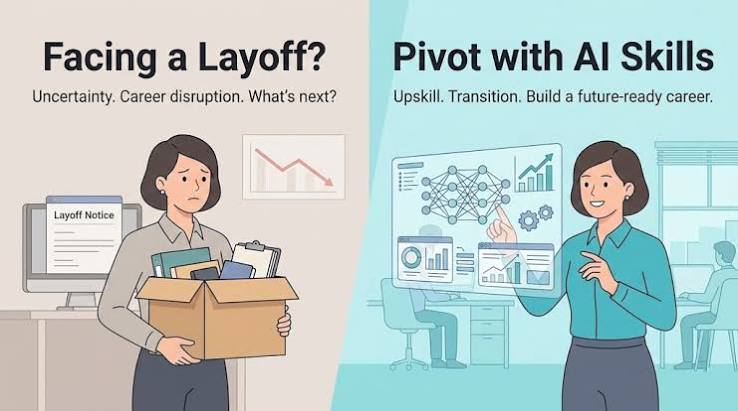
If you’re a tech worker or in a role that involves routine cognitive tasks, this feels unsettling. But history offers a different lens: past tech shifts from mainframes to PCs, from the internet to cloud computing caused short-term pain but ultimately created more jobs than they eliminated. The key is that the new jobs required different skills. This article cuts through the noise to give you a clear, practical roadmap for navigating AI-related layoffs: understanding what’s happening, which skills employers actually want, and how to pivot your career with confidence.
Why This Wave Feels Different
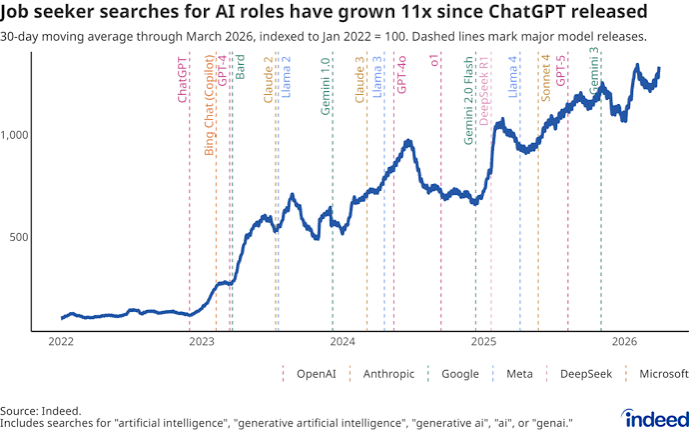
The release of ChatGPT in November 2022 marked an inflection point. For the first time, generative AI made automation of knowledge work commercially viable at scale. Tools like Microsoft Copilot, Google Gemini, and Anthropic’s Claude can draft emails, write code, analyze data, and even create art. This is not just about replacing manual labor; it’s about automating cognitive tasks.
But economists distinguish between automation (replacing tasks) and augmentation (helping humans do tasks better). Current layoffs skew toward automation of routine cognitive work—like basic customer support, data entry, and junior coding. However, augmentation is also creating new roles that never existed before.
The Numbers: What the Data Shows
Layoffs.fyi tracks tech layoffs and shows over 250,000 workers laid off in 2023, with a slower but steady pace in 2024–2025. Goldman Sachs estimated in 2023 that AI could automate 300 million full-time jobs globally, but economists emphasize that this means task displacement, not whole-job elimination. In practice, most jobs consist of a bundle of tasks, and AI might automate some while leaving others—especially those requiring human judgment—untouched.
Tech unemployment remains low, around 2–3%, but the perception of instability is high. Layoffs are concentrated in tech hubs like the Bay Area, Seattle, and NYC, but remote work spreads both the impact and the opportunity.
The Skills Employers Are Actually Hiring For
Let’s get practical. What do employers want right now? The research points to four key areas:
1. AI Literacy
This is the baseline. You don’t need to be a machine learning engineer, but you must understand how AI models work, how to prompt them effectively, and when to use them. Prompt engineering—crafting inputs to get useful outputs—is a skill in demand across roles. For example, a marketing manager who can use Midjourney to create visuals or ChatGPT to draft campaign copy is more valuable than one who can’t.
2. AI-Adjacent Technical Skills
If you’re in a technical role, Python, data analysis, machine learning fundamentals, and MLOps (managing ML models in production) are gold. But you don’t need a PhD. A software engineer can upskill into ML engineering or AI product management with focused courses and projects.
3. Human-Centric Skills
Critical thinking, emotional intelligence, complex problem-solving, adaptability, and cross-functional communication are consistently cited as the hardest to automate. These are the skills that AI can’t replicate—yet. For example, a customer service representative who can handle an irate customer with empathy and creative problem-solving is not easily replaced by a chatbot.
4. Domain Expertise + AI
The fastest-growing job postings combine AI skills with a specific industry. Healthcare AI, legal AI, marketing analytics—these hybrid roles are booming. For instance, a nurse who understands AI diagnostic tools is more valuable than a generic AI engineer. The pattern is clear: AI is a multiplier, but you need the domain to multiply.
Career Pivot Trends: Where People Are Going
Let’s look at real-world pivot patterns:
From Technical to AI-Specific: Software engineers are moving into ML engineering, AI product management, and AI infrastructure. They’re not starting from zero; they’re building on existing coding skills.
From Routine to Strategic: People in repetitive roles—data entry, basic customer support, junior design—are pivoting into roles that require judgment, client relationship management, or oversight of AI systems. A data entry clerk might become an AI trainer who labels data for model training, or an AI implementation consultant who helps businesses integrate tools.
Growth of AI-Adjacent Roles: New categories are emerging: AI trainers, prompt engineers, AI content reviewers, AI safety analysts, and AI implementation consultants. These roles often don’t require deep technical expertise but do require understanding of AI and strong communication.
Historical Precedent: The Long View
The shift from mainframes to PCs in the 1980s displaced many clerical jobs but eventually created an entire industry of software developers, IT support, and computer trainers. The internet boom of the 1990s eliminated some middlemen but created e-commerce, digital marketing, and web development. Each time, there was a lag between job destruction and creation, and the new jobs required different skills.
Some economists invoke the Jevons paradox: AI will increase demand for human labor in adjacent areas. For example, if AI makes it cheaper to build software, more software will be built, requiring more product managers, QA testers, and UX designers. But this is contested—and the transition period can be brutal for those caught in the middle.
Practical Steps to Pivot Your Career
Here’s a concrete plan to future-proof your career:
- Assess your current role: List the tasks you do daily. Which are routine and repetitive? Which require judgment, creativity, or human interaction? The first category is at risk; the second is your safety net.
- Learn AI basics: Take a free course on prompt engineering or AI literacy. Understand how models work, their limitations, and their ethical implications. This is table stakes now.
- Build a portfolio: Apply AI to your current domain. If you’re in marketing, create a project using AI to analyze customer data. If you’re in HR, use AI to screen resumes ethically. Show, don’t tell.
- Network strategically: Connect with people in AI-adjacent roles. Join communities, attend webinars, and inform your network about your pivot. Opportunities often come through people.
- Consider certification: While not essential, certifications in data science, AI ethics, or project management can signal commitment.
The Role of Employers and Policy
Layoffs are not purely a personal problem. Employers have a responsibility to reskill and redeploy workers. IBM’s hiring freeze is a case in point—they also invested in training employees for AI-related roles. Governments can support with unemployment benefits, reskilling programs, and portable benefits.
But in the end, individual adaptability is key. The research is clear: those who learn to work with AI, rather than against it, will thrive.
AI-related layoffs are real, but they are not the end of work. They are a signal that the skill mix is changing. The workers who will succeed are those who embrace AI literacy, double down on human-centric skills, and combine their domain expertise with new tools. Start today: assess your tasks, learn the basics, and build a portfolio. The future is not about being replaced; it’s about becoming indispensable in a new way.
Summary
- AI-related layoffs are happening, but they often reflect task automation, not whole-job elimination.
- Employers are hiring for AI literacy, human-centric skills, and domain expertise + AI.
- Career pivots are moving from technical to AI-specific, and routine to strategic roles.
- Historical tech shifts show net job creation over time, but with a lag and new skill requirements.
- Practical steps: assess your tasks, learn AI basics, build a portfolio, and network strategically.
FAQ
Q: Will AI really replace my job?
A: AI is more likely to replace certain tasks within your job, not the entire job. For example, a data entry clerk might lose the typing part but gain a role overseeing AI accuracy. Focus on tasks that require judgment, empathy, and creativity—those are hardest to automate.
Q: What skills should I learn to stay relevant?
A: Start with AI literacy—understand how models work and how to prompt them. Then, add human-centric skills like critical thinking and communication. Finally, combine AI with your domain expertise; for instance, a marketer who can use AI analytics is highly valued.
Q: Are there new jobs being created because of AI?
A: Yes, roles like AI trainers, prompt engineers, AI content reviewers, and AI safety analysts are emerging. These often don’t require deep technical backgrounds but do require understanding of AI and strong communication.
Q: If I’m in a repetitive role, is it too late to pivot?
A: Not at all. Many people in routine roles are pivoting into AI-adjacent positions. Start by learning AI basics and look for opportunities to apply them in your current job. Build a small project to demonstrate your skills.
Q: How long will the transition take?
A: Historically, job creation lagged behind displacement by a few years. In the meantime, focus on upskilling and networking. The key is to stay adaptable and keep learning.