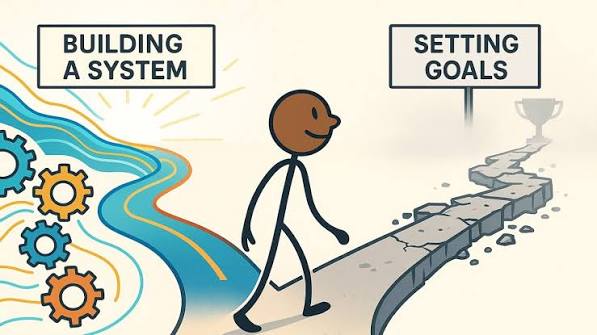
You’ve probably been told your whole life to set goals: lose 20 pounds, write a novel, earn six figures. But what if that advice is actually holding you back? A growing counter-movement argues that goals are overrated, and that the real secret to lasting success lies in something far more mundane: systems.
A system is a repeatable process you engage in regularly, regardless of immediate outcomes. Instead of fixating on the finish line, you focus on showing up every day. This shift in mindset can compound over time, leading to achievements that goals alone could never deliver. Here’s why ditching goals for systems might be the most productive thing you do.
The Problem with Goals
Goals are everywhere. From SMART goals in corporate boardrooms to vision boards in wellness circles, the message is clear: set a target, work hard, achieve it. But there’s a hidden downside. Goals create a binary pass/fail mindset. If you don’t hit the target, you feel like a failure, even if you made significant progress. And when you do hit the goal, there’s often a surprising emptiness—a phenomenon known as the “arrival fallacy.” You expected a life transformation, but instead you just feel… the same.
Moreover, goals are finite. Once you achieve them, they stop motivating you. You’re back to square one, needing to invent a new goal to chase. This cycle of striving and emptiness can be exhausting.
The Power of Systems
A system, by contrast, is about the process, not the outcome. It’s the daily habit, the routine, the consistent action. Scott Adams, the creator of Dilbert, popularized this idea with his blunt phrase: “Goals are for losers; systems are for winners.” In his book How to Fail at Almost Everything and Still Win Big, he argues that goals are limiting because they create a binary pass/fail mindset, while systems provide ongoing feedback and adaptability.
James Clear, author of Atomic Habits, echoes this sentiment with a memorable line: “You do not rise to the level of your goals. You fall to the level of your systems.” In other words, your daily habits—not your aspirations—determine your outcomes.
Consider the difference:
- Goal: “I want to run a marathon.” System: “I run four times a week, rain or shine.”
- Goal: “I want to write a novel.” System: “I write 500 words every morning.”
- Goal: “I want to lose 20 pounds.” System: “I cook healthy meals and walk daily.”
In each case, the system is within your control, while the goal depends on external factors. Systems also build identity. When you show up consistently, you start to see yourself as “a runner” or “a writer,” which reinforces the behavior.
Why Systems Are Unpopular
Despite the evidence, systems remain the less popular choice. Why? Because they’re not sexy. Goals give us a clear finish line and a moment of celebration. Systems, on the other hand, are mundane and repetitive. There’s no dramatic “win” moment—just a series of small, unglamorous actions.
The self-help industry thrives on selling the fantasy of a single breakthrough. Books, apps, and coaches promise transformation through a big goal. Systems require patience and delayed gratification, which are hard to market.
There’s also a cultural bias. Western society, business, and education are saturated with goal-setting frameworks—New Year’s resolutions, OKRs, vision boards. We’re taught that goals are the key to success. The idea that they might be counterproductive is deeply counterintuitive.
But there’s a growing counter-movement. Post-pandemic burnout has made rigid goal-chasing feel exhausting. Remote work and the gig economy have blurred the lines between work and life, making sustainable systems more relevant than rigid annual targets. And increased mental health awareness has highlighted the anxiety and shame associated with “failing” goals.
The Science Behind Systems
Psychological research supports the systems approach. Studies on “implementation intentions” by Peter Gollwitzer (1999) show that planning when, where, and how you’ll act—a core component of systems—significantly increases follow-through compared to merely stating intentions. Instead of “I’ll exercise more,” you say, “I’ll go for a run every Monday, Wednesday, and Friday at 7 a.m.” This specificity turns a vague intention into a concrete action plan.
Systems also leverage the power of compounding. Reading 10 pages a day might not seem like much, but it adds up to about 12 books a year. Small, repeated actions accumulate over time, producing results that goals alone can’t achieve.
The Case for Goals (and the Middle Ground)
It’s not that goals are inherently bad. They provide clarity, direction, and a sense of urgency. Some achievements require a goal: winning a competition, hitting a revenue target, or meeting a deadline. Goals can give you a compass.
The problem is when goals become the primary driver, and systems are neglected. The best approach might be to use goals sparingly for direction, but invest most of your energy in systems for execution. As James Clear puts it, “Goals are about the results you want to achieve. Systems are about the processes that lead to those results.”
There’s also a distinction between outcome goals (external, uncontrollable) and process goals (internal, controllable). Systems are essentially process goals on autopilot. By focusing on the process, you reduce anxiety and increase your chances of success.
How to Start Building Systems
Ready to make the shift? Start small. Pick one area of your life where you’ve been goal-obsessed. Identify a daily or weekly action you can take, regardless of how you’re feeling that day. Write it down, schedule it, and track it.
For example, if you want to get fit, don’t set a goal to lose 20 pounds. Instead, commit to a 20-minute walk every day. If you want to write a book, don’t focus on the finished manuscript. Commit to writing 500 words every morning.
Remember, the key is consistency, not intensity. A system that you can maintain for years will always beat a goal that burns out in weeks. And as you build these systems, you’ll start to see yourself differently. You’ll become someone who shows up, day after day, and that identity is the real reward.
Goals have their place, but they’re not the holy grail of productivity. Systems are the unsung heroes—the daily habits that compound into extraordinary results. By shifting your focus from outcomes to processes, you can reduce stress, build resilience, and achieve more than you ever thought possible. So go ahead, ditch the goal. Start building a system instead.
Summary
- Goals create a binary pass/fail mindset and can lead to the arrival fallacy.
- Systems are repeatable processes that focus on daily actions, not outcomes.
- Research shows that implementation intentions (a system component) boost follow-through.
- Compounding effects mean small daily actions lead to big results over time.
- Use goals as a compass, but invest most energy in systems for execution.
FAQ
Q: Are goals completely useless?
A: No. Goals can provide direction and clarity. The issue is over-reliance on them. Use goals sparingly, but focus on building systems to achieve them.
Q: How do I know if a system is working?
A: Focus on consistency rather than immediate results. If you’re showing up regularly, the system is working. Results will follow over time.
Q: What if I have a deadline?
A: Deadlines require goals. But you can still use systems to meet them. Break the goal into daily actions and set up a system for those actions.
Q: Can I apply systems to creative work like writing or art?
A: Absolutely. In fact, creative work benefits greatly from systems. Instead of waiting for inspiration, set a daily practice. Inspiration will come more readily.
Q: How long does it take to see results from a system?
A: It depends on the system and your goals. Some results come in weeks, others in months or years. The key is to trust the process and stay consistent.
Leave a Reply