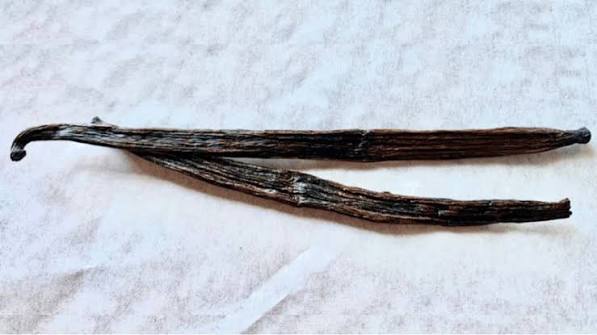
Vanilla is the second most expensive spice in the world, but its journey from a sacred Mesoamerican ritual to a global commodity is a story of conquest, ingenuity, and bitter exploitation. This single orchid fruit, once reserved for Aztec emperors, now flavors everything from ice cream to perfume, yet its production remains a fragile, labor-intensive art.
Behind every vanilla bean lies a series of improbable events: a bee that only lives in one corner of the world, a flower that blooms for a single day, and a 19th-century enslaved boy whose hand-pollination technique still feeds a global industry. Understanding vanilla’s odyssey is not just about tracing a spice—it’s about seeing how colonialism, botany, and economics intertwine in a single, fragrant pod.
The Only Orchid That Feeds Us
Vanilla is not a bean. It is a capsule—a seed pod of an orchid, the only orchid in the world that produces an edible fruit. The vine, Vanilla planifolia, climbs through tropical forests, wrapping itself around trees in the region that is now Mexico, Belize, Guatemala, and Honduras. Its natural pollinators, the Melipona bee and certain hummingbirds, are native only to these Mesoamerican forests. This geographic exclusivity shaped vanilla’s history: for centuries, the spice could only be produced in this one corner of the world.
Before the Spanish arrived, the Totonac people of the Gulf Coast cultivated vanilla. They used it to flavor xocolatl, a bitter cacao drink, along with honey, maize, and chili. When the Aztecs conquered the Totonac region in the 15th century, they demanded vanilla as tribute. The Aztec emperor Montezuma II reportedly served a vanilla-cacao concoction to Hernán Cortés in 1519—the moment that launched vanilla’s European journey.
A Totonac legend explains the vine’s origin: Princess Xanat, forbidden to marry a mortal, fled with her lover. When discovered, they were beheaded. Where her blood touched the ground, a vine grew; where her severed finger fell, a fragrant orchid bloomed. The vine was called Caxixanath, “sacred flower.”
From Spanish Court to European Luxury
Cortés brought vanilla and cacao to Spain in the 1520s. For nearly 300 years, vanilla remained a luxury of the Spanish court, used almost exclusively to flavor chocolate. The English apothecary Hugh Morgan introduced vanilla to England in the early 1600s as a standalone flavor, but it stayed rare and costly. The problem: outside Mexico, the vines would not fruit.
Each vanilla flower opens for only 6 to 12 hours, and if not pollinated in that narrow window, it withers and dies. In Mexico, the Melipona bee did the work naturally. Elsewhere, no pollinator existed. For centuries, anyone who tried to grow vanilla outside its native range watched the flowers bloom and fall, fruitless.
The Boy Who Cracked the Code
In 1836, Belgian botanist Charles Morren figured out the pollination mechanism but failed to turn it into a commercial method. The breakthrough came in 1841, on the French island of Réunion, when a 12-year-old enslaved boy named Edmond Albius invented a simple, rapid hand-pollination technique. Using a bamboo splinter or a thorn, he would lift the flap of the flower and press the male and female parts together. That’s it. The entire process takes seconds.
Albius’s method was so effective that a skilled worker can pollinate 1,000 to 2,000 flowers per day. But with hundreds of flowers per vine, it still means every single flower gets individual attention, by hand. This technique, essentially unchanged, is still used across the world today.
Albius’s contribution was immense, but he saw little reward. He was freed and given a modest pension, yet died in poverty in 1880. His name is now celebrated, but his story highlights the brutal economics of colonial botany: the knowledge of an enslaved boy built an industry, while he remained dispossessed.
The Alchemy of Curing
Fresh green vanilla pods are odorless and flavorless. The magic happens during a curing process that takes 3 to 6 months. It starts with blanching—scalding the pods in hot water. Then comes sweating, where the pods are steamed in boxes. After that, they are slowly dried and conditioned in a process that reduces their weight by 70 to 80%. During this time, enzymes break down a compound called glucovanillin into vanillin, the molecule that gives vanilla its signature aroma and taste.
This labor-intensive process is why vanilla is the second most expensive spice after saffron. It’s also why price volatility is extreme: after Cyclone Enawo hit Madagascar in 2017, prices spiked to over $600 per kilogram. They have since fallen to roughly $50–100 per kilogram.
Madagascar and the Modern Vanilla Trade
Madagascar now produces about 80% of the world’s vanilla, known as Bourbon vanilla (named after the old name for Réunion, Île Bourbon). Other producers include Indonesia, Mexico, Papua New Guinea, Uganda, and India. Tahiti produces a distinct species, Vanilla tahitensis, with different flavor notes.
Madagascar’s dominance began in the late 19th century, when the French established plantations there. By the mid-20th century, it had overtaken all other sources. Today, the global vanilla market is worth roughly $1 to $2 billion annually, but the growers—mostly smallholders—often see little of that wealth. The colonial-era pattern persists: a crop from the Global South, consumed in the Global North, with profits concentrated in middlemen and processors.
Vanilla’s odyssey is far from over. Climate change threatens Madagascar’s production, and synthetic vanillin (made from petrochemicals or lignin) competes with natural vanilla, selling for a fraction of the price. Yet the demand for real, hand-pollinated vanilla remains, driven by consumers who value its complexity over the single-note flavor of artificial substitutes. The next chapter of vanilla’s story will be written by the farmers who continue this delicate craft, and by the choices we make as buyers.
Summary
- Vanilla is the only orchid fruit, native to Mesoamerica, and second only to saffron in price.
- The natural pollinator, the Melipona bee, limits production to Mexico; elsewhere, hand-pollination is required.
- Edmond Albius, a 12-year-old enslaved boy, invented the hand-pollination method in 1841 that is still used today.
- Curing involves blanching, sweating, drying, and conditioning, which develops vanillin and reduces pod weight by 70–80%.
- Madagascar produces ~80% of the world’s vanilla, but prices are volatile, spiking after cyclones.
FAQ
Q: Why is vanilla so expensive?
A: Vanilla is labor-intensive: each flower must be hand-pollinated within a single day, and the curing process takes months, reducing weight by 70–80%. This makes it the second most expensive spice after saffron.
Q: What is the difference between natural and artificial vanilla?
A: Natural vanilla comes from the cured pods of the orchid and contains hundreds of flavor compounds. Artificial vanillin is a single molecule, usually derived from petrochemicals or lignin, offering a simpler, cheaper flavor.
Q: How did vanilla spread from Mexico to the rest of the world?
A: Spanish explorers brought it to Europe in the 1520s, but cultivation outside Mexico failed until Edmond Albius’s hand-pollination method in 1841, which allowed Réunion, Madagascar, and other tropical regions to grow vanilla.
Q: What is Bourbon vanilla?
A: Bourbon vanilla refers to vanilla grown in the Bourbon islands—Réunion, Madagascar, and nearby—named after the old French name for Réunion. It is the most common type, known for its rich, creamy flavor.
Q: Is vanilla a bean or an orchid?
A: Vanilla is a seed pod (capsule) of an orchid, the only orchid that produces an edible fruit. The term “bean” is a misnomer.
Leave a Reply