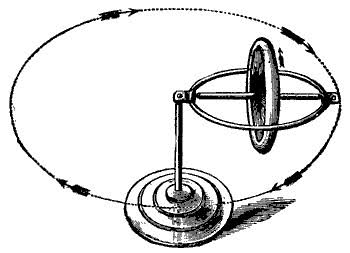
A spinning top stands upright, defying gravity’s pull, while a stationary one topples over instantly. This simple toy demonstrates a profound physical principle that guides everything from bicycle wheels to billion-dollar satellites. The same mathematics that explains a child’s toy also keeps the Hubble Space Telescope pointed at distant galaxies and your smartphone aware of its orientation.
At the heart of this phenomenon is angular momentum, a vector quantity that describes the ‘amount’ of rotation an object has and the direction of its spin axis. When no external torque acts on a spinning object, its angular momentum—both magnitude and direction—remains constant. This conservation law is the reason a spinning top resists falling over and why a spinning satellite maintains its pointing direction in the vacuum of space.
The Physics of a Spinning Top
Imagine a top spinning on a table. Gravity pulls downward on its center of mass, creating a torque about the pivot point. You might expect this torque to tip the top over, but instead, the top slowly rotates around the vertical axis—a motion called precession. The faster the top spins, the slower it precesses and the more stable it becomes. This happens because the torque doesn’t act directly against the spin; rather, it changes the direction of the angular momentum vector, causing the spin axis to trace a cone around the vertical.
This counterintuitive behavior—where a force produces motion at right angles to the applied force—is the essence of gyroscopic motion. To understand it, you need vectors: angular momentum points along the axis of rotation, and a torque applied perpendicular to that axis rotates the vector without changing its magnitude. This is why a spinning top “defies” gravity: the gravitational torque is continuously redirected into precession, not tipping.
A Brief History of Gyroscopes
The physics of spinning tops has been known for centuries, but it wasn’t until 1851 that Léon Foucault gave it a name and a purpose. He coined “gyroscope” from Greek words meaning “to see the circle” and used it to demonstrate Earth’s rotation. His device maintained its orientation in space, showing that the Earth turns beneath it. This was a dramatic proof of a concept that had been theoretical until then.
In the early 20th century, Elmer Sperry turned gyroscopes into practical tools. His gyrocompass, developed in 1908, allowed ships made of steel—where magnetic compasses are useless—to navigate reliably. He went on to create gyroscopic stabilizers for ships and early autopilots for aircraft. These innovations paved the way for modern inertial navigation systems (INS) used in submarines, aircraft, missiles, and spacecraft.
From Toys to Satellites
The same equations that describe a child’s top govern the orientation of spacecraft. A spinning satellite maintains its pointing direction because no external torque acts on it in the vacuum of space. When a satellite needs to change orientation, it spins up internal reaction wheels—the angular momentum exchange causes the satellite body to rotate in the opposite direction, exactly analogous to a top’s precession under torque.
Reaction wheels and control moment gyroscopes (CMGs) are two ways to implement this. Reaction wheels exchange momentum with the spacecraft directly; CMGs use gimbaled spinning rotors to amplify torque. Both are gyroscopes in application. For example, the Hubble Space Telescope uses reaction wheels to point at celestial targets with astonishing precision, while the International Space Station uses CMGs to manage its orientation.
Gyroscopes in Your Pocket
Modern smartphones contain MEMS (micro-electromechanical systems) gyroscopes. These tiny devices don’t have spinning rotors; instead, they use vibrating proof masses that sense rotation through the Coriolis effect. When the phone rotates, the vibrating mass experiences a force perpendicular to its motion, which can be measured electronically. This allows your phone to know its orientation for screen rotation, image stabilization, and augmented reality.
Despite the different implementation, the underlying physics is the same: they measure angular velocity and integrate it to determine orientation. This is a form of inertial navigation, which is why your phone can track your steps even without GPS.
The Toy That Teaches Physics
Spinning tops are among humanity’s oldest toys, with archaeological evidence from ancient Egypt, Greece, China, and Rome. They remain popular today, from simple wooden tops to competitive “battle tops” like Beyblade. The “sleeping top” phenomenon—a top that spins so fast it appears motionless and resists tilting—is a dramatic demonstration of gyroscopic rigidity, where the angular momentum is so large that external torques have little effect.
These toys are invaluable educational tools. They make abstract concepts like angular momentum and torque tangible and visual. Physics curricula often underemphasize rotational dynamics relative to linear mechanics, leaving a gap in public understanding. A spinning top can bridge that gap, showing that the same fundamental laws govern everything from a child’s plaything to the most advanced spacecraft.
The Limits of Gyroscopes
Real gyroscopes are not perfect. Imperfections such as bearing friction and mass imbalance cause drift—a slow error in the measured orientation. This is why inertial navigation systems are often corrected with GPS or star trackers. For example, the Kepler space telescope suffered reaction wheel failures that ended its primary mission, demonstrating the fragility of these systems. Engineers must design for such failures, often using redundancy or alternative methods like spin stabilization.
Despite these challenges, gyroscopes remain essential. From the gyrocompasses that guide ships to the MEMS sensors in your phone, they are a testament to the power of a simple physical principle: conservation of angular momentum.
The next time you spin a top, remember that you’re witnessing one of the most elegant laws of physics in action. That spinning toy shares its fundamental principle with the gyroscopes that keep satellites aligned and the sensors in your pocket. By understanding the physics of the spinning top, you gain insight into a vast range of technologies—and a deeper appreciation for the invisible forces that shape our world.
Summary
- A spinning top stays upright due to conservation of angular momentum: its spin axis resists change, and gravitational torque causes precession rather than tipping.
- Gyroscopic motion is counterintuitive because forces produce motion at right angles to the applied force.
- Foucault’s gyroscope (1851) demonstrated Earth’s rotation; Sperry’s gyrocompass (1908) enabled navigation on steel ships.
- Modern applications include reaction wheels and CMGs on satellites, MEMS gyroscopes in smartphones, and gyrocompasses in ships and aircraft.
- Spinning tops are excellent educational tools for teaching rotational dynamics, linking a simple toy to advanced aerospace engineering.
FAQ
Q: Why doesn’t a spinning top fall over?
A: A spinning top has angular momentum, a vector pointing along its spin axis. Gravity exerts a torque, but instead of toppling the top, it causes the axis to precess—rotate around the vertical. The faster the spin, the more stable the top.
Q: What is precession?
A: Precession is the slow rotation of a spinning object’s axis around another axis when a torque is applied perpendicular to the spin. It’s like watching a top’s handle trace a cone as it leans.
Q: How do gyroscopes work in satellites?
A: Satellites use reaction wheels or control moment gyroscopes that spin internally. By changing their spin speed, they exchange angular momentum with the satellite body, causing it to rotate for attitude control.
Q: What’s the difference between a gyroscope and a MEMS gyroscope?
A: Traditional gyroscopes have spinning rotors, but MEMS gyroscopes use tiny vibrating structures. They measure rotation via the Coriolis effect—the vibration creates a measurable force when the device rotates.
Q: Why do gyroscopes drift?
A: Real gyroscopes have imperfections like friction and imbalance, causing small errors in orientation over time. That’s why they’re often combined with GPS or star trackers for correction.
Leave a Reply