Tag: angular momentum

  • The Spinning Top’s Secret: How Gyroscopic Motion Keeps Toys and Satellites Aligned

    The Spinning Top’s Secret: How Gyroscopic Motion Keeps Toys and Satellites Aligned

    A spinning top stands upright, defying gravity’s pull, while a stationary one topples over instantly. This simple toy demonstrates a profound physical principle that guides everything from bicycle wheels to billion-dollar satellites. The same mathematics that explains a child’s toy also keeps the Hubble Space Telescope pointed at distant galaxies and your smartphone aware of its orientation.

    At the heart of this phenomenon is angular momentum, a vector quantity that describes the ‘amount’ of rotation an object has and the direction of its spin axis. When no external torque acts on a spinning object, its angular momentum—both magnitude and direction—remains constant. This conservation law is the reason a spinning top resists falling over and why a spinning satellite maintains its pointing direction in the vacuum of space.

    The Physics of a Spinning Top

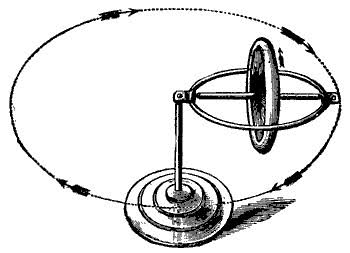
    Imagine a top spinning on a table. Gravity pulls downward on its center of mass, creating a torque about the pivot point. You might expect this torque to tip the top over, but instead, the top slowly rotates around the vertical axis—a motion called precession. The faster the top spins, the slower it precesses and the more stable it becomes. This happens because the torque doesn’t act directly against the spin; rather, it changes the direction of the angular momentum vector, causing the spin axis to trace a cone around the vertical.

    This counterintuitive behavior—where a force produces motion at right angles to the applied force—is the essence of gyroscopic motion. To understand it, you need vectors: angular momentum points along the axis of rotation, and a torque applied perpendicular to that axis rotates the vector without changing its magnitude. This is why a spinning top “defies” gravity: the gravitational torque is continuously redirected into precession, not tipping.

    A Brief History of Gyroscopes

    The physics of spinning tops has been known for centuries, but it wasn’t until 1851 that Léon Foucault gave it a name and a purpose. He coined “gyroscope” from Greek words meaning “to see the circle” and used it to demonstrate Earth’s rotation. His device maintained its orientation in space, showing that the Earth turns beneath it. This was a dramatic proof of a concept that had been theoretical until then.

    In the early 20th century, Elmer Sperry turned gyroscopes into practical tools. His gyrocompass, developed in 1908, allowed ships made of steel—where magnetic compasses are useless—to navigate reliably. He went on to create gyroscopic stabilizers for ships and early autopilots for aircraft. These innovations paved the way for modern inertial navigation systems (INS) used in submarines, aircraft, missiles, and spacecraft.

    From Toys to Satellites

    The same equations that describe a child’s top govern the orientation of spacecraft. A spinning satellite maintains its pointing direction because no external torque acts on it in the vacuum of space. When a satellite needs to change orientation, it spins up internal reaction wheels—the angular momentum exchange causes the satellite body to rotate in the opposite direction, exactly analogous to a top’s precession under torque.

    Reaction wheels and control moment gyroscopes (CMGs) are two ways to implement this. Reaction wheels exchange momentum with the spacecraft directly; CMGs use gimbaled spinning rotors to amplify torque. Both are gyroscopes in application. For example, the Hubble Space Telescope uses reaction wheels to point at celestial targets with astonishing precision, while the International Space Station uses CMGs to manage its orientation.

    Gyroscopes in Your Pocket

    Modern smartphones contain MEMS (micro-electromechanical systems) gyroscopes. These tiny devices don’t have spinning rotors; instead, they use vibrating proof masses that sense rotation through the Coriolis effect. When the phone rotates, the vibrating mass experiences a force perpendicular to its motion, which can be measured electronically. This allows your phone to know its orientation for screen rotation, image stabilization, and augmented reality.

    Despite the different implementation, the underlying physics is the same: they measure angular velocity and integrate it to determine orientation. This is a form of inertial navigation, which is why your phone can track your steps even without GPS.

    The Toy That Teaches Physics

    Spinning tops are among humanity’s oldest toys, with archaeological evidence from ancient Egypt, Greece, China, and Rome. They remain popular today, from simple wooden tops to competitive “battle tops” like Beyblade. The “sleeping top” phenomenon—a top that spins so fast it appears motionless and resists tilting—is a dramatic demonstration of gyroscopic rigidity, where the angular momentum is so large that external torques have little effect.

    These toys are invaluable educational tools. They make abstract concepts like angular momentum and torque tangible and visual. Physics curricula often underemphasize rotational dynamics relative to linear mechanics, leaving a gap in public understanding. A spinning top can bridge that gap, showing that the same fundamental laws govern everything from a child’s plaything to the most advanced spacecraft.

    The Limits of Gyroscopes

    Real gyroscopes are not perfect. Imperfections such as bearing friction and mass imbalance cause drift—a slow error in the measured orientation. This is why inertial navigation systems are often corrected with GPS or star trackers. For example, the Kepler space telescope suffered reaction wheel failures that ended its primary mission, demonstrating the fragility of these systems. Engineers must design for such failures, often using redundancy or alternative methods like spin stabilization.

    Despite these challenges, gyroscopes remain essential. From the gyrocompasses that guide ships to the MEMS sensors in your phone, they are a testament to the power of a simple physical principle: conservation of angular momentum.

    The next time you spin a top, remember that you’re witnessing one of the most elegant laws of physics in action. That spinning toy shares its fundamental principle with the gyroscopes that keep satellites aligned and the sensors in your pocket. By understanding the physics of the spinning top, you gain insight into a vast range of technologies—and a deeper appreciation for the invisible forces that shape our world.

    Summary

    • A spinning top stays upright due to conservation of angular momentum: its spin axis resists change, and gravitational torque causes precession rather than tipping.
    • Gyroscopic motion is counterintuitive because forces produce motion at right angles to the applied force.
    • Foucault’s gyroscope (1851) demonstrated Earth’s rotation; Sperry’s gyrocompass (1908) enabled navigation on steel ships.
    • Modern applications include reaction wheels and CMGs on satellites, MEMS gyroscopes in smartphones, and gyrocompasses in ships and aircraft.
    • Spinning tops are excellent educational tools for teaching rotational dynamics, linking a simple toy to advanced aerospace engineering.

    FAQ

    Q: Why doesn’t a spinning top fall over?
    A: A spinning top has angular momentum, a vector pointing along its spin axis. Gravity exerts a torque, but instead of toppling the top, it causes the axis to precess—rotate around the vertical. The faster the spin, the more stable the top.

    Q: What is precession?
    A: Precession is the slow rotation of a spinning object’s axis around another axis when a torque is applied perpendicular to the spin. It’s like watching a top’s handle trace a cone as it leans.

    Q: How do gyroscopes work in satellites?
    A: Satellites use reaction wheels or control moment gyroscopes that spin internally. By changing their spin speed, they exchange angular momentum with the satellite body, causing it to rotate for attitude control.

    Q: What’s the difference between a gyroscope and a MEMS gyroscope?
    A: Traditional gyroscopes have spinning rotors, but MEMS gyroscopes use tiny vibrating structures. They measure rotation via the Coriolis effect—the vibration creates a measurable force when the device rotates.

    Q: Why do gyroscopes drift?
    A: Real gyroscopes have imperfections like friction and imbalance, causing small errors in orientation over time. That’s why they’re often combined with GPS or star trackers for correction.
  • The Hidden Physics of Everyday Objects: Why a Spinning Top Defies Gravity

    The Hidden Physics of Everyday Objects: Why a Spinning Top Defies Gravity

    Spin a top on your kitchen table and watch it wobble, lean, and yet stubbornly refuse to fall over. It seems to defy gravity, hovering on a single point as if held by an invisible hand. But the top is no magician it’s a master of obeying physics in a way that looks like magic.

    This simple toy holds the key to understanding angular momentum, torque, and precession principles that keep your smartphone’s orientation sensor accurate, stabilize drones in flight, and even explain why Earth’s axis slowly wobbles over 26,000 years. Let’s spin into the hidden physics of this everyday marvel.

    The Great Escape: How a Top Evades Gravity

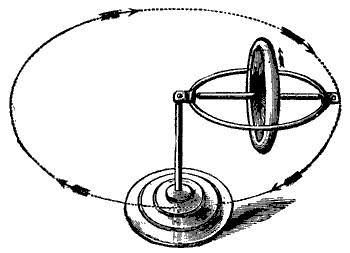
    When you set a top spinning, gravity pulls down on its center of mass. If the top weren’t spinning, that pull would create a torque (a twisting force) about the tip, and the top would topple over. But when it’s spinning, something remarkable happens: the torque doesn’t knock the top down it makes the top’s axis rotate in a slow circle around the vertical. This motion is called precession.

    Think of it like this: you’re pushing a heavy door. If you push at the edge, it swings open smoothly. But if you push at the hinges, it doesn’t open it just stays put. With a spinning top, gravity’s push is redirected. Instead of pushing the top “down,” the torque pushes the top’s axis “sideways” and because the top is spinning, that sideways push causes the axis to rotate around in a cone. This is precession, and it’s why the top seems to defy gravity: it’s not fighting gravity; it’s just taking a different path.

    The Secret Ingredient: Angular Momentum

    To understand why a spinning top behaves this way, we need to talk about angular momentum. This is a measure of how much rotation an object has like momentum for spinning. It depends on two things: how fast the object spins (angular velocity, ω) and how the mass is distributed relative to the spin axis (moment of inertia, I). The equation is simple: L = Iω.

    The spin axis of a top points upward, so its angular momentum points upward too. Here’s the key: when a torque is applied to a spinning object, it changes the direction of the angular momentum, not its magnitude. Gravity’s torque is horizontal (perpendicular to the spin axis), so it doesn’t slow the spin down it just nudges the direction of the angular momentum vector sideways. That sideways nudge, combined with the spin, produces precession.

    It’s like riding a bike: when you’re moving forward, a gentle push on the handlebars doesn’t knock you over; it just turns you. Similarly, gravity’s push on the top’s axis turns it, rather than toppling it.

    The Numbers: How Fast Does a Top Spin?

    A typical toy top, with a radius of about 2 cm and a mass of 50 grams, spins at 500–3,000 revolutions per minute (rpm) when launched by hand or with a string. That’s roughly 50–300 radians per second in physics units. The precession, in contrast, is much slower typically 1–10 radians per second. This huge difference in speed is why the precession looks like a smooth, lazy wobble.

    The top can keep spinning upright for seconds to minutes, depending on tip friction and air drag. But there’s a critical threshold: when the spin rate drops below about 10–30 rad/s (roughly 100–300 rpm), the top can no longer maintain its balance. At that point, gravity’s torque wins, and the top topples over.

    The Wobble: Nutation and Sleep

    If you watch a top closely, you’ll notice it doesn’t precess perfectly smoothly—it also has a smaller, faster wobble superimposed on the precession. This secondary wobble is called nutation. It’s caused by the initial conditions (like how you launch the top) or by tiny disturbances, like air currents or imperfections in the tip. Nutation usually damps out quickly due to friction, leaving just the smooth precession.

    Sometimes, a top will “sleep”—it spins upright with almost no visible precession. This happens when the top’s spin is high enough that the torque from gravity is relatively small compared to the angular momentum. As the spin slows, precession becomes more pronounced, and eventually the top falls.

    A Brief History of Top Physics

    The spinning top has fascinated scientists for centuries. In the 1750s, Leonhard Euler formulated the equations of rigid-body motion, which describe how a spinning object responds to forces and torques. In the early 1800s, Jean-Baptiste Biot and Félix Savart studied gyroscopic effects, and in the 1860s, Lord Kelvin and Peter Guthrie Tait wrote the first comprehensive treatise on spinning tops and gyroscopes. In 1897, Felix Klein and Arnold Sommerfeld published The Theory of the Top, a rigorous mathematical treatment. Even in the 20th century, tops were used to illustrate stability theory and chaos—the same math that describes planetary orbits and electron spin.

    Beyond the Toy: Everyday Gyroscopes

    The spinning top isn’t just a toy—it’s a fundamental demonstration of physics that engineers use every day. Inside your smartphone, a tiny gyroscope (essentially a miniature spinning top) helps detect orientation and rotation. Drones use gyroscopes to stay stable in the air. Aircraft and spacecraft rely on gyrocompasses and inertial navigation systems. Even a bicycle wheel is a gyroscope: when you’re riding, the spinning wheels resist tipping, which is why it’s easier to balance at speed than when you’re stopped.

    And on a cosmic scale, Earth itself is a spinning top. The gravitational pull from the Sun and Moon creates a torque on Earth’s equatorial bulge, causing its axis to precess slowly over about 26,000 years. This is called the precession of the equinoxes, and it’s the same physics as your toy top, just on a much grander timescale.

    So the next time you spin a top, you’re not watching a defiance of gravity—you’re watching a perfect demonstration of angular momentum and torque in action. The top’s graceful dance is a reminder that even the simplest objects can hold profound physics, and that the same principles govern everything from a child’s toy to the rotation of our planet.

    Summary

    • A spinning top doesn’t defy gravity; it obeys it by redirecting gravity’s torque into precession.
    • Angular momentum (L = Iω) points along the spin axis; gravity’s torque changes its direction, not its magnitude.
    • Precession is the slow circular motion of the spin axis, while nutation is a smaller wobble that damps out.
    • Critical spin rate: a typical top falls when spin drops below ~10–30 rad/s (100–300 rpm).
    • The same physics powers gyroscopes in smartphones, drones, and explains Earth’s 26,000-year axis precession.

    FAQ

    Q: Does a spinning top really defy gravity?
    A: No, it obeys gravity completely. The top’s angular momentum causes gravity’s torque to be redirected into a circular motion of the spin axis (precession), rather than a topple, as long as it spins fast enough.

    Q: Why does a top fall over when it slows down?
    A: When the spin rate drops below a critical threshold, the torque from gravity becomes larger than the stabilizing effect of angular momentum, and the top can no longer precess fast enough to maintain balance.

    Q: What is precession?
    A: Precession is the slow rotation of the spin axis around the vertical, caused by a torque that is perpendicular to the angular momentum. It’s like the top “leaning” into a circular path instead of falling.

    Q: What is nutation?
    A: Nutation is a smaller, faster wobble superimposed on precession, caused by initial conditions or disturbances. It usually damps out due to friction, leaving smooth precession.

    Q: How is a spinning top relevant to real-world technology?
    A: The same physics is used in gyroscopes in smartphones, drones, aircraft, and spacecraft for orientation and stabilization. Even Earth’s axis precesses due to gravitational torques from the Sun and Moon.

  • The Physics of the Perfect Dive: How Divers Defy Gravity

    The Physics Behind The Perfect Dive

    When a diver launches off a 10-meter platform, they have about 1.4 seconds before hitting the water. In that brief moment, they twist, somersault, and straighten out, all while obeying the same laws of physics that govern a thrown baseball or a spinning ice skater.

    Most spectators see only the grace and the splash (or lack thereof). But behind every perfect dive is a precise balance of gravity, angular momentum, and fluid dynamics. Understanding the physics not only explains how divers perform their incredible feats, but also why a ‘rip’ entry is so satisfying to watch—and so hard to achieve.

    Gravity and the Fall

    A diver leaving the platform is, at first, a projectile. Gravity pulls them downward at 9.8 meters per second squared, the same acceleration for any object. From 10 meters up, the fall lasts about 1.4 seconds, and they hit the water at roughly 14 meters per second—about 50 kilometers per hour.

    That’s fast, but the diver isn’t just falling. They push off with a horizontal component to their velocity, creating a parabolic arc. Air resistance is so small at these speeds that the path is nearly perfect projectile motion, exactly as if they were a ball thrown at an angle. The center of mass follows that parabola, while the diver rotates around it.

    The Spinning Secret: Angular Momentum

    Here’s the key: once in the air, a diver’s total angular momentum is conserved. That means if they start spinning, they’ll keep spinning unless something changes their shape. The trick is that changing shape changes how fast they spin.

    Imagine a figure skater pulling their arms in to spin faster. A diver does the same thing by tucking into a ball. By pulling their arms and legs close to the center of mass, they reduce their moment of inertia—the resistance to rotation. Since angular momentum is the product of moment of inertia and spin rate, reducing the first increases the second. Elite divers can reach 4–5 revolutions per second in a tight tuck.

    To slow down for the entry, they extend their body, increasing moment of inertia and decreasing spin. This is how they control exactly how many somersaults they complete before straightening out.

    Twisting: Not What You Think

    Twists are even more subtle. A twist isn’t a separate rotation; it’s a reorientation of the body’s rotation axis. The diver uses asymmetric arm movements or a slight bend at the hip to convert some of the somersault rotation into a twist. This is the same principle that lets a cat right itself mid-air: by rotating its front and rear halves in opposite directions, it changes its orientation without external torque.

    A diver initiates a twist by moving one shoulder or arm differently, which shifts the axis of rotation. Because angular momentum is a vector—it has both magnitude and direction—the total remains constant, but the distribution between somersault and twist can change.

    The Takeoff: Where It All Begins

    Most of a dive’s success is decided at the takeoff. For platform divers, the board is rigid, so they must generate all their rotation and height from muscle power alone. For springboard divers, the board acts like a spring: the diver’s downward force compresses it, storing elastic potential energy, which is released on the rebound.

    Springboards have adjustable fulcrums to change stiffness, letting divers tune the energy return. The takeoff angle and speed determine the trajectory of the center of mass, and the eccentric force applied at takeoff sets the initial angular momentum. Get this right, and the rest of the dive is about controlling that momentum.

    The Perfect Entry: The Physics of the Rip

    A clean entry—the ‘rip’—is a hydrodynamic marvel. When a diver enters vertically with hands together and body streamlined, they create a cavity in the water that closes smoothly behind them. The reduced surface area minimizes drag and prevents the water from splashing outward.

    The key is to enter with the body as vertical as possible, ideally at 90 degrees to the surface. A slight tilt can cause a large splash and a painful impact. The impact force depends on entry angle and body shape; a perfect entry reduces the effective impact area, allowing the body to slip through with minimal disturbance.

    It’s the same principle as a knife cutting through water—a streamlined shape displaces less water and creates less turbulence. That’s why the rip looks so clean: the water closes over the diver without a splash, as if they were swallowed by the pool.

    The Numbers Behind the Sport

    Olympic platform diving is always 10 meters, and springboard is 3 meters. But cliff divers push the limits: Red Bull Cliff Diving events have divers leaping from 27–28 meters, hitting speeds near 100 kilometers per hour. At those speeds, the entry is even more critical to avoid injury.

    Difficulty ratings reflect the number of somersaults and twists. A dive with a high degree of difficulty might require more rotations, but it also demands more precise control. The physics doesn’t change; the challenge is in executing the required movements within the fixed time of flight.

    The Bottom Line

    A perfect dive is physics in action: a controlled fall, a conserved rotation, and a clean slice through water. The diver’s skill is in applying these principles—generating the right launch, adjusting body shape mid-air, and aligning perfectly at the moment of impact.

    Next time you watch a dive, remember the physics at play. That brief flight is a demonstration of gravity, angular momentum, and fluid dynamics. The diver’s athleticism is in the precise application of these laws, turning a simple fall into a work of art.

    Summary

    • A dive from 10 meters takes about 1.4 seconds, reaching 14 m/s (50 km/h) at entry.
    • Divers conserve angular momentum by tucking to spin faster and extending to slow down.
    • Twists are a reorientation of the rotation axis, not a separate spin, using asymmetric body movements.
    • The takeoff determines most of the dive’s success; springboards add elastic energy.
    • A ‘rip’ entry minimizes splash by creating a smooth cavity with a vertical, streamlined body position.

    FAQ

    Q: How do divers spin so fast?
    A: By tucking their arms and legs close to their center of mass, reducing moment of inertia, which increases spin rate due to conservation of angular momentum.

    Q: Why do divers enter the water with their hands together?
    A: To create a streamlined shape that reduces drag and minimizes splash, allowing a clean entry with less impact force.

    Q: What is the difference between springboard and platform diving physics?
    A: A springboard stores and returns elastic energy, helping the diver gain height and rotation, while a platform is rigid, requiring the diver to generate all motion from their own muscles.

    Q: Why do divers twist during somersaults?
    A: Twisting is a way to reorient the body’s rotation axis, using asymmetric movements to convert some somersault rotation into twist, allowing for more complex dives.

    Q: Is air resistance important in diving?
    A: No, at the speeds and distances involved, air resistance is negligible, so the trajectory is close to ideal projectile motion.