Tag: physics

  • Why Ice Floats and Balls Bounce: The Surprising Physics of Everyday Objects

    Why Does Ice Float? - guernseydonkey.com

    Have you ever dropped an ice cube into a glass of water and watched it bob to the surface, or bounced a basketball and wondered why it springs back up? These everyday occurrences are so common we rarely think about them, but they are actually remarkable feats of physics. Ice floating defies our intuition—after all, solids are usually denser than liquids—and a bouncing ball seems to defy energy loss, returning most of its energy to you. In this article, we’ll explore the science behind these two phenomena, revealing the hidden rules that govern our world.

    Understanding why ice floats and balls bounce isn’t just about satisfying curiosity. It has profound implications for life on Earth, from the survival of aquatic ecosystems to the design of sports equipment and safety gear. By looking at the molecular structure of water and the physics of elastic materials, we can appreciate the elegance of nature’s design and the cleverness of human engineering. So, let’s dive in and uncover the physics that makes our everyday world work.

    The Anomalous Expansion of Water: Why Ice Floats

    Most substances contract when they cool, becoming denser as their molecules pack more tightly together. But water is different. It reaches its maximum density at about 4°C (39°F) and then expands as it cools further to its freezing point at 0°C (32°F). This is known as the anomalous expansion of water, and it’s the reason ice floats.

    To understand why, we need to look at the molecular level. Water molecules are made of two hydrogen atoms and one oxygen atom. The oxygen atom is more electronegative than hydrogen, so it pulls shared electrons closer, giving the oxygen a slight negative charge and the hydrogens a slight positive charge. This polarity allows water molecules to form hydrogen bonds with each other—weak attractions between the positive hydrogen of one molecule and the negative oxygen of another.

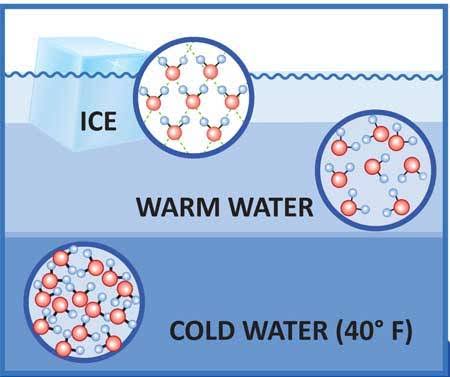
    In liquid water, these hydrogen bonds are constantly breaking and reforming, allowing molecules to slide past each other. But as water cools, the molecules slow down, and the hydrogen bonds become more stable. At 4°C, the molecules are packed as tightly as possible. Below that, the hydrogen bonds begin to arrange the molecules into a fixed, open hexagonal lattice—the crystal structure of ice. This lattice has more empty space than liquid water, making ice less dense.

    The numbers tell the story: liquid water at 4°C has a density of about 1.000 g/cm³, while ice at 0°C has a density of about 0.917 g/cm³. That’s a 9% difference. According to Archimedes’ principle, an object floats if it is less dense than the fluid it’s in. So ice floats, with about 90% of its mass below the surface and only 10% visible above.

    Why This Matters for Life on Earth

    If ice sank, lakes and oceans would freeze from the bottom up. In winter, the coldest water (near 0°C) would sink to the bottom, and the warmer water (near 4°C) would rise to the surface, where it would freeze. Over time, the entire body of water could freeze solid, killing aquatic life. But because ice floats, it forms an insulating layer on top, protecting the liquid water below. Fish and other organisms can survive the winter in the relatively warm 4°C water at the bottom.

    This phenomenon also affects global climate. Sea ice reflects sunlight back into space, helping to cool the planet. If ice sank, this albedo effect would be lost, and the climate would be very different. So the simple fact that ice floats is crucial for life as we know it.

    The Physics of Bouncing: Elasticity and Energy

    Now, let’s turn to bouncing balls. When you drop a ball, it falls due to gravity, gaining kinetic energy. When it hits the ground, that kinetic energy doesn’t just disappear—it’s transformed. The ball deforms, squishing on impact, and this deformation stores energy as elastic potential energy. Then, the ball springs back to its original shape, releasing that stored energy and converting it back into kinetic energy, which propels the ball upward.

    This process is governed by the material’s elasticity. Elastic materials can deform and return to their original shape, storing and releasing energy. Rubber is a classic example. Its long polymer chains can stretch and snap back, making it highly elastic. But no material is perfectly elastic—some energy is always lost, usually as heat, sound, or internal friction.

    The Coefficient of Restitution

    Scientists quantify a ball’s bounciness using the coefficient of restitution (COR), which is the ratio of the ball’s velocity after impact to its velocity before impact. A COR of 1.0 would mean a perfectly elastic collision with no energy lost—something that only happens in theory. Real balls have COR values between 0 and 1. For example, a basketball has a COR of about 0.8, a tennis ball about 0.75, and a superball (a highly elastic rubber ball) about 0.9. A wet clay ball, on the other hand, has a COR close to 0—it splats and doesn’t bounce at all.

    Why Some Balls Bounce Better Than Others

    The material matters. Rubber, especially vulcanized rubber (which has sulfur cross-links between polymer chains), is highly elastic. The cross-links help the material return to its original shape more efficiently. But other factors also affect bounciness:

    • Temperature: Cold balls bounce less because the polymer chains stiffen, reducing elasticity. Warm balls bounce higher. This is why tennis players keep balls warm during matches.
    • Pressure: An under-inflated basketball is less bouncy because it deforms more on impact, losing more energy to deformation. A properly inflated ball maintains its shape and bounces better.
    • Air resistance: During flight, air resistance slows the ball, but this is a small effect compared to the energy lost during impact.

    Engineering Bounciness

    Engineers use the COR to design balls for specific sports. For example, golf clubs are regulated to have a maximum COR of 0.83 to prevent balls from being hit too far. In basketball, the NBA specifies the inflation pressure and material to ensure consistent bounce. The physics of bouncing also applies to safety gear, like helmets and padding, which are designed to be inelastic—they absorb energy rather than return it, protecting your head from impact.

    The Bigger Picture: From Ice to Balls, Physics Is Everywhere

    These two phenomena—ice floating and balls bouncing—are just the tip of the iceberg (pun intended). They illustrate fundamental principles: density and buoyancy, energy conservation, and material properties. By understanding these principles, we can solve real-world problems, from designing better sports equipment to predicting climate change.

    So next time you enjoy a cold drink or play a game of basketball, take a moment to appreciate the physics at work. It’s not just science—it’s the invisible hand that shapes our everyday experiences.

    From the molecular dance of hydrogen bonds to the elastic snap of polymer chains, the physics of everyday objects is both fascinating and essential. Ice floats because water is unusual, and that anomaly supports life in lakes and oceans. Balls bounce because materials can store and release energy, and that principle powers everything from sports to safety. By understanding these simple phenomena, we gain a deeper appreciation for the world around us—and the science that makes it work.

    Summary

    • Ice floats because water expands when it freezes, making ice less dense than liquid water.
    • This is due to hydrogen bonding, which creates an open hexagonal lattice in ice.
    • If ice sank, aquatic life in temperate and polar regions would be impossible.
    • Balls bounce because of elastic deformation, where kinetic energy is stored and released.
    • The coefficient of restitution (COR) measures bounciness, with real balls losing some energy to heat, sound, and deformation.

    FAQ

    Q: Why does ice float if it’s a solid?
    A: Most solids are denser than their liquid form, but water is unusual. When water freezes, hydrogen bonds arrange molecules into a hexagonal lattice with more empty space, making ice less dense than liquid water. So ice floats.

    Q: What is the coefficient of restitution?
    A: It’s a measure of how much kinetic energy a ball retains after bouncing. It’s the ratio of the ball’s speed after impact to its speed before impact. A value of 1 means no energy lost, while 0 means no bounce at all.

    Q: Why does a cold ball bounce less?
    A: Cold temperatures make polymer chains in rubber stiffer and less elastic. This means the ball deforms less efficiently and loses more energy to internal friction, resulting in a lower bounce.

    Q: How does air pressure affect a ball’s bounce?
    A: An under-inflated ball is softer and deforms more on impact, losing more energy to deformation. A properly inflated ball maintains its shape and bounces better because more energy is returned.

    Q: Why is it important that ice floats?
    A: If ice sank, lakes and oceans would freeze from the bottom up, potentially killing aquatic life. Floating ice forms an insulating layer on top, protecting the water below and allowing organisms to survive winter.

  • Can We Squeeze the Space Between Atoms? The Physics of Compression

    Atomic spacing - Wikipedia

    When you squeeze a balloon, the air molecules inside get closer together. But can we do the same to solids—pushing atoms so tight that they almost touch? The answer is both yes and no, and the reasons reveal some of the deepest truths about matter.

    Atoms are not tiny billiard balls; they are fuzzy clouds of probability. The space between them is not empty but filled with electron waves and quantum fields. Understanding what limits compression—and what we can achieve with extreme pressure—is a journey into the heart of physics and materials science.

    The Myth of Empty Space

    It’s often said that atoms are 99.999% empty space. If you scaled a hydrogen atom to the size of a football stadium, the nucleus would be a pea at the center, and the electron would be a blur somewhere in the stands. But this picture is misleading. Electrons are not particles orbiting like planets; they are probability clouds. The ’empty’ space is actually filled with the electron’s wavefunction, which exerts real forces.

    When two atoms approach each other, their electron clouds begin to overlap. Because electrons are fermions, they obey the Pauli exclusion principle: no two electrons can occupy the same quantum state. This creates a powerful repulsion that prevents atoms from merging. It’s like trying to push two magnets together with like poles facing—the closer you get, the harder it pushes back.

    The Natural Distance: Equilibrium Spacing

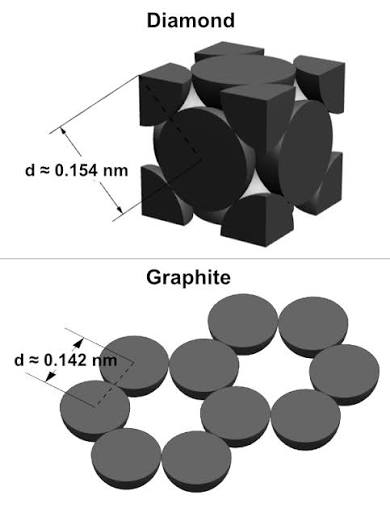
    In a solid, atoms settle at a distance where attractive forces (like van der Waals or chemical bonds) balance the Pauli repulsion. This is called the equilibrium spacing. For most materials, it’s a few Ångströms—about 0.1 to 0.3 nanometers. For example, the distance between carbon atoms in a diamond is 1.54 Å, and in table salt (NaCl), it’s about 2.8 Å.

    This spacing is not fixed. If you apply pressure, you can push atoms closer together, but only up to a point. The Pauli repulsion acts like a spring: the more you compress, the stronger it pushes back. Remove the pressure, and atoms spring back to their natural positions.

    What We Can Do: Compression and Phase Changes

    Everyday Compression

    You don’t need a lab to see atoms squeezed together. When you pump air into a scuba tank, you’re compressing gas molecules from a spread-out state into a much smaller volume. The molecules are still far apart compared to a solid, but the space between them has decreased dramatically.

    Extreme Pressure: Diamond Anvil Cells

    For solids, scientists use diamond anvil cells—devices that squeeze a sample between two diamond tips. These can generate pressures over 500 GPa, which is about 5 million times atmospheric pressure. Under such conditions, materials undergo dramatic changes:

    • Ice X: At about 60 GPa, water ice transforms into a superionic phase where hydrogen ions flow like a liquid through a solid oxygen lattice.
    • Metallic Hydrogen: Predicted to form at around 400–500 GPa, hydrogen would become a metal and potentially a room-temperature superconductor. This remains one of the holy grails of high-pressure physics.
    • Superhard Materials: Compressing boron nitride or other compounds can create materials harder than diamond, useful for cutting tools.

    Phase Changes: Gas to Liquid to Solid

    Changing temperature and pressure can also reduce interparticle spacing without ‘removing’ space. When a gas condenses into a liquid, molecules come much closer together. When a liquid freezes into a solid, they pack even tighter. This is a reversible process—no permanent ‘removal’ of space, but a rearrangement of matter into denser states.

    What We Cannot Do: The Pauli Exclusion Principle

    No matter how much pressure we apply, we cannot make atoms occupy the same volume. The Pauli exclusion principle is a fundamental law of quantum mechanics. It states that no two identical fermions (like electrons) can be in the same quantum state. When electron clouds overlap, this principle forces them to stay apart.

    This is why matter doesn’t collapse. If it weren’t for Pauli repulsion, all atoms would collapse into a tiny, dense blob. The stability of everything—from your chair to your body—depends on this quantum effect.

    Beyond the Limits: Degenerate Matter

    In extreme astrophysical environments, gravity can compress matter so much that atoms lose their identity. In white dwarfs, electrons are squeezed into a degenerate gas, and the atoms are stripped of their electron clouds. In neutron stars, even protons and electrons merge to form neutrons. This is the ultimate compression, but it’s not something we can achieve on Earth—it requires the mass of a star.

    The Future: Designing Dense Materials

    Instead of just squeezing, scientists are learning to design materials with atoms packed more efficiently. Nanotechnology and crystal engineering allow us to create new structures with tailored properties. For example, graphene is a single layer of carbon atoms arranged in a honeycomb lattice—it’s incredibly strong and conducts electricity better than copper. By stacking layers or creating new arrangements, we can effectively ‘decrease spacing’ in a controlled way.

    Machine learning is now helping predict how materials will behave under extreme pressure, opening up new possibilities for discovering superhard materials, high-temperature superconductors, and other exotic states.

    Conclusion

    So, can we remove or decrease spaces between atoms? We can decrease them—dramatically—by applying pressure or changing phase. But we cannot remove them entirely. The Pauli exclusion principle sets a hard limit that no amount of force can overcome. Understanding this limit not only explains why matter is stable but also guides us in creating new materials with extraordinary properties. The space between atoms is not empty; it’s a battleground of quantum forces, and we are just beginning to master it.

    The space between atoms is not a void to be filled but a dynamic region governed by quantum mechanics. While we can compress matter to incredible densities, the Pauli exclusion principle ensures that atoms will never truly touch. This fundamental limit is not a barrier but a feature—it gives matter its solidity and stability. As we continue to explore extreme conditions and design new materials, we are learning to work within these quantum constraints to create technologies once thought impossible.

    Summary

    • Atoms never truly touch; the space between them is governed by quantum mechanics, specifically the Pauli exclusion principle.
    • We can decrease interatomic spacing by applying pressure (e.g., diamond anvil cells) or changing phase (gas → liquid → solid).
    • Extreme pressure can create exotic states like metallic hydrogen or superhard materials.
    • The Pauli exclusion principle sets an absolute limit: atoms cannot occupy the same volume.
    • Materials science and nanotechnology offer ways to design denser arrangements without brute force.

    FAQ

    Q: Can we make atoms touch each other?
    A: No, atoms never truly touch in the classical sense. The electron clouds repel each other due to the Pauli exclusion principle, creating a ‘hard wall’ that prevents them from merging.

    Q: What is the smallest distance between atoms?
    A: The equilibrium spacing in a solid is typically 1–3 Ångströms (10⁻¹⁰ meters). Under extreme pressure, this can be reduced, but not to zero.

    Q: How do diamond anvil cells work?
    A: They squeeze a tiny sample between two diamond tips, generating pressures over 500 GPa. This compresses materials to a fraction of their normal volume, often creating new phases.

    Q: Is metallic hydrogen real?
    A: It’s predicted to exist at pressures around 400–500 GPa, but experimental confirmation is still debated. If created, it could be a room-temperature superconductor.

    Q: Why don’t atoms collapse under pressure?
    A: The Pauli exclusion principle prevents electrons from occupying the same quantum state, creating a repulsive force that resists compression. This is why matter is stable.