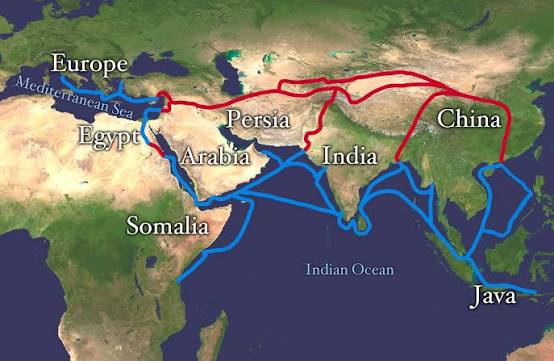
Imagine a world where your dinner plate is a map of ancient connections. The cinnamon in your morning oatmeal might have traveled from Sri Lanka, the black pepper on your eggs from India, and the technique for pulling noodles from China. This isn’t just globalization—it’s the legacy of the Silk Road, a network of trade routes that for over 1,500 years linked East and West, not only with silk and gold but with flavors that would forever change how humanity eats.
Today, we often take for granted the spices and dishes that define our cuisines. But behind every pinch of cumin or forkful of pilaf lies a story of caravans crossing deserts, ships braving monsoons, and empires rising and falling. The Silk Road wasn’t just a highway for goods; it was a superhighway for culinary innovation, where ingredients, techniques, and recipes mingled and evolved. This is the story of how a network of dusty trails and maritime routes turned local eats into global feasts.
The Spice Rack of Empires
Before refrigeration, spices were more than just flavor—they were power. Black pepper, known as ‘black gold,’ was so valuable it could be used as currency or to pay rent. Cloves, nutmeg, and cinnamon came from tiny islands in Southeast Asia, and their trade made and broke empires. The Portuguese and Dutch fought bloody wars, including the horrific massacre of the Banda Islands in 1621, to control the nutmeg trade. But the Silk Road was the original spice highway, moving these treasures from the East to the Mediterranean and beyond.
Each region contributed its own signature spices. From China and Southeast Asia came cinnamon, ginger, star anise, and Sichuan pepper. India offered black pepper, cardamom, turmeric, and cumin. Persia (modern Iran) gave the world saffron, sumac, and dried limes. The Mediterranean added oregano, thyme, and bay leaves. This exchange wasn’t just about adding heat or aroma; it was about status. In medieval Europe, owning spices was a sign of wealth, and they were often displayed as prominently as jewels.
Noodles, Dumplings, and the Art of the Stretch
One of the most enduring gifts of the Silk Road is the noodle. In Central Asia, you’ll find lagman, a dish of hand-pulled noodles with spiced meat and vegetables. It’s a direct descendant of Chinese lamian, brought west by travelers and adapted with local ingredients like lamb and cumin. The technique of pulling noodles by hand is a skill that traveled alongside the noodles themselves, and it eventually reached Italy, though the popular myth that Marco Polo brought pasta from China is likely false—pasta existed in the Mediterranean before his travels. Still, the Silk Road facilitated a cross-pollination of noodle-making that enriched both East and West.
Dumplings tell a similar story. Chinese jiaozi, Central Asian manti, Tibetan momos, and Russian pelmeni are all variations on a theme: seasoned meat wrapped in dough. Each culture added its own twist, from the dipping sauces of China to the yogurt toppings of Central Asia. These portable, satisfying parcels were perfect for travelers and became staples along the route.
Rice, Bread, and the Rise of the Feast
Rice, too, made its journey. Plov, or pilaf, is a dish of rice cooked with meat, carrots, and spices that spread from Persia to Central Asia and India, where it evolved into biryani. In Uzbekistan, plov is a national dish, often cooked in massive cauldrons for celebrations. The technique of cooking rice in seasoned broth, rather than plain water, is a Silk Road innovation that transformed grains into centerpieces.
Bread, the staff of life, also traveled. Naan, with its Persian origins, became a staple across the Middle East and South Asia. Tandoor breads, baked in clay ovens, spread from India to Central Asia. And the humble flatbread, in its many forms, became a universal companion to stews and kebabs. Kebabs themselves, from the Persian kabab, spread across the Turkic world and into South Asia, becoming a global favorite.
Sweets and Fermented Delights
Desserts also crossed borders. Baklava, with its layers of phyllo, nuts, and honey, has a lineage that includes Ottoman, Byzantine, and Central Asian Turkic influences. Samosas, the fried pastries filled with spiced potatoes or meat, originated as Persian sanbosag and made their way to India and East Africa. And fermented dairy—yogurt, kefir, and dried curds called qurut—became essential in Central Asian cuisine, providing protein and probiotics that sustained travelers on long journeys.
The People Behind the Plates
The Silk Road wasn’t just about goods; it was about people. Zhang Qian, a Han Dynasty envoy in the 2nd century BCE, opened Central Asian routes that would become the Silk Road. Marco Polo, the Venetian merchant, popularized Eastern foods in Europe (even if his accounts were sometimes embellished). Ibn Battuta, the Moroccan traveler, documented foods from Timbuktu to China, giving us a rich record of culinary diversity. And Genghis Khan’s Mongol Empire, in the 13th century, unified much of the route, creating a period of peace—the Pax Mongolica—that allowed unprecedented cultural and culinary exchange.
The Maritime Shift and the Columbian Exchange
The overland Silk Road declined after the 15th century, as Ottoman-Venetian tensions and the rise of Portuguese and Dutch maritime routes shifted trade to the seas. But the story didn’t end there. The Columbian Exchange, following Columbus’s voyages, introduced New World foods like chili peppers, tomatoes, potatoes, and maize to Asia. Chilies, for instance, became integral to Sichuan and Korean cuisine only in the last 400 years. So the next time you enjoy a spicy Sichuan dish, you’re tasting a fusion of ancient Silk Road trade and post-1492 globalization.
A Living Legacy
Today, the Silk Road lives on in our kitchens. The spices on our racks, the noodles in our bowls, and the dumplings on our plates are all testaments to a time when the world was connected by caravans and courage. The next time you cook a pilaf or sprinkle cumin on a dish, remember: you’re not just following a recipe—you’re participating in a culinary journey that spans millennia and continents.
The Silk Road was more than a trade route; it was a culinary bridge that connected distant cultures and transformed how we eat. From the spice-laden caravans to the humble dumpling, its legacy is on every table. As we savor these flavors, we honor the travelers, traders, and cooks who, over centuries, wove a global tapestry of taste.
Summary
- The Silk Road was a network of routes (130 BCE–15th century CE) that exchanged not just silk but spices, ingredients, and cooking techniques between East and West.
- Key spices like pepper, cinnamon, and saffron were so valuable they shaped economies and fueled empires.
- Dishes like lagman, plov, dumplings, and kebabs evolved as they traveled, blending local ingredients with foreign techniques.
- Empires like Persia, the Mongols, and the Ottomans facilitated this exchange, creating periods of peace and cultural mixing.
- The maritime shift and Columbian Exchange later added new ingredients, but the Silk Road’s culinary influence remains foundational.
FAQ
Q: Was the Silk Road a single road?
A: No, it was a network of overland and maritime routes connecting East Asia to the Mediterranean, not a single path.
Q: Did Marco Polo really bring pasta to Italy?
A: Likely not. Pasta existed in the Mediterranean before his travels, though the Silk Road did facilitate noodle-making techniques.
Q: What was the most valuable spice on the Silk Road?
A: Black pepper was often called ‘black gold’ and was so valuable it could be used as currency.
Q: How did chili peppers become part of Asian cuisine?
A: They were introduced after 1492 via the Columbian Exchange, and only became integral to Sichuan and Korean food in the last 400 years.
Q: What is a signature dish that shows Silk Road influence?
A: Plov (pilaf) is a great example—it spread from Persia to Central Asia and India, becoming biryani, and is still a national dish in Uzbekistan.
Leave a Reply