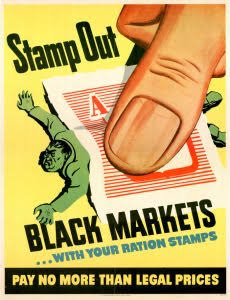
In 1943, an American housewife in Chicago could buy a pound of butter on the legal market only with the right ration stamps if her grocer had any in stock. But two blocks away, a butcher kept a stash under the counter, and for $1.50 (nearly four times the official price) she could walk out with that butter, no questions asked. That transaction, repeated millions of times across every combatant nation, was the black market.
World War II rationing was a monumental act of collective sacrifice: governments froze prices, limited purchases, and issued coupons to ensure scarce goods were shared fairly. But these controls created an artificial scarcity that ordinary citizens, desperate for a taste of normalcy, were willing to circumvent. The result was a vast shadow economy that, at its peak in the United States, moved roughly $1 billion a year equivalent to $15–18 billion today.
The Rationing That Created the Opportunity
Rationing wasn’t a minor inconvenience; it touched nearly every aspect of daily life. In the United States, it began in May 1942 with sugar, then expanded to coffee, gasoline, tires, meat, butter, and processed foods. Every civilian received a ration book filled with stamps, each color and letter designating what could be purchased and in what quantity. A car owner had to display a windshield sticker A, B, C, or T to show how much gasoline they were entitled to, with the lowest category (A) allowing just a few gallons a week.
The United Kingdom started even earlier, in January 1940, and rationing there extended to clothing and fuel, continuing long after the war ended some items weren’t freed until 1954. The Soviet Union maintained strict state rationing throughout the war, and Germany introduced its system in 1939.
These controls were necessary. Submarine warfare, bombing raids, and labor shortages disrupted supply chains; without rationing, the wealthy would have hoarded food and fuel, and prices would have spiraled out of control. But the system had a fundamental flaw: it created shortages where none truly existed. Goods were available just not at the official price or in the legal quantity. That gap between what the government allowed and what people wanted was the black market’s breeding ground.
The black market of WWII was neither a simple crime wave nor a heroic resistance. It was a messy, human response to the impossible pressures of total war a shadow economy that fed the hungry, frustrated the powerful, and, in the end, proved as unstoppable as the tide. When the guns fell silent, the black market didn’t vanish; it lingered for years, a stubborn reminder that even in the most disciplined of societies, the urge to trade, to barter, to survive, cannot be rationed away.
Summary
- Black markets emerged in every combatant nation, driven by artificial scarcity from rationing and price controls
- In the U.S., the OPA estimated black market activity reached $1 billion per year at its 1943–1944 peak
- Ordinary citizens, not just criminals, participated seeing it as survival or a way to beat the system
- In occupied Europe, black markets were often the only source of food for urban populations
- Post-war, black markets persisted, with cigarettes serving as currency in Germany until the 1948 currency reform
FAQ
Q: What exactly was the black market during WWII?
A: It was the illegal buying and selling of rationed goods—food, gasoline, clothing, and more—outside government controls. It operated in every combatant nation, from the U.S. to the Soviet Union.
Q: Why did rationing create a black market?
A: Rationing set legal limits on purchases and official prices, but demand still exceeded supply. Goods existed but couldn’t be legally obtained, so people turned to illegal channels to get them.
Q: Were black marketeers punished severely?
A: It varied. In the U.S., the OPA had about 3,000 investigators, and penalties included fines and jail, but enforcement was inconsistent. In Germany, the Gestapo pursued black marketeers brutally, with executions for serious offenses.
Q: Did the black market help or hurt the war effort?
A: It’s ambiguous. It undermined rationing’s fairness but also helped feed people in occupied countries where official rations were starvation-level. Many participants saw it as a necessary survival mechanism.
Q: What happened to the black market after the war?
A: It persisted for years due to continued shortages. In Germany, cigarettes became the de facto currency until the 1948 currency reform introduced the Deutsche Mark, which restored confidence in official money.
Leave a Reply