Tag: rationing

  • The Shadow Economy of WWII: How Rationing Gave Birth to the Black Market

    The Shadow Economy of WWII: How Rationing Gave Birth to the Black Market

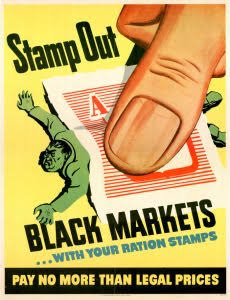
    In 1943, an American housewife in Chicago could buy a pound of butter on the legal market only with the right ration stamps if her grocer had any in stock. But two blocks away, a butcher kept a stash under the counter, and for $1.50 (nearly four times the official price) she could walk out with that butter, no questions asked. That transaction, repeated millions of times across every combatant nation, was the black market.

    World War II rationing was a monumental act of collective sacrifice: governments froze prices, limited purchases, and issued coupons to ensure scarce goods were shared fairly. But these controls created an artificial scarcity that ordinary citizens, desperate for a taste of normalcy, were willing to circumvent. The result was a vast shadow economy that, at its peak in the United States, moved roughly $1 billion a year equivalent to $15–18 billion today.

    The Rationing That Created the Opportunity

    Rationing wasn’t a minor inconvenience; it touched nearly every aspect of daily life. In the United States, it began in May 1942 with sugar, then expanded to coffee, gasoline, tires, meat, butter, and processed foods. Every civilian received a ration book filled with stamps, each color and letter designating what could be purchased and in what quantity. A car owner had to display a windshield sticker A, B, C, or T to show how much gasoline they were entitled to, with the lowest category (A) allowing just a few gallons a week.

    The United Kingdom started even earlier, in January 1940, and rationing there extended to clothing and fuel, continuing long after the war ended some items weren’t freed until 1954. The Soviet Union maintained strict state rationing throughout the war, and Germany introduced its system in 1939.

    These controls were necessary. Submarine warfare, bombing raids, and labor shortages disrupted supply chains; without rationing, the wealthy would have hoarded food and fuel, and prices would have spiraled out of control. But the system had a fundamental flaw: it created shortages where none truly existed. Goods were available just not at the official price or in the legal quantity. That gap between what the government allowed and what people wanted was the black market’s breeding ground.

    The black market of WWII was neither a simple crime wave nor a heroic resistance. It was a messy, human response to the impossible pressures of total war a shadow economy that fed the hungry, frustrated the powerful, and, in the end, proved as unstoppable as the tide. When the guns fell silent, the black market didn’t vanish; it lingered for years, a stubborn reminder that even in the most disciplined of societies, the urge to trade, to barter, to survive, cannot be rationed away.

    Summary

    • Black markets emerged in every combatant nation, driven by artificial scarcity from rationing and price controls
    • In the U.S., the OPA estimated black market activity reached $1 billion per year at its 1943–1944 peak
    • Ordinary citizens, not just criminals, participated seeing it as survival or a way to beat the system
    • In occupied Europe, black markets were often the only source of food for urban populations
    • Post-war, black markets persisted, with cigarettes serving as currency in Germany until the 1948 currency reform

    FAQ

    Q: What exactly was the black market during WWII?
    A: It was the illegal buying and selling of rationed goods—food, gasoline, clothing, and more—outside government controls. It operated in every combatant nation, from the U.S. to the Soviet Union.

    Q: Why did rationing create a black market?
    A: Rationing set legal limits on purchases and official prices, but demand still exceeded supply. Goods existed but couldn’t be legally obtained, so people turned to illegal channels to get them.

    Q: Were black marketeers punished severely?
    A: It varied. In the U.S., the OPA had about 3,000 investigators, and penalties included fines and jail, but enforcement was inconsistent. In Germany, the Gestapo pursued black marketeers brutally, with executions for serious offenses.

    Q: Did the black market help or hurt the war effort?
    A: It’s ambiguous. It undermined rationing’s fairness but also helped feed people in occupied countries where official rations were starvation-level. Many participants saw it as a necessary survival mechanism.

    Q: What happened to the black market after the war?
    A: It persisted for years due to continued shortages. In Germany, cigarettes became the de facto currency until the 1948 currency reform introduced the Deutsche Mark, which restored confidence in official money.
  • The Last Ration Book: How Britain’s Scraps Defined a Decade

    The Last Ration Book: How Britain’s Scraps Defined a Decade

    In January 1940, every household in Britain received a small buff-coloured book. Inside, pages of coupons promised a weekly allowance of bacon, butter, and sugar. No one knew then that the last coupon would not be torn out until 4 July 1954 nine years after the war in Europe ended.

    This is the story of those fourteen years, when a nation of 48 million learned to measure its life in ounces. It is a story of grey bread, dried eggs, and a vegetable pie named after a politician. But it is also a story of how scarcity, managed with ruthless fairness, reshaped what it meant to be British.

    The Fair Shares Principle

    When the Second World War began, Britain imported about 70% of its food. German U-boats quickly targeted those supply lines, sinking roughly 2,000 British merchant ships between 1939 and 1945. By 1943, imports had collapsed to 30%.

    Memories of the First World War haunted the government. Food riots and profiteering had damaged morale then. So, in 1939, the Ministry of Food was created with a single mission: make sure shortages did not lead to hoarding or class resentment. The solution was rationing, introduced on 8 January 1940 for bacon, butter, and sugar. Within two years, most foodstuffs were rationed.

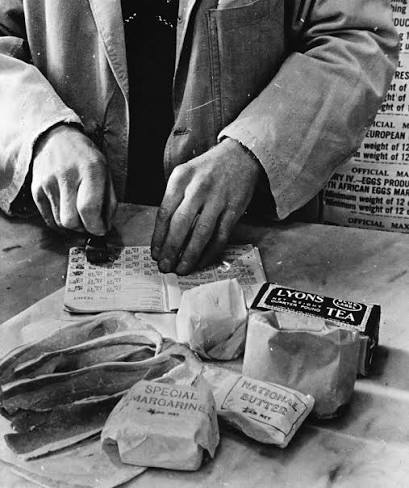
    Every man, woman, and child received a colour-coded ration book: buff for adults, green for pregnant women and children, blue for under-fives. Registration was compulsory. You picked a grocer, a butcher, and a milkman, and you bought only from them. The system tracked every purchase, and inspectors could check your book against the shop’s records.

    The Weekly Allowance

    At the peak of rationing in 1942–43, an adult’s weekly allowance was stark:

    • Meat: about 450g of cheap cuts, often bone-in
    • Bacon or ham: 113g
    • Butter: 57g
    • Margarine: 113g
    • Sugar: 227g
    • Cheese: 57g (occasionally 113g)
    • Tea: 57g
    • Eggs: one fresh egg plus dried egg powder equivalent to about one egg per fortnight
    • Sweets: 113g
    • Milk: 1.7 litres, with more for children and expectant mothers

    These numbers meant constant arithmetic. A slice of bread and scrape of butter was a meal. A single egg was a luxury, stretched across a family breakfast.

    The government did not simply ration — it dictated what you could eat. The National Loaf, introduced in 1942, was mandatory. Made from high-extraction wholemeal flour, it was grey, dense, and widely hated. Yet it was nutritionally superior to white bread, and the Ministry of Food did not care that it tasted like cardboard.

    The Points System and the Black Market

    Canned goods, dried fruit, cereals, and biscuits were not part of the basic ration. Instead, from December 1941, a points system allowed some choice. Each person received a set number of points per month, and every non-perishable item had a points price. This flexibility prevented panic buying and let families save up for a treat.

    But scarcity bred temptation. The black market flourished. Contemporary estimates suggested it turned over £100–£200 million a year, though figures remain vague. Under-the-counter sales, coupon fraud, and theft from supply chains were common. “Spivs” — flashy men in wide-lapelled coats — sold nylons, cigarettes, and petrol on street corners.

    Ministry of Food inspectors pursued offenders with zeal. Fines and prison sentences were handed out. Yet the public’s attitude was complicated. Many saw the black market as a necessary evil, a way to feed a family or celebrate a wedding. The spiv became a folk anti-hero, a symbol of post-war cynicism.

    Digging for Victory

    The Ministry of Food did more than restrict. It also produced, with a propaganda machine that would make a modern PR firm blush. The “Dig for Victory” campaign launched in October 1939. By 1943, 1.4 million allotments were in use, producing about 10% of Britain’s food.

    Cartoon characters pushed the message. Dr. Carrot promised better night vision. Potato Pete sang the praises of the humble spud. The Ministry published recipes for Woolton Pie — a vegetable pie named after Minister of Food Lord Woolton, with a pastry or potato crust. It was designed to stretch scarce meat and cheese, and it became a symbol of make-do cooking.

    Lord Woolton himself, a former businessman, was the public face of austerity. His name attached to pies, bread, and an ethos of “making do.” He also oversaw British Restaurants — communal canteens serving cheap, nutritious meals. By 1943, there were more than 2,000 of them across the country.

    The Paradox of Post-War Austerity

    The war ended in May 1945, but rationing did not. In fact, it got worse. Lend-Lease was abruptly terminated in August 1945, leaving Britain bankrupt. A $3.75 billion US loan arrived in 1946, but with strings: sterling had to be convertible, which triggered a financial crisis in 1947.

    Bread, which had never been rationed during the war, was rationed in July 1946. Potatoes followed in 1947–48 after a brutal winter and harvest failure. The Attlee Labour government chose austerity deliberately, prioritising exports and rebuilding industry over domestic consumption.

    This was the “Age of Austerity” — a period that stretched until 1954. It included the 1947 austerity budget, the 1949 devaluation of the pound, and even the 1951 Festival of Britain, which was meant to look forward but could not escape the grey reality of the present.

    The End of the Line

    Rationing ended piecemeal. Tea came off in 1952. Sugar and sweets followed in 1953. But the final item was meat, which came off ration on 4 July 1954. Housewives queued at butchers that morning, and newspapers ran photos of people buying unrestricted chops.

    For nearly a decade after VE Day, Britons had lived on scraps. The ration book had been a constant companion — a small, dog-eared object that decided what was for dinner. When it was finally put away, something else went with it. The memory of queuing, of counting ounces, of making Woolton Pie from whatever the garden produced, stayed with a generation.

    The nutrition policy left a quieter legacy. Free milk, orange juice, and cod liver oil for children and pregnant women meant that, by some measures, the poorest Britons ate better during rationing than before the war. The fair shares principle had been a moral experiment, and it had worked — at a cost no one wanted to pay again.

    The ration book is a museum piece now, but its shadow lingers. It taught Britons to measure value in ounces, to distrust waste, and to believe that fairness could be administered from a government office. When the last coupon was torn on 4 July 1954, it was not just the end of austerity. It was the end of a shared national experiment in how to survive on less — and the beginning of a new era of plenty that no one quite trusted.

    Summary

    • Rationing began in January 1940 with bacon, butter, and sugar, and expanded until most food was rationed by 1942.
    • The weekly adult ration at its peak included 113g of bacon, 57g of butter, and one fresh egg — plus dried egg powder.
    • The National Loaf, dried egg, and Spam became iconic foods of the era, while the black market thrived despite enforcement.
    • Post-war austerity continued after 1945, with bread rationed in 1946 and meat rationing ending only on 4 July 1954.
    • The government’s nutrition policy — free milk, orange juice, and cod liver oil for children — improved health for many despite scarcity.

    FAQ

    Q: When did rationing start in Britain?
    A: Rationing began on 8 January 1940, with bacon, butter, and sugar. It expanded to most foodstuffs by 1942, and clothes rationing started in June 1941.

    Q: What was the weekly ration per adult at its peak?
    A: At the peak in 1942–43, an adult received about 113g of bacon or ham, 57g of butter, 113g of margarine, 227g of sugar, 57g of cheese, 57g of tea, one fresh egg, and 1.7 litres of milk, plus points for canned goods.

    Q: Why was bread rationed after the war?
    A: Bread was rationed in July 1946 because Britain was bankrupt after Lend-Lease ended, and the government prioritised exports over domestic consumption. It lasted until July 1948.

    Q: What was the black market like?
    A: The black market in rationed goods was significant, with contemporary estimates of £100–£200 million annually. Offences included under-the-counter sales and coupon fraud, punished by fines and imprisonment, but many saw it as a necessary evil.

    Q: Did rationing have any positive effects?
    A: Yes, the government used rationing to improve nutrition. Free milk, orange juice, and cod liver oil for children and pregnant women, plus the wholemeal National Loaf, meant many poorer Britons ate better than before the war.