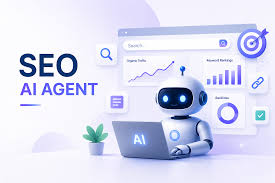
Searches for “SEO AI agents” have jumped 285% year-over-year. That’s not a typo. SEO professionals are flocking to a new breed of software that doesn’t just suggest it does. But what exactly is an SEO AI agent, and why the sudden frenzy? This article unpacks the technology, separates hype from reality, and offers a practical guide for anyone trying to decide if agents belong in their workflow.
What Is an SEO AI Agent?
An SEO AI agent is a software system that uses large language models (LLMs) to perform SEO tasks with minimal human intervention. Unlike traditional AI SEO tools like Surfer SEO or Clearscope—which offer recommendations you have to implement yourself—agents can take action. They might update your meta tags, generate content drafts, or submit sitemaps on their own. Think of the difference: a calculator gives you the answer; an autonomous car drives you to the destination. Traditional tools are the calculator; agents are the self-driving car.
Why the 285% Spike?
The surge in searches didn’t happen in a vacuum. Several forces aligned. First, the release of GPT-4 and similar models gave agents the ability to handle unstructured data—reading a webpage, understanding user intent—rather than just structured APIs. Second, SEO work is repetitive and data-heavy, making it a natural fit for automation. Third, agencies and in-house teams face pressure to do more with less, and agents promise 24/7 operation at a fraction of the cost of junior hires. Finally, Google’s own shift toward AI-generated overviews and the Search Generative Experience has made SEO professionals nervous; they’re looking for tools to keep pace with a changing landscape.
What Can SEO AI Agents Actually Do?
Current agents can perform a range of tasks:
– Keyword clustering and content gap analysis: They group thousands of keywords by intent and identify topics your competitors cover but you don’t.
– Content generation: They draft SEO-optimized articles, though human review is still the norm.
– Technical SEO: They crawl your site, spot broken links or missing schema markup, and even fix them automatically.
– Rank tracking: They monitor your positions in real time, including SERP features like featured snippets.
– Internal linking: They suggest or automatically add internal links to improve site structure.
– Competitor monitoring: They watch your rivals’ changes and alert you to new opportunities.
The Human-in-the-Loop Reality
Despite the hype, most practitioners use agents as “co-pilots,” not replacements. A 2024 survey from Ahrefs found that while 87% of SEO professionals are aware of AI agents, only 18% have fully integrated them into their workflows. The dominant model is human-in-the-loop: the agent does the grunt work, and a human reviews and approves the output. This approach mitigates the risk of generating low-quality content that could trigger Google penalties.
Google’s Stance: Quality Over Origin
Google’s spam policies explicitly target “scaled content abuse.” If an agent mass-produces low-value pages, you’re asking for trouble. But Google also uses AI internally (RankBrain, MUM) and says it rewards genuinely helpful AI-assisted content. The line isn’t “AI vs. human”; it’s “helpful vs. spam.” Agents that prioritize quality and adhere to E-E-A-T guidelines can thrive. Those that cut corners will get penalized.
The Vendor Landscape and Economic Drivers
Major platforms like Semrush, Ahrefs, and Moz are integrating agentic features. Startups are popping up daily. The economic appeal is clear: agents reduce the cost of delivering SEO services, allowing agencies to scale without hiring. For clients, that can mean lower prices and faster results. But there’s a catch: automation can lead to a race to the bottom on pricing, and some tools overpromise autonomous capabilities that fail in production.
The Risks and Misconceptions
- “AI agent” ≠ “AI chatbot”: A chatbot responds to prompts; an agent plans and executes multi-step tasks. Don’t confuse the two.
- Search interest ≠ adoption: The 285% spike might reflect curiosity, not usage. Actual adoption remains under 20%.
- Quality control: Agents can make factual errors or produce generic content. Without human oversight, you risk brand damage.
- Transparency issues: Clients may find it hard to audit what an agent did, raising accountability concerns.
Practical Advice for Using SEO AI Agents
- Start small: Use agents for low-risk tasks like keyword clustering or rank tracking before letting them touch your content.
- Keep a human in the loop: Always review AI-generated content for accuracy and brand voice.
- Monitor Google’s guidelines: Stay updated on spam policies and algorithm updates to avoid penalties.
- Choose tools wisely: Look for agents that offer transparency—logs of actions taken—and clear integration with your existing stack.
The Future Outlook
As LLMs improve, agents will become more autonomous and capable. But the core principle won’t change: SEO is about earning trust, not gaming algorithms. Agents that help you create genuinely useful content and improve user experience will be assets. Those used to spam will be liabilities. The 285% surge signals a shift, but the smartest practitioners will treat it as an opportunity to work smarter, not to replace human judgment entirely.
SEO AI agents are not a passing fad, but they’re also not a magic bullet. The 285% spike in searches shows real interest, but adoption is still in its early stages. The key is to use agents as powerful assistants, not autonomous overlords. Keep humans in the loop, focus on quality, and stay aligned with search engine guidelines. Done right, agents can free you to focus on strategy and creativity—the parts of SEO that truly move the needle.
Summary
- Searches for “SEO AI agents” rose 285% year-over-year, reflecting growing interest in automating SEO workflows.
- An SEO AI agent is an autonomous system that can execute tasks like keyword research, content generation, and technical audits, unlike assistive tools that only provide recommendations.
- Current adoption is low (under 20%), with most practitioners using agents as co-pilots rather than full replacements.
- Google penalizes scaled content abuse, but rewards helpful AI-assisted content—quality, not origin, is the key.
- Practical advice: start small, keep human oversight, and choose transparent tools to avoid pitfalls.
FAQ
Q: What is the difference between an AI SEO tool and an AI agent?
A: An AI SEO tool (like Surfer SEO) provides recommendations that you implement yourself. An AI agent takes action—e.g., it can update meta tags or generate content drafts autonomously. Tools are assistive; agents are executive.
Q: Will SEO AI agents replace SEO professionals?
A: Most practitioners use agents as co-pilots, not replacements. The human-in-the-loop model is dominant because agents still need oversight to ensure quality and avoid penalties. Full replacement is unlikely in the near term.
Q: Are SEO AI agents safe to use with Google?
A: Yes, if used responsibly. Google targets scaled content abuse, not AI per se. Agents that produce high-quality, helpful content align with Google’s guidelines. Low-quality mass production can lead to penalties.
Q: How can I start using an SEO AI agent?
A: Begin with low-risk tasks like keyword clustering or rank tracking. Choose a tool that offers transparency and integrates with your existing stack. Always review AI output before publishing.
Q: Is the 285% increase in searches a sign that agents are widely adopted?
A: No. Search interest doesn’t equal usage. Surveys suggest actual adoption is under 20%. The spike reflects curiosity and awareness, not necessarily mainstream implementation.
Leave a Reply