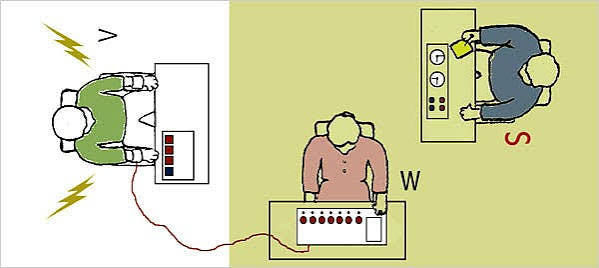
In 1961, as the world watched Adolf Eichmann stand trial in Jerusalem, a young psychologist at Yale University began a series of experiments that would disturb the very foundations of what we believe about human nature. Stanley Milgram wanted to know whether Eichmann’s defense ‘I was just following orders’ could be true of anyone. What he found was both shocking and sobering: ordinary people, placed in the right situation, will inflict pain on others simply because an authority figure tells them to. This article explores the psychology behind that obedience, from Milgram’s shock machine to Zimbardo’s mock prison, and asks a question that still haunts us today: how far would you go?
The Machine That Measured Conscience
In a basement laboratory at Yale, a participant let’s call him ‘Mr. Wallace,’ a 47-year-old accountant sat before a formidable shock generator. The panel boasted 30 switches, starting at 15 volts and climbing to 450. At the 300-volt mark, a red label warned: ‘Danger: Severe Shock.’ Next to him, an experimenter in a gray lab coat gave simple instructions: ‘Please continue.’
Mr. Wallace was the ‘teacher.’ In the next room, a friendly, middle-aged man—a confederate was the ‘learner.’ The learner was strapped into a chair, electrodes attached to his wrists. The teacher read word pairs, tested the learner, and administered shocks for each mistake. The voltage increased by 15 volts each time.
The learner, of course, was an actor. No real shocks were delivered. But Mr. Wallace didn’t know that.
At 75 volts, the learner grunted. At 120 volts, he shouted that the shocks were painful. At 150 volts, he cried out, ‘Let me out of here! I refuse to go on!’ At 180 volts, he screamed about his heart condition. At 300 volts, he pounded the wall and went silent. And still, the experimenter said, ‘Please continue.’
Mr. Wallace paused, his face contorted. He turned to the experimenter, sweating, and said, ‘He can’t stand it, I’m not going to kill that man.’ The experimenter was calm: ‘The experiment requires that you continue.’ Mr. Wallace, trembling, pressed the next switch.
He wasn’t a sadist. He was a typical participant—one of 40 men from the New Haven area, recruited through newspaper ads for a study on ‘memory and learning.’ They were clerks, engineers, laborers, and teachers. And like Mr. Wallace, 65% of them administered the maximum 450-volt shock, the highest level, marked with a sinister ‘XXX,’ despite the learner’s desperate protests and their own visible distress.
The Milgram experiments, conducted between 1961 and 1963, were born directly from the trial of Adolf Eichmann. The Nazi bureaucrat, who organized the logistics of the Holocaust, sat in a glass booth and claimed he was merely a cog in the machine. ‘I was just following orders,’ he said. The court rejected his defense and executed him in 1962, but Milgram wanted to test whether that defense could be true of anyone. His findings suggested a chilling yes.
The Agentic State: When Responsibility Shifts
Milgram didn’t just want to show that people obey; he wanted to explain why. He proposed a theory called the ‘agentic state.’ When people enter an authority structure, they shift from acting autonomously—guided by their own conscience—to acting as agents of the authority. In this state, the individual feels that the responsibility for their actions rests with the person giving orders.
This shift is reinforced by what Milgram called ‘binding factors.’ The participant had made a commitment to the experimenter, and breaking that commitment felt like a breach of trust. Politeness, the desire to be a ‘good participant,’ and the difficulty of walking out all worked to bind the person to the situation. And the escalation was gradual—each shock was only 15 volts more than the last. There was no single moment where the participant had to make a clear, dramatic choice to cross a line; instead, they crossed it in tiny increments until they were at maximum voltage without ever feeling they’d made a decisive leap.
Milgram didn’t stop with the baseline experiment. He tested variations, and each one showed how situational factors could either strengthen or weaken obedience. When the experimenter left the room and gave instructions by phone, obedience dropped to about 20%. When the teacher and learner were placed in the same room, it fell to 40%. When the teacher had to physically force the learner’s hand onto the shock plate, only 30% complied. When two experimenters gave conflicting orders, nobody obeyed. And when a peer—a confederate—refused to continue, obedience plummeted to about 10%.
These results were not just about authority; they were about presence, proximity, and social pressure. The physical and psychological distance between the teacher, the victim, and the authority figure mattered enormously.
The Prison That Became Real
A decade later, Philip Zimbardo took the question of situational evil to an even more extreme level. In 1971, in the basement of Stanford University’s psychology department, he constructed a mock prison. Twenty-four college students, screened for psychological stability, were randomly assigned to be either guards or prisoners. They were given roles, uniforms, and a set of rules. The experiment was meant to last two weeks.
It lasted six days.
The guards, given khaki uniforms and reflective sunglasses, quickly began to dehumanize the prisoners. They forced them to strip, placed them in solitary confinement, and subjected them to sleep deprivation. They made the prisoners address them by numbers, not names. The prisoners, in turn, became passive and depressed. One broke down so severely that Zimbardo had to release him. Others showed signs of acute stress. The study spiraled out of control until a graduate student, Christina Maslach, confronted Zimbardo about the ethics of what was happening. Only then did he end it.
Zimbardo later admitted that he, too, had been absorbed in his role as ‘prison superintendent,’ failing to intervene because he was caught up in the system he had created. He argued that evil emerges not just from individual roles but from systems—institutional structures, ideologies, and power dynamics that legitimize harmful behavior. The guards’ uniforms gave them anonymity and deindividuation; the prisoners’ uniforms and numbers stripped them of identity, fostering learned helplessness.
The Banality of Evil
Hannah Arendt, a political philosopher, covered the Eichmann trial for The New Yorker. She coined the phrase ‘the banality of evil’ to describe what she saw: Eichmann was not a monster, but a shallow, unreflective bureaucrat who thought in clichés and followed orders without deep thought. He seemed disturbingly ordinary. Milgram’s experiments seemed to confirm that Eichmann was not an anomaly—that any of us, placed in the right situation, could become an Eichmann.
But this conclusion has been challenged. The situational vs. dispositional debate continues. Some psychologists argue that personality traits matter, that certain individuals are more prone to obedience or cruelty. Milgram and Zimbardo, however, insisted that the power of the situation was so strong that individual differences became almost irrelevant.
What the experiments undeniably show is that human behavior is profoundly shaped by context. The same person who would never dream of hurting another in normal life can, under the right conditions, inflict severe pain—and do so while believing they are just doing their job.
The Echoes Today
The questions raised by Milgram and Zimbardo are not just historical curiosities. They echo in modern incidents of organizational wrongdoing, from corporate scandals to military atrocities. The Abu Ghraib prison abuses in 2003 were compared to Zimbardo’s experiment by many observers. The ‘just following orders’ defense still appears in courtrooms around the world.
The legacy of these experiments is a sobering reminder of our own vulnerability to authority. They force us to ask uncomfortable questions: When does obedience become complicity? At what point would we refuse? And would we really be as strong as we like to think?
The Milgram and Zimbardo experiments remain controversial, both ethically and scientifically. They pushed the boundaries of what was acceptable in research and left a lasting mark on psychology and ethics. But their core finding endures: human behavior is not fixed by character alone. Situations can lead ordinary people to extraordinary acts of cruelty. In a world where authority is often unquestioned, the lesson is clear: we must remain vigilant, not just about those who give orders, but about our own willingness to follow them.
Summary
- In Milgram’s 1961–1963 experiments, 65% of participants delivered what they believed were maximum 450-volt shocks to a screaming victim simply because an experimenter told them to.
- Milgram’s ‘agentic state’ theory explains that people shift responsibility to authority figures, making them feel less personally accountable.
- Obedience dropped significantly when the experimenter was absent, the victim was visible, or when peers refused to comply.
- Zimbardo’s 1971 Stanford Prison Experiment showed how roles and systems can lead to dehumanization and cruelty, with guards abusing prisoners within days.
- The ‘banality of evil’ concept, coined by Hannah Arendt, suggests that evil acts can be committed by ordinary bureaucrats, not just monsters.
FAQ
Q: What was the purpose of Milgram’s obedience experiments?
A: Stanley Milgram designed them to test whether ordinary people would obey an authority figure even when asked to harm another person, directly addressing the ‘just following orders’ defense used by Nazi war criminal Adolf Eichmann.
Q: How were participants affected by the Milgram experiments?
A: Many participants showed signs of extreme distress, including sweating, trembling, and verbal protests, yet most continued to administer shocks. The ethical implications were heavily criticized, leading to stricter guidelines for human research.
Q: What role did proximity play in obedience in Milgram’s variations?
A: When the experimenter was physically present, obedience was highest (65%). When the experimenter gave orders by phone, obedience fell to 20%. When the learner was in the same room, obedience dropped to 40%, and when physical contact was required, it fell to 30%.
Q: How did the Stanford Prison Experiment end?
A: It was terminated after only 6 days, instead of the planned 14, because of the escalating abuse by guards and the severe psychological distress of prisoners, which included breakdowns and depression.
Q: What is the ‘agentic state’?
A: It’s a psychological state in which an individual sees themselves as an agent of an authority figure, thereby feeling reduced personal responsibility for their actions. This shift is facilitated by gradual escalation and binding factors like politeness and commitment.
Leave a Reply