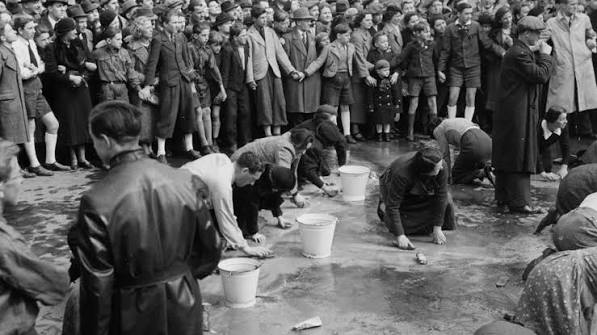
In the summer of 1941, as Einsatzgruppen squads moved through Eastern Europe conducting mass shootings, they often did so in broad daylight, in open pits, sometimes with hundreds of local residents watching. These onlookers were not SS members, not collaborators, not active participants in the killing. They were ordinary people farmers, shopkeepers, mothers who stood by and did nothing. Their inaction, multiplied across millions of moments across occupied Europe, became a defining feature of the Holocaust: not the brutality of the perpetrators alone, but the silence of the many who allowed it to happen.
Why did so many do nothing? The answer lies not in simple cowardice or indifference, but in a complex web of social-psychological mechanisms that have been studied for decades. The same forces that keep a crowd passive during a street emergency diffusion of responsibility, pluralistic ignorance, fear of standing out operated on a catastrophic scale during the Holocaust. Understanding these mechanisms does not excuse the silence, but it helps explain how a genocide of six million Jews could unfold with the passive compliance of the vast majority of the population.
This article examines the bystander effect as it applied to the Holocaust, from the psychological experiments that defined it to the historical realities that gave it such devastating power. It challenges the simple narrative of ‘good’ versus ‘evil,’ and instead looks at the situational pressures that turned ordinary people into silent witnesses—and the rare few who broke that silence.
The Birth of a Concept: Kitty Genovese and the 38 Witnesses
The term ‘bystander effect’ entered the psychological lexicon in 1968, following the murder of Kitty Genovese in New York City. According to initial reports, 38 people witnessed the attack from their apartment windows over a 30-minute period, yet no one called the police. Social psychologists John Darley and Bibb Latané were disturbed by this apparent apathy and conducted experiments that revealed a counterintuitive truth: the more witnesses present, the less likely any one of them is to help.
Darley and Latané identified two key mechanisms. The first is diffusion of responsibility—when a crowd is present, individuals feel less personal accountability, assuming that ‘someone else’ will act. The second is pluralistic ignorance—in ambiguous situations, people look to others to interpret what is happening. If no one else is reacting, they conclude the event is not an emergency.
These findings, originally observed in controlled laboratory settings, would later be applied to far larger and darker historical events. The Genovese case itself has been revisited and the story partially disputed, but the psychological principles it inspired remain foundational to understanding group behavior in crises.
From Street Corner to Genocide: How the Bystander Effect Operates on a Mass Scale
The Holocaust was not a single emergency but a gradual, state-sponsored campaign of persecution that unfolded over years. It began with legal discrimination—the Nuremberg Laws of 1935 stripped Jews of citizenship—and escalated through social ostracism, ghettoization, and finally mass murder. This incremental nature made it particularly conducive to bystander passivity.
When persecution arrives step by step, each stage normalizes the previous one. People adapt to the status quo, and what might have once seemed outrageous becomes acceptable. By the time the killing began, the groundwork of social compliance had already been laid. It was not a sudden crisis but a creeping horror, and the bystander effect thrives in such ambiguity.
Consider the Evian Conference of 1938. Thirty-two nations gathered in France to discuss the growing crisis of Jewish refugees fleeing Nazi Germany. Most countries, including the United States and Britain, refused to significantly increase their immigration quotas. They were, in effect, international bystanders. Their inaction was not a single dramatic failure but a collective decision to look away, each nation assuming that others would take in the refugees or that the problem would somehow resolve itself.
The Five Steps to Intervention (and Where They Failed)
Darley and Latané proposed that intervention requires five steps: notice the event, interpret it as an emergency, assume responsibility, decide how to help, and act. Failure at any step results in inaction.
During the Holocaust, each step presented its own barriers. Noticing the persecution was impossible to avoid—Jews were forced to wear yellow stars, ghettos were visible, and mass shootings occurred in open areas. But interpreting it as an emergency was harder. Nazi propaganda dehumanized Jews, labeling them Untermenschen (subhumans), which made it easier for people to rationalize that the victims were not fully human and thus not deserving of help.
Assuming responsibility was perhaps the most difficult step. The Nazi state was totalitarian, with pervasive surveillance by the Gestapo, SS, and a network of informants. Hiding a Jew was punishable by death—not merely for the rescuer but often for their entire family. This fear of reprisal created a powerful disincentive to act. The risk was not abstract; it was immediate and lethal.
Deciding how to help was also complex. Even those who felt compassion for the victims often had no idea what to do. Could they hide a family in their home? Forge documents? Bribe officials? The logistics of rescue were daunting, especially for ordinary people with limited resources.
Finally, acting required overcoming the psychological numbing that prolonged exposure to atrocity produces. As historian Raul Hilberg noted, many Europeans became desensitized to the violence around them, a coping mechanism that made daily life bearable but also eroded the moral urgency to intervene.
The Historical Reality: Who Were the Bystanders?
The vast majority of Europeans under Nazi occupation were neither active perpetrators nor active rescuers. Historians estimate that rescuers—those who hid or helped Jews at great personal risk—numbered well under 1% of the population in most occupied countries. Yad Vashem, Israel’s official Holocaust memorial, has recognized over 28,000 individuals as ‘Righteous Among the Nations,’ a significant number but a tiny fraction of the population.
Take the Warsaw Ghetto Uprising of 1943. For nearly a month, Jewish fighters held out against the German army in one of the most heroic acts of resistance in the Holocaust. But the surrounding Polish population largely did not intervene. Some were hostile, some were indifferent, and some were paralyzed by fear. The uprising was brutally suppressed, and the ghetto was burned to the ground.
Similarly, the Einsatzgruppen massacres in Eastern Europe occurred in open areas, often witnessed by local populations. In many cases, the killers were assisted by local collaborators, but many more simply stood by. The sheer scale of the killing—over a million Jews shot in mass graves—made individual intervention seem futile. What could one person do against a firing squad?
These examples illustrate a critical point: the bystander effect in the Holocaust was not merely a matter of individual psychology but of overwhelming power dynamics. The Nazi state had a monopoly on violence, and any act of rescue could be met with swift and brutal reprisal. The bystander effect, in this context, was amplified by terror.
The Psychology of Obedience and Dehumanization
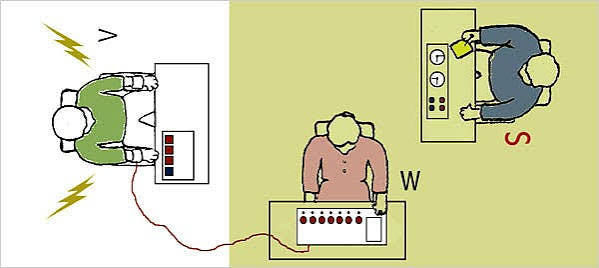
Stanley Milgram’s experiments in the early 1960s provided another key insight into bystander behavior. In his now-famous study, ordinary people were willing to administer what they believed were painful electric shocks to another person when instructed by an authority figure. Even when the ‘victim’ screamed and begged to stop, many participants continued, driven by a sense of obedience to authority.
Milgram’s findings suggest that the bystander effect is not simply about apathy but about the power of authority to override individual conscience. During the Holocaust, the authority of the Nazi state was absolute. People were conditioned to obey orders, and the propaganda machine reinforced the idea that Jews were enemies of the state. This combination of obedience and dehumanization made it psychologically possible for ordinary people to stand by while their neighbors were dragged away.
Dehumanization played a crucial role. By labeling Jews as subhuman, the Nazi regime reduced the moral inhibition against harming them. For bystanders, this meant that the victims were not seen as fully human, making it easier to look away. The psychological distance created by propaganda was reinforced by physical distance—Jews were segregated into ghettos and camps, making them less visible and easier to ignore.
The Exception: The Righteous Among the Nations
Despite the overwhelming pressures to do nothing, a small minority did act. The Righteous Among the Nations are a testament to the fact that the bystander effect is not inevitable. These individuals—some 28,000 recognized by Yad Vashem—risked their lives to hide Jews, forge documents, and provide food and shelter. They came from all walks of life: farmers, diplomats, clergy, and ordinary housewives.
What made them different? Research suggests that rescuers often had a strong moral compass, a personal connection to a Jewish friend or neighbor, or a deep religious conviction. Some simply acted on impulse, driven by a sense of outrage that overcame their fear. They were not immune to the bystander effect; they were able to override it through individual agency.
One example is Oskar Schindler, a German industrialist who saved over 1,000 Jews by employing them in his factory. Schindler was not a saint; he was a flawed man who initially profited from the war. Yet he underwent a transformation, using his wealth and influence to protect his workers. His story, immortalized in the film ‘Schindler’s List,’ illustrates that the decision to act can come from the most unexpected places.
Another example is Irena Sendler, a Polish social worker who smuggled over 2,500 Jewish children out of the Warsaw Ghetto. She was arrested and tortured by the Gestapo but refused to reveal the children’s names. Sendler’s courage shows that even in the face of extreme danger, individuals can choose to act.
These rescuers are the exception, but they prove that the bystander effect, while powerful, is not deterministic. The circumstances of the Holocaust were extremely adverse, but some people still found the strength to resist the forces of diffusion and pluralistic ignorance.
The Moral Question: Is Inaction Ever Neutral?
The bystander effect is a descriptive concept—it explains why people do nothing, but it does not justify their inaction. Philosophers like Hannah Arendt, who coined the term ‘the banality of evil,’ argued that the greatest moral failure of the Holocaust was not the actions of the perpetrators alone but the passivity of the many. Arendt observed that evil could be committed by ordinary people who simply went along with the system, never thinking critically about what they were doing.
Emmanuel Levinas, a philosopher who lost his family in the Holocaust, argued that we have an infinite responsibility to the other person. Inaction, in his view, is never morally neutral. When we see suffering and do nothing, we become complicit in it.
These philosophical perspectives challenge us to consider the bystander effect not as an excuse but as a warning. If we understand the psychological mechanisms that lead to inaction, we can work to counteract them. Education, moral courage, and a willingness to question authority are antidotes to the bystander effect.
Conclusion: Lessons from the Silence
The Holocaust stands as the darkest example of the bystander effect in human history. It shows how ordinary people, under the right conditions, can become silent witnesses to genocide. The mechanisms of diffusion of responsibility, pluralistic ignorance, obedience to authority, and dehumanization did not operate in isolation; they combined with terror and totalitarian control to create a society where inaction was the norm.
But the story of the Righteous Among the Nations reminds us that the bystander effect is not an iron law. It can be overcome. The choice to act lies within each individual, even in the most dire circumstances. The lesson of the Holocaust is not that people are inherently passive but that we must be vigilant against the forces that lead to inaction. We must train ourselves to notice, to interpret, to take responsibility, and to act.
As we reflect on this history, we face a moral imperative: to ensure that we are not bystanders in our own time. The silence of the crowd during the Holocaust was a collective failure of humanity. We honor the memory of the victims by working to ensure that we, and future generations, are never silent again.
The bystander effect, as it manifested during the Holocaust, reveals a terrifying truth about human nature: under extreme pressure, most people will do nothing. Yet it also reveals that some will act, often at great personal cost. The difference between the two is not always clear-cut, but it is shaped by individual conscience, moral clarity, and the courage to defy authority. The silence of the many was a tragedy; the actions of the few were a beacon of hope. We must choose which example to follow.
Summary
- The bystander effect, coined by Darley and Latané after the Kitty Genovese murder, explains why people are less likely to help in emergencies when others are present.
- Mechanisms include diffusion of responsibility and pluralistic ignorance, which were amplified during the Holocaust by totalitarian terror and dehumanization.
- The vast majority of Europeans were neither perpetrators nor rescuers; rescuers numbered less than 1% of the population, with 28,000 recognized as Righteous Among the Nations.
- Key examples of mass inaction include the Warsaw Ghetto Uprising, Einsatzgruppen massacres, and the Evian Conference.
- Despite overwhelming pressure to do nothing, individuals like Oskar Schindler and Irena Sendler acted, proving the bystander effect can be overcome.
- Philosophical perspectives, such as those of Arendt and Levinas, argue that inaction is never morally neutral and that we have a responsibility to act against injustice.
FAQ
Q: What is the bystander effect?
A: The bystander effect is a social-psychological phenomenon where individuals are less likely to offer help in an emergency when other people are present. The more bystanders, the less likely any one person is to intervene, due to mechanisms like diffusion of responsibility and pluralistic ignorance.
Q: How did the bystander effect apply to the Holocaust?
A: The Holocaust was a state-sponsored genocide with overwhelming power dynamics. The gradual escalation of persecution, combined with terror and dehumanization, made it difficult for people to recognize a single moment requiring intervention. The risk of helping was death, and the Nazi regime’s surveillance created a climate of fear that amplified passivity.
Q: Who were the Righteous Among the Nations?
A: The Righteous Among the Nations are non-Jews who risked their lives to save Jews during the Holocaust. Yad Vashem has recognized over 28,000 individuals, though this represents a tiny fraction of the population. They are honored for their courage and moral integrity.
Q: Why did some people choose to help while others did not?
A: Rescuers often had a strong moral compass, personal connections to Jewish friends or neighbors, or deep religious convictions. They were able to override the bystander effect through individual agency, despite the extreme danger. Their actions show that even in the worst circumstances, some people choose to act.
Q: What can we learn from the bystander effect in the Holocaust?
A: The Holocaust teaches us that inaction in the face of atrocity is not morally neutral. Understanding the psychological mechanisms that lead to passivity can help us counteract them. We must train ourselves to notice, interpret, take responsibility, and act, so that we do not become bystanders in our own time.