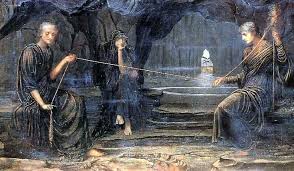
In a corner of Greek myth, three old women sit at a cosmic loom. One spins a thread, another measures it, and the third waits with shears. They are the Moirai—Clotho, Lachesis, and Atropos—and the thread they tend is a human life. The image is so familiar that we barely notice its power: the idea that our days are a finite strand, spun, measured, and cut, has haunted Western thought for millennia.
But the Fates were more than a grim metaphor. They were a way of asking the hardest question there is: If the future is fixed, what good is trying? The Greeks never settled on a single answer—sometimes the Fates bowed to Zeus, sometimes they outranked him—and that very ambiguity made them endlessly useful. From Homer’s heroes to modern films, the Fates have shaped how we tell stories about destiny, choice, and the limits of control.
Who Were the Moirai?
The Moirai were the personified allotment of life. Their names tell the story: Clotho, “the Spinner,” twists the thread of existence; Lachesis, “the Allotter,” measures its length; Atropos, “the Inflexible,” snips it with her shears. In art they appear as stern old women, though earlier depictions sometimes showed them as maidens—a reminder that fate’s cruelty doesn’t always announce itself.
Their parentage was as tangled as their threads. Hesiod’s Theogony offers two versions: they are daughters of Nyx (Night), born without a father, or daughters of Zeus and Themis, the goddess of divine order. The first makes them primordial forces; the second makes them enforcers of cosmic law. Both ideas coexisted, and the tension was never resolved.
The word “moira” itself originally meant “portion” or “share”—not a goddess but the simple fact that everyone gets a cut. In Homer, heroes speak of “my moira” as an impersonal fate, not a trio of spinners. Only later did the three sisters emerge as characters.
The Fates and the Gods: Who’s Really in Charge?
The Fates occupied a paradoxical place in the divine hierarchy. Zeus was sometimes called Moiragetes, “Leader of the Fates,” suggesting he directed them. Yet other myths show them binding even Zeus. In the Iliad, Zeus mourns that his son Sarpedon is fated to die—he cannot save him, only honor the body. The Fates are not capricious; they administer what has been allotted, and not even the king of the gods can rewrite that ledger.
This ambiguity was a feature, not a bug. It allowed the Greeks to hold two truths at once: that the world runs on order, and that power has limits. The Fates were the visible edge of that order, the point where even divine will met a wall.
Spinning at Birth, Cutting at Death
The Fates showed up at the two great thresholds of life. At a child’s birth, they appeared within three days to decree its destiny—so the myths say. At death, Atropos cut the thread. But their influence wasn’t just about beginnings and endings. They also oversaw the fates of gods and mortals in between, often in surprising ways.
Take the birth of Heracles. Zeus boasted that a descendant of Perseus would rule, so Hera delayed Alcmene’s labor, letting Eurystheus be born first and claim the throne. The Fates sealed the outcome, turning a boast into a binding decree. Or consider Meleager, whose life was tied to a brand on the hearth—as long as it burned, he lived. When his mother threw it into the fire, he died. The Fates declared the condition, but human action fulfilled it.
They could even be bargained with, though only within strict rules. When Apollo asked them to spare Admetus, they agreed—if someone would die in his place. His wife Alcestis volunteered, and the deal held. The myth, dramatized by Euripides, shows the Fates as administrators of a contract, not blind executioners.
From Goddesses to Philosophy
As Greek thought matured, the Fates drifted from myth into philosophy. The Pre-Socratics wrestled with fate (heimarmenē) as a cosmic principle. Plato gave them a starring role in the Myth of Er in the Republic: Lachesis sings the past, Clotho the present, Atropos the future. But here, souls choose their own lots—the Fates merely ratify the choice. It’s a crucial move, linking fate to moral responsibility.
The Stoics went further, equating fate with divine reason (logos). For them, the Moirai symbolized the causal chain of the universe. Chrysippus argued that fate doesn’t eliminate free will—a compatibilist position that still animates debates today. Aristotle, meanwhile, puzzled over future contingents. His “sea battle” thought experiment—will there be a sea battle tomorrow?—remains a classic in free will discussions.
The Fates also had a religious side. They were worshipped at crossroads, in caves, and near oracles. At Delphi, they were said to have preceded Apollo. They were sometimes conflated with Eileithyia, goddess of childbirth, and with the Erinyes, the Furies, both of whom dealt with fate and justice. In Orphic cults, they became daughters of Ananke, Necessity—emphasizing cosmic compulsion.
The Moirai in Modern Storytelling
The Fates didn’t stay in antiquity. They migrated into Western culture, reappearing whenever storytellers needed to dramatize destiny. In Shakespeare’s Macbeth, the three witches spin prophecies that drive the plot—their “double, double toil and trouble” echoes the Fates’ spinning. In Neil Gaiman’s The Sandman, the Fates appear as a trio of old women who embody the same roles, now woven into a larger tapestry of myth. The 2012 film Cloud Atlas uses the image of a thread and a knife to explore reincarnation and consequence.
Even when the Fates aren’t named, their logic shapes narratives. The “prophecy” trope—a hero learns their future and tries to avoid it, only to fulfill it—runs from Oedipus Rex to Harry Potter. The idea of a fixed timeline, popular in time-travel stories, is a secularized fate. The Fates’ power to bind even gods echoes in modern fiction where cosmic orders are immutable, from the laws of thermodynamics to the prime directives of science fiction.
The Moirai endure because they answer a need: they give form to the feeling that some things are out of our hands. They let us explore the tension between destiny and choice, not by resolving it, but by making it visible. Every time a story asks whether the hero could have done otherwise, the Fates are in the room.
The Fates’ Legacy
What’s left of the Moirai today? The word “fate” itself derives from the Latin fatum, “that which has been spoken,” the Roman equivalent of the Fates’ decrees. We still say someone’s “thread was cut short” or that they “spun out” a story. The image of spinning, measuring, cutting is baked into our language.
But the deeper legacy is philosophical. The Moirai embody the oldest puzzle: if the future is already written, why act? The Greeks offered no single answer. They left the question open, and that openness is the Fates’ greatest gift. They are not a solution; they are a mirror, reflecting our own uncertainty about how much control we really have.
The Moirai were never just mythological characters. They were a way of thinking about the shape of a life—the portion we’re given, the length we’re measured, the moment we’re cut. Their myth asks us to consider what we can change and what we can’t, a question that remains as pressing now as it was in ancient Greece. The next time you watch a hero struggle against prophecy, or wonder why your own plans keep derailing, remember the three sisters at the loom. They’ve been there all along.
Summary
- The Moirai—Clotho, Lachesis, and Atropos—personified destiny in Greek myth, spinning, measuring, and cutting the thread of life.
- Their parentage was ambiguous: daughters of Night or of Zeus and Themis, reflecting a tension between primordial force and cosmic law.
- They could bind even Zeus, yet were sometimes subordinate to him, embodying the paradox of fate and divine power.
- Philosophers from Plato to the Stoics used the Fates to explore free will and determinism, a debate that continues today.
- Modern storytelling, from Shakespeare to Harry Potter, still relies on the Fates’ logic of prophecy and fixed destiny.
FAQ
Q: What are the names of the three Fates and what did they do?
A: Clotho spun the thread of life, Lachesis measured its length, and Atropos cut it, ending life. Together they determined each person’s destiny.
Q: Were the Fates more powerful than Zeus?
A: It depends on the source. Sometimes Zeus was called their leader, but in other myths they bound even him—he couldn’t save his son Sarpedon once fate was set.
Q: Did the Greeks believe in fate or free will?
A: Both, in a way. They held that fate set limits, but within those limits humans made choices. Plato’s Myth of Er even shows souls choosing their own lots before the Fates ratify them.
Q: How are the Fates different from the Norse Norns?
A: The Norns—Urd, Verdandi, and Skuld—are similar spinning goddesses, but they have their own mythology and are tied to the Norse cosmos, not the Greek. They’re a parallel, not a copy.
Q: Why do the Fates still appear in modern stories?
A: Because they dramatize the tension between destiny and choice. The prophecy trope—where trying to avoid fate actually fulfills it—is a direct descendant of the Moirai, and it remains a powerful storytelling device.
Leave a Reply