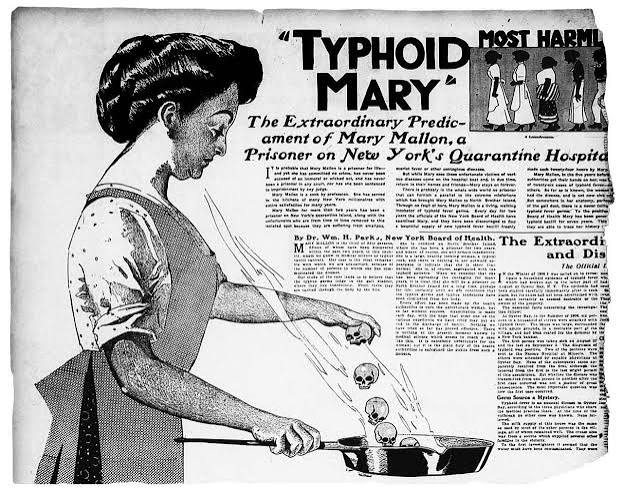
In the summer of 1906, a mysterious typhoid outbreak struck a rented mansion in Oyster Bay, New York. Six of the eleven people in the house fell ill with high fevers and debilitating symptoms. The owner, desperate to find the source, hired a sanitation engineer named George Soper. His investigation would uncover a medical mystery that challenged everything scientists thought about infectious disease and it centered on a seemingly healthy Irish cook named Mary Mallon.
Mallon’s story is not just a historical footnote; it’s a pivotal moment that shaped modern public health. Her case forced scientists to recognize that carriers of disease could be asymptomatic, transforming how we track and control outbreaks. But her story also raises profound ethical questions about individual rights versus public safety questions we still grapple with today during pandemics and vaccine mandates.
A Disease That Followed a Cook
Typhoid fever in the early 1900s was a terrifying scourge. In 1906, the United States reported around 25,000 to 35,000 cases annually, with a mortality rate of about 10%. The disease, caused by the bacterium Salmonella typhi, spreads through contaminated food and water. Once ingested, the bacteria invade the intestines, causing sustained fever, weakness, abdominal pain, and sometimes death. Without antibiotics, treatment was largely supportive—bed rest, fluids, and hope.
George Soper, a sanitary engineer, was a pioneer in the new field of epidemiology. When he investigated the Oyster Bay outbreak, he noticed a pattern: the only person who had left the household before the outbreak was the cook, Mary Mallon. Soper traced Mallon’s employment history and found a trail of typhoid cases. Between 1900 and 1907, she had worked for eight families, and 22 cases of typhoid were linked to her, including one death. The evidence pointed to Mallon as a carrier, but she appeared perfectly healthy.
Soper needed proof. In March 1907, he visited Mallon to request stool samples for testing. His approach was, by all accounts, aggressive and lacking in tact. He later admitted, “I had a rather bad half hour with her.” Mallon, who felt fine and had never been sick, was understandably confused and angry. She refused to believe she could spread a disease without being ill herself. When she refused to cooperate, Soper left, but he returned with police and health officials. Mallon was forcibly apprehended and taken to Riverside Hospital on North Brother Island, a quarantine facility in the East River.
The Birth of the Carrier Concept
At the hospital, laboratory tests confirmed Soper’s suspicion: Mallon’s stool samples tested positive for Salmonella typhi. This was a groundbreaking discovery. Before Mallon, scientists believed that only sick individuals could transmit typhoid. The idea that a healthy person could carry and spread the bacteria was revolutionary. Mallon was among the first documented cases of an asymptomatic carrier in the United States.
The medical explanation is both fascinating and a bit unsettling. In some people infected with typhoid, the bacteria take up residence in the gallbladder, where they can survive for years without causing symptoms. These carriers shed the bacteria in their feces, which can contaminate food if they don’t practice rigorous hand hygiene. For a cook like Mallon, who prepared meals for others, the risk was significant.
Mallon’s case proved that carriers were a real threat, but it also created a public health dilemma. How do you protect the public from someone who doesn’t look or feel sick? In the early 1900s, quarantine laws were designed for visibly ill patients, not healthy carriers. There was no legal precedent for indefinitely detaining someone who showed no symptoms. Yet, the health department, fearing further outbreaks, decided to keep Mallon isolated.
A Life Interrupted
Mallon spent three years on North Brother Island from 1907 to 1910. She lived in a small cottage, away from other patients, and was subjected to repeated medical tests. She never accepted her diagnosis, believing that she was being persecuted because of her Irish immigrant background. In 1909, she sued the New York City Health Department for wrongful imprisonment. The case drew significant media attention, and Mallon became a public figure—not sympathetically, but as a menace. Newspapers dubbed her “Typhoid Mary,” a label that stuck and demonized her.
In 1910, a new health commissioner offered Mallon her freedom on one condition: she must never work as a cook again. Mallon agreed, but she struggled to find other employment. Her only skill was cooking, and she was illiterate, making it hard to secure other work. For a time, she took a job as a laundress, but the pay was poor. Eventually, she returned to cooking under the alias “Mrs. Brown,” a decision that would seal her fate.
In 1915, an outbreak of typhoid struck Sloane Maternity Hospital in Manhattan. Twenty-five people fell ill, and two died. Health officials traced the source to a cook known as “Mrs. Brown.” It was Mary Mallon. She had been working there for several months, unaware that she was still contagious. The second outbreak destroyed any remaining public sympathy. Mallon was arrested again and confined permanently to North Brother Island.
The Ethics of Isolation
Mallon’s story is a cautionary tale about the tension between individual rights and public health. On one hand, her isolation protected countless people from a deadly disease. On the other hand, she was detained without due process, based on the fear of what she might do, not what she had done. She never received a trial; the health department simply kept her confined.
Soper’s role is also troubling. He was a scientist, not a physician, and his approach was heavy-handed. He didn’t explain the science to Mallon in a way she could understand, and he didn’t offer alternatives like regular testing or education. Instead, he treated her as a problem to be solved, not a person to be helped.
Mallon’s case also highlights the social prejudices of the time. Irish immigrants in New York faced rampant discrimination. They were often stereotyped as unclean and disease-prone. Mallon’s refusal to cooperate was seen as evidence of her ignorance and stubbornness, rather than a reasonable response to an unbelievable accusation.
Legacy and Lessons
Despite the ethical failures, Mallon’s case changed public health for the better. It led to the development of carrier surveillance programs, where health departments tracked individuals known to carry infectious diseases. It also prompted regulations for food handlers, requiring testing and vaccination in some cases. Today, we have a robust system for monitoring and managing carriers of diseases like typhoid, hepatitis A, and even COVID-19.
The term “Typhoid Mary” has entered the lexicon as a metaphor for someone who spreads disease or misfortune. But it’s a loaded term that obscures Mallon’s humanity. She was a victim of circumstance, trapped by a medical condition she couldn’t control and a system that had no good answers.
Mary Mallon died on November 11, 1938, at Riverside Hospital, after spending nearly 26 years in isolation. An autopsy revealed live typhoid bacteria still in her gallbladder—a poignant reminder that she was never cured, only contained. Her story remains a powerful case study in public health ethics, a reminder that protecting the community must not come at the cost of basic human dignity.
Mary Mallon’s life is a complex legacy. She was both a vector of disease and a victim of a nascent public health system. Her case accelerated scientific understanding of asymptomatic carriers, leading to better surveillance and prevention strategies. But it also serves as a warning about the dangers of stigmatization and the importance of treating individuals with respect, even when they pose a risk to others. As we continue to face new infectious threats, Mallon’s story reminds us that public health measures must balance the needs of the many with the rights of the few.
Summary
- Mary Mallon, an Irish immigrant cook in early 1900s New York, was the first documented asymptomatic carrier of typhoid fever in the U.S.
- Her employment history traced 22 cases of typhoid to her, and she was linked to a total of about 50 cases and 3 deaths over her lifetime.
- George Soper’s investigation in 1906 proved that healthy carriers could spread disease, a revolutionary concept at the time.
- Mallon was forcibly quarantined twice, spending nearly 26 years in isolation on North Brother Island, despite never showing symptoms herself.
- Her case led to carrier surveillance programs and food-handler regulations, but also raised ethical questions about civil liberties vs. public safety.
FAQ
Q: Who was Mary Mallon?
A: Mary Mallon, also known as “Typhoid Mary,” was an Irish immigrant cook in New York City who was the first documented healthy carrier of typhoid fever in the United States. She unknowingly spread the disease to dozens of people while showing no symptoms herself.
Q: What is an asymptomatic carrier?
A: An asymptomatic carrier is a person who is infected with a pathogen but does not exhibit any symptoms. They can still transmit the disease to others. Mary Mallon carried Salmonella typhi in her gallbladder and shed it in her feces, contaminating food she prepared.
Q: Why was Mary Mallon quarantined?
A: Mary Mallon was quarantined because she was a carrier of typhoid fever and worked as a cook, putting others at risk. Public health officials believed that isolating her was necessary to prevent further outbreaks, even though she was healthy herself.
Q: How long was Mary Mallon isolated?
A: Mary Mallon was isolated for a total of about 26 years. She was first quarantined from 1907 to 1910, then released on the condition she stop cooking. After causing another outbreak in 1915, she was re-quarantined and remained on North Brother Island until her death in 1938.
Q: Did Mary Mallon ever accept that she was a carrier?
A: No, Mary Mallon never fully accepted that she was a carrier. She believed she was being unfairly targeted, possibly due to her immigrant status. Even after laboratory tests confirmed she carried the bacteria, she remained skeptical and resentful of her treatment.
Leave a Reply