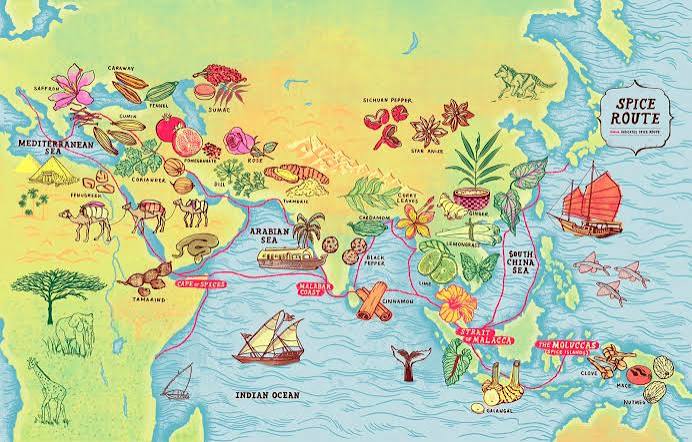
Imagine a world where a handful of peppercorns could buy a man’s freedom, where a single nutmeg could be sold for enough to feed a family for a week, and where nations risked war over a few islands in a distant sea. This was the reality of the spice trade, a global economic engine that ran for over a millennium, shaping the destinies of empires and transforming the way we eat.
Today, spices are so commonplace that we barely notice them. But for centuries, pepper, cinnamon, and nutmeg were among the most valuable commodities on Earth—more precious than gold. Their allure drove explorers to cross uncharted oceans, sparked the first multinational corporations, and led to some of the darkest chapters of colonial history. This is the story of how three humble spices changed the world.
The Allure of the East: Why Spices Were Worth a Fortune
To understand why spices were so coveted, we have to step into a medieval European kitchen. Without refrigeration, meat spoiled quickly, and spices—though not true preservatives—helped mask the taste of decay. They were also believed to have medicinal properties, curing everything from the plague to indigestion (most claims were exaggerated, but the belief was powerful).
But above all, spices were a status symbol. A dish studded with peppercorns or dusted with cinnamon signaled that the host could afford the rarest luxuries on Earth. In medieval Europe, pepper was literally used as currency: rents, taxes, and even dowries could be paid in peppercorns. The phrase “peppercorn rent”—a nominal sum—survives to this day.
The mystery surrounding their origins only added to their mystique. Arab traders, who controlled the overland routes, spun fantastic tales to protect their monopoly: cinnamon was said to be harvested from giant bird nests in Arabia, and pepper was guarded by serpents. In reality, cinnamon came from Sri Lanka, and pepper from India’s Malabar Coast, but the secrecy kept prices astronomical.
The Race for the Spice Islands
By the 15th century, the spice trade was a lucrative bottleneck controlled by Arab and Venetian middlemen. European monarchs, eager to break this monopoly and tap into the wealth directly, funded daring voyages. The Portuguese, led by Vasco da Gama, rounded the Cape of Good Hope in 1498 and reached India, opening a direct sea route. The Spanish, under Magellan, sought a western passage—and stumbled upon the Americas, which they initially mistook for the Spice Islands.
The Treaty of Tordesillas (1494) divided the world between Spain and Portugal, largely to settle competing claims over spice territories. This papal decree had a profound impact: it gave Portugal a monopoly on the eastern route to India, and Spain a claim to the Americas, inadvertently shaping the colonial map for centuries.
The Dark Side of Spice: Dutch Brutality in the Banda Islands
Nowhere was the spice trade’s ruthlessness more evident than in the Banda Islands, the sole source of nutmeg and mace in the 17th century. The Dutch East India Company (VOC), the world’s first multinational corporation, was determined to control this precious commodity. In the 1620s, they invaded the islands, and in a brutal campaign, they killed or enslaved much of the native population. The survivors were forced to work in the nutmeg groves, and the Dutch destroyed any trees outside their control to maintain a monopoly.
The VOC’s tactics were chillingly efficient. They restricted nutmeg cultivation to a few islands, burned surplus stock to keep prices high, and even treated nutmeg with lime to prevent it from sprouting elsewhere. This monopoly was so valuable that the Dutch traded Manhattan to the British in 1667—in the Treaty of Breda—to secure their claim to Run, a tiny nutmeg-producing island.
The Spice Trade’s Legacy: From Monopoly to Globalization
The Dutch monopoly eventually crumbled. In the 19th century, nutmeg was smuggled out of the Banda Islands and introduced to Grenada in the Caribbean, breaking the Indonesian stranglehold. Cinnamon, too, spread to other colonies, and pepper cultivation expanded across Southeast Asia. By the late 1800s, spice prices had collapsed, and the trade that had once driven global exploration became just another agricultural commodity.
But the spice trade’s legacy endures. It laid the groundwork for modern capitalism: the VOC pioneered joint-stock companies, tradable shares, and colonial administration—innovations that would shape global commerce. It also transformed cuisines worldwide. While European cooking today uses fewer spices than in medieval times, the flavors of South Asian, Southeast Asian, and Middle Eastern dishes are unimaginable without pepper, cinnamon, and nutmeg.
Ironically, the spice trade also introduced new crops that would have an even greater impact. Chili peppers, brought from the Americas by Portuguese traders, revolutionized Indian and Thai cooking—though they are not part of the classic trio. The spice trade was a catalyst for the exchange of not just goods, but plants, ideas, and people, on a global scale.
The Spice Trade’s Enduring Lessons
The story of pepper, cinnamon, and nutmeg is a cautionary tale about the dangers of monopoly and the human cost of greed. It also demonstrates the power of supply and demand, and how a simple commodity can reshape geopolitics. As we sprinkle cinnamon on our oatmeal or grind pepper over our salad, we are participating in a legacy that spans continents and centuries—a reminder that the most ordinary things can have extraordinary histories.
The spice trade was more than a commercial enterprise; it was a force that redrew maps, toppled empires, and connected distant cultures. From the pepper fields of Kerala to the nutmeg groves of the Banda Islands, these tiny seeds and barks fueled exploration, innovation, and exploitation. Today, as we enjoy the fruits of that trade, we should remember the complex and often painful history behind every pinch of spice.
Summary
- Pepper, cinnamon, and nutmeg were once among the most valuable commodities on Earth, worth more than gold.
- The search for spices drove European exploration, leading to the discovery of the Americas and the first global trade networks.
- The Dutch East India Company’s brutal monopoly on nutmeg in the Banda Islands is a dark example of colonial exploitation.
- The spice trade laid the foundations for modern capitalism, including the joint-stock company and multinational corporations.
- The legacy of the spice trade is visible in global cuisines and the interconnected world we live in today.
FAQ
Q: Why were spices so valuable in medieval Europe?
A: Spices were prized for their ability to mask the taste of spoiled meat, their supposed medicinal properties, and as status symbols. They were so valuable that they were used as currency in some regions.
Q: Where did the main spices come from?
A: Black pepper is native to India’s Malabar Coast, true cinnamon comes from Sri Lanka, and nutmeg and mace are exclusively from the Banda Islands in Indonesia.
Q: How did the spice trade lead to the discovery of the Americas?
A: Columbus sought a western sea route to the Spice Islands to break the Arab-Venetian monopoly. He didn’t find the Spice Islands, but he did find the Americas, which were initially mistaken for Asia.
Q: What was the role of the Dutch East India Company?
A: The VOC was the first multinational corporation and controlled much of the spice trade in the 17th century. They used violent tactics to maintain a monopoly on nutmeg, including massacring the native population of the Banda Islands.
Q: Why did the spice trade decline?
A: The trade declined in the 19th century as cultivation spread to other colonies, breaking the monopolies, and as prices collapsed due to overproduction. Demand also shifted as European tastes evolved.
Leave a Reply