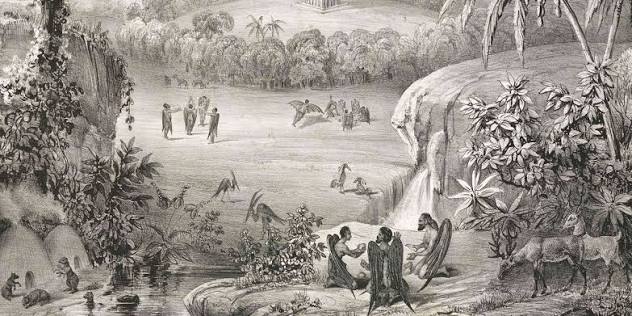
In August 1835, the New York Sun published a series of articles claiming that the famous astronomer Sir John Herschel had discovered life on the Moon using a powerful new telescope. The articles described trees, oceans, and strange animals, including bison-like creatures and a ‘man-bat’ with bat-like wings. The story was a complete fabrication, but it fooled many readers and boosted the paper’s circulation from 8,000 to nearly 20,000 copies per day, making it the best-selling newspaper in the world at the time.
This episode is a landmark in the history of journalism, illustrating the power of sensationalism and the tension between circulation and truth. It also reflects the scientific and cultural context of the 1830s, when the Moon was a subject of genuine curiosity and the idea of lunar life was not considered absurd by many. The hoax was revealed as a fabrication within two weeks, but its legacy endures as a cautionary tale about fake news and the importance of verification.
The Penny Press and the Hunger for Sensation
The 1830s saw the rise of the ‘penny press’—cheap, mass-circulation newspapers aimed at working-class readers. The New York Sun, founded in 1833 by Benjamin Day, was a pioneer of this model, selling papers for one cent instead of the traditional six cents. This created intense competition for readership, and editors quickly learned that sensational stories sold papers. The Moon hoax was a product of this environment, where the line between news and entertainment was often blurred.
The Hoax Unfolds: A Six-Part Series
The series ran from August 21 to August 31, 1835, as a supplement to the regular edition. It claimed that Sir John Herschel, a real and respected astronomer, had made incredible discoveries using a telescope with a 24-foot lens and magnification of 42,000x—technology far beyond anything that existed. The articles described:
- Trees, oceans, and vegetation on the lunar surface
- Strange animals, including bison-like creatures and a ‘man-bat’ (a humanoid creature with bat-like wings)
- Blue-tinted, goat-like unicorns
- A temple made of polished sapphire
- The claim that Herschel had named the discovery the ‘Vespertilio-homo’ (bat-man)
These details were presented with scientific precision, complete with technical descriptions and references to Herschel’s real work. The fact that Herschel was in South Africa at the time made it difficult for him to respond quickly, adding to the hoax’s credibility.
The Scientific and Cultural Context
Why did so many people believe the story? In the 1830s, the ‘plurality of worlds’ theory—that other celestial bodies might harbor life—was widely discussed. Some respected scientists, including William Herschel (John’s father), had speculated about life on the Moon. The concept of ‘selenites’ (lunar inhabitants) had appeared in earlier speculative works, such as those by the German astronomer Johann Schröter. So the idea of lunar life was not absurd to many readers.
The hoax also touched on theological questions: If life existed on the Moon, did it have souls? Were they descended from Adam? These questions were debated in the press, and some religious publications initially took the story seriously, while others condemned it as blasphemous.
The Author: Richard Adams Locke
Richard Adams Locke, a British-born journalist and editor at the Sun, is widely credited as the author of the hoax. Some historians argue that Locke intended the story as a satire of contemporary scientific speculation and religious credulity, not a malicious deception. His targets may have included the astronomer John Herschel and the popular press’s tendency to sensationalize science. The Sun never formally retracted the story; when the hoax was exposed, the paper’s response was muted and defensive.
The Public’s Reaction: Gullibility or Skepticism?
Contemporary accounts suggest many readers were genuinely fooled, but some historians argue that the public was more skeptical than later retellings suggest. The hoax was exposed relatively quickly—within about two weeks—partly because readers and rival papers began questioning the details. Some evidence suggests that many readers understood it as entertainment or satire, not literal truth. Still, the circulation jump from 8,000 to nearly 20,000 copies per day indicates that the story captured the public’s imagination.
The Scientific Community’s Response
Real astronomers were initially puzzled and then outraged. Some wrote letters to other papers denouncing the claims. The hoax damaged public trust in scientific reporting, though it also sparked genuine public interest in astronomy. Some scientists used the hoax as a cautionary tale about the need for rigorous verification in scientific communication.
The Herschel Family’s Perspective
Sir John Herschel reportedly found the hoax amusing when he learned of it, though he was initially annoyed. His reputation was not permanently damaged; he continued his work and later became a respected figure in British science. The hoax has been called ‘The Great Moon Hoax’ only in retrospect; at the time it was sometimes called ‘The Lunar Hoax’ or ‘The Astronomical Hoax.’
Legacy and Lessons
The Great Moon Hoax remains a powerful example of ‘fake news’ long before the term existed. It highlights the ethical responsibilities of journalists and the dangers of prioritizing circulation over truth. It also shows how scientific ignorance and cultural beliefs can make people vulnerable to misinformation. In an era of rapid technological change and intense media competition, the lessons of 1835 are still relevant today.
The Great Moon Hoax of 1835 was a pivotal moment in the history of journalism, demonstrating both the power of the press and its capacity for deception. While the hoax was short-lived, its impact on public trust and its role as a cautionary tale continue to resonate. As we navigate our own era of misinformation, the story of the New York Sun and its fabricated lunar life serves as a reminder of the importance of critical thinking and responsible reporting.
Summary
- In August 1835, the New York Sun published a six-part series falsely claiming that astronomer Sir John Herschel had discovered life on the Moon.
- The hoax described bizarre creatures like man-bats and unicorns, and boosted the paper’s circulation from 8,000 to nearly 20,000 copies per day.
- The story was likely written by Richard Adams Locke, possibly as a satire of scientific speculation and credulity.
- The hoax was exposed within two weeks, but it damaged public trust in scientific reporting and remains a classic example of fake news.
- The episode highlights the tension between sensationalism and truth in journalism, a lesson still relevant today.
FAQ
Q: Was the Great Moon Hoax a deliberate deception?
A: Yes, the articles were fabricated, but some historians argue that the author, Richard Adams Locke, intended it as a satire of scientific speculation and religious credulity, not a malicious lie.
Q: How did the public react when the hoax was revealed?
A: Many readers were initially fooled, but within two weeks, rival papers and skeptical readers began questioning the details, leading to exposure. Some readers may have understood it as entertainment from the start.
Q: Did the hoax damage Sir John Herschel’s reputation?
A: No, Herschel reportedly found it amusing and his reputation was not permanently harmed. He continued his scientific work and remained respected.
Q: Why did so many people believe the story?
A: The idea of lunar life was not considered absurd in the 1830s, and Herschel’s real work in South Africa added credibility. The detailed, scientific tone of the articles also helped.
Q: What is the legacy of the Great Moon Hoax?
A: It is a landmark example of fake news and a cautionary tale about the dangers of sensationalism in journalism. It also sparked public interest in astronomy and highlighted the need for verification in science reporting.
Leave a Reply