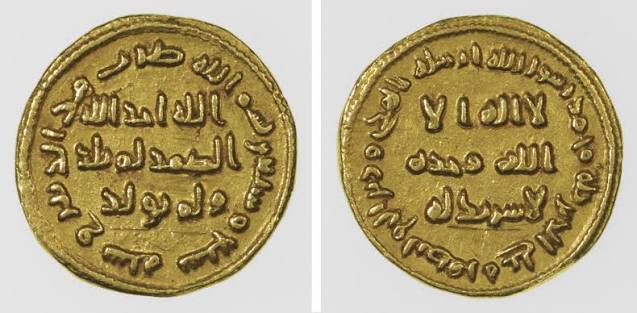
Before the dollar and the euro, a small gold coin—weighing just 4.25 grams—served as the trusted currency across three continents. The Islamic gold dinar, first minted in 697 CE, was the backbone of trade from Spain to China, enabling merchants to move silk, spices, and gold across thousands of miles. Its consistency and purity made it the ‘hard currency’ of the medieval world, a status that modern economies still strive for. The dinar’s legacy is not just a tale of coins but of how trust, standardization, and financial innovation shaped the global economy.
A Coin Born from Reform
The gold dinar emerged during a pivotal moment in Islamic history. In 697 CE, the Umayyad Caliph Abd al-Malik initiated a monetary reform that replaced the imitative Byzantine and Sasanian coins that had circulated after the early conquests. The new coin was a statement of independence—both political and religious. It carried no images of emperors or gods, only Arabic calligraphy declaring the faith and the year of issue according to the Hijri calendar. Weighing 4.25 grams of near-pure gold, it was based on the Byzantine solidus but adjusted to align with Islamic weights, making it slightly lighter yet more consistent.
This was not just a symbolic change. Abd al-Malik was centralizing his empire: Arabic became the administrative language, the Dome of the Rock was built in Jerusalem, and the dinar became the standard for taxes, legal payments, and long-distance contracts. The coin was a tool of statecraft, designed to unify a vast caliphate under a single economic standard.
The Dinar’s Role in the Silk Road Network
The Silk Road was not a single highway but a web of overland and maritime routes connecting East Asia, the Middle East, and Europe. The dinar was the one currency that bridged these diverse segments. Overland, caravans carried dinars into Central Asia and China, where they were often melted into bullion or used as weight standards because of their reliable purity. Maritime routes saw dinars in ports like Basra, Siraf, and Aden, linking to Indian and Southeast Asian markets.
What made the dinar so effective was its consistency. Unlike many local coins, which varied in weight and fineness, the dinar maintained a high standard for centuries. This reliability was crucial for high-value transactions—silk, spices, horses, and even slaves. The 10th-century Cairo Geniza documents reveal how merchants used dinars in partnerships, letters of credit, and bills of exchange, laying the groundwork for modern banking instruments.
Why Gold? The Geopolitics of Precious Metals
The Islamic heartland, particularly the Hijaz and Iraq, was poor in gold. The metal flowed in from West Africa via trans-Saharan trade, from Nubia, and from Central Asian mines. In contrast, the eastern caliphate relied more on silver. This created a regional bimetallism: gold in the west and Mediterranean, silver in the east. The gold-silver ratio fluctuated, typically between 1:10 and 1:14, offering arbitrage opportunities but also causing periodic currency crises when one metal was overvalued.
Gold was chosen for the dinar because it was the metal of international trade. Silver was too bulky for large transactions, and copper was for small change. Gold’s high value-to-weight ratio made it ideal for long-distance commerce, and its rarity in the Islamic heartland meant that its supply was closely tied to trade routes—making the dinar a barometer of economic connectivity.
The Dinar’s Rivals and the Rise of European Gold
The dinar did not exist in a vacuum. The Byzantine solidus and later the hyperpyron continued to circulate in the eastern Mediterranean, and the two currencies often traded at slight premiums relative to each other. But in the 13th century, European powers began to mint their own gold coins: Florence introduced the florin in 1252, and Venice followed with the ducat in 1284. These coins, inspired by the dinar’s example, soon dominated Mediterranean trade as Islamic gold supplies dwindled.
Even the Mongols, who conquered much of the Islamic world, initially adopted the dinar system. But their later experiment with paper money in Persia in 1294 was a spectacular failure, serving as an early lesson on the dangers of fiat currency without backing or trust.
The Legacy: From Dinar to Modern Finance
The gold dinar’s influence extends far beyond its circulation period. Its principles—standardized weight, purity, and trust—are foundational to modern monetary systems. The dinar also paved the way for financial innovations like checks and letters of credit, which were essential for long-distance trade. Today, some Islamic finance advocates call for a return to the gold dinar as a way to avoid inflation and currency manipulation.
In the numismatic world, the dinar is prized not only for its gold but for its artistic and historical value. The calligraphy on each coin tells a story of dynasties and empires, from the Umayyads to the Fatimids to the Almoravids. The Fatimid dinar, for instance, was so pure it was widely imitated, even by European mints.
The Dinar in Today’s Economy
While the dinar is no longer minted, its legacy persists in discussions about global currencies and financial stability. The euro, with its standardized coinage across nations, echoes the dinar’s role in unifying trade. The rise of cryptocurrencies like Bitcoin, which aim to be decentralized and trustless, also reflects the dinar’s appeal as a reliable store of value.
Understanding the gold dinar helps us see that currencies are more than just money—they are instruments of power, trust, and connection. The dinar’s forgotten history is a reminder that economic systems are built on confidence, and that confidence can be as valuable as gold itself.
The gold dinar was more than a coin; it was a catalyst for global trade and a precursor to modern finance. Its story is a testament to how a standardized currency can foster economic integration across diverse cultures. As we navigate today’s complex financial landscape, the dinar’s lessons about trust, purity, and interoperability remain as relevant as ever.
Summary
- The gold dinar, first minted in 697 CE, was a standardized Islamic coin weighing 4.25 grams of near-pure gold.
- It served as the primary ‘hard currency’ for Silk Road trade, bridging overland and maritime routes from North Africa to China.
- Its design rejected images in favor of Arabic calligraphy, reflecting religious and political authority.
- The dinar’s consistency enabled financial innovations like letters of credit and bills of exchange.
- It faced competition from Byzantine and later European gold coins, but set the standard for monetary trust and purity.
FAQ
Q: What was the gold dinar’s weight and purity?
A: The dinar weighed approximately 4.25 grams of near-pure gold, typically 22-24 karats, based on the Byzantine solidus but adjusted to Islamic weights.
Q: Why was the dinar important for Silk Road trade?
A: Its consistent weight and purity made it a reliable medium of exchange for high-value goods across politically fragmented regions, facilitating long-distance contracts and trust.
Q: What replaced the gold dinar?
A: European gold coins like the Venetian ducat (1284) and Florentine florin (1252) replaced the dinar in Mediterranean trade as Islamic gold supplies declined.
Q: How did the dinar influence modern finance?
A: The dinar’s principles of standardization and trust underpinned early banking instruments like letters of credit, and its legacy is seen in discussions about currency stability and even cryptocurrencies.
Q: Are there any modern attempts to revive the gold dinar?
A: Some Islamic finance advocates propose a return to the gold dinar to avoid inflation, but no major economy has adopted it as official currency.
Leave a Reply