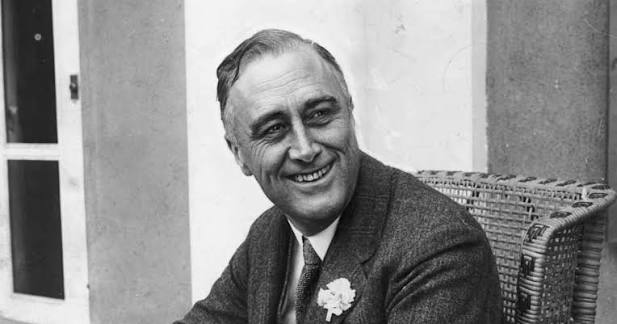
When Franklin Delano Roosevelt took the oath of office on March 4, 1933, the United States was in freefall. Unemployment had hit 25%, banks were shuttering by the hundreds, and industrial production had been cut in half. In his first inaugural address, he told a terrified nation that “the only thing we have to fear is fear itself.” But FDR didn’t just offer words; he launched an unprecedented wave of legislation that would forever change the relationship between the government and its citizens.
From Hyde Park to the White House
Born into privilege in Hyde Park, New York, on January 30, 1882, Franklin Delano Roosevelt seemed destined for a life of comfort, not crisis. A distant cousin of Theodore Roosevelt, he attended Harvard and Columbia Law School (without graduating), then followed his cousin’s path into politics. He served as Assistant Secretary of the Navy under Woodrow Wilson and ran as the vice-presidential candidate on the losing Democratic ticket in 1920.
Then, in 1921, at age 39, disaster struck. Roosevelt contracted polio, leaving him permanently paralyzed from the waist down. He spent years in rehabilitation, learning to move with braces and a wheelchair. This experience, historians often argue, deepened his empathy for the suffering of ordinary Americans a quality that would define his presidency.
The New Deal: A New Relationship Between Government and Citizens
When FDR took office, the nation was in the grips of the Great Depression. His response was the New Deal, a series of programs and reforms that unfolded in two waves. The First New Deal (1933-1934) focused on relief and recovery, creating agencies like the Civilian Conservation Corps (CCC), the Tennessee Valley Authority (TVA), and the Federal Deposit Insurance Corporation (FDIC), which guaranteed bank deposits to restore public confidence.
The Second New Deal (1935-1936) shifted toward reform and security. The Social Security Act of 1935 established a permanent safety net for the elderly and unemployed. The Wagner Act protected workers’ rights to unionize. The Works Progress Administration (WPA) put millions of Americans to work on public projects, from roads and bridges to murals and plays.
These programs were transformative, but they were not without controversy. In 1937, FDR overreached with his “court-packing” plan, proposing to expand the Supreme Court to secure favorable rulings on New Deal legislation. The move was widely seen as a political miscalculation, and it tarnished his prestige. A recession in 1937-1938, partly caused by premature spending cuts, also raised doubts about the New Deal’s effectiveness.
Leading Through World War II
As the world lurched toward war in the late 1930s, FDR initially pursued neutrality, but he quietly aided the Allies through programs like “cash-and-carry.” In January 1941, he delivered his famous “Four Freedoms” speech, envisioning a world founded on freedom of speech, worship, from want, and from fear.
When Japan attacked Pearl Harbor on December 7, 1941, FDR led the United States into total war. He served as Commander-in-Chief, implementing a “Germany First” strategy and overseeing the Manhattan Project. He played a central role in Allied conferences at Casablanca, Tehran, and Yalta, shaping the postwar world.
His leadership was indispensable, but his record is not without stains. In 1942, he signed Executive Order 9066, which led to the internment of over 100,000 Japanese Americans—a grave violation of civil liberties that remains a dark chapter in American history.
The Legacy: Four Terms and a Transformed Nation
FDR was elected to an unprecedented four terms, a feat that led to the 22nd Amendment limiting future presidents to two. He was the first president to appear on television and the first to appoint a woman to a cabinet post, choosing Frances Perkins as Secretary of Labor.
His partnership with his wife, Eleanor Roosevelt, was revolutionary. She transformed the role of First Lady, advocating for human rights and social justice both at home and abroad.
FDR died of a cerebral hemorrhage on April 12, 1945, just weeks before Germany’s surrender. He never lived to see the final Allied victory or the postwar boom that his policies helped set in motion.
Scholars continue to debate his economic legacy. Some argue that the New Deal saved capitalism and restored public confidence; others, like economist Amity Shlaes, contend that it prolonged the Depression and that only WWII mobilization brought full recovery. Regardless, FDR’s presidency fundamentally redefined the social contract, establishing the expectation that the federal government would protect its citizens from economic devastation.
Franklin D. Roosevelt is not just a historical figure; he is the architect of modern America. His presidency expanded the powers of the federal government, created the social safety net, and guided the nation through the two greatest crises of the 20th century. His flaws—from court-packing to internment—remind us that even the most transformative leaders are human. But his vision of a government that actively works for the welfare of its people remains a defining ideal of American democracy.
Summary
- FDR served as the 32nd U.S. President from 1933 until his death in 1945, winning four terms.
- His New Deal programs, including Social Security and the FDIC, created the modern social safety net.
- He led the U.S. through the Great Depression and World War II, shaping the postwar order.
- His presidency was marked by both transformative achievements and significant failures, such as the internment of Japanese Americans.
- His partnership with Eleanor Roosevelt set a new standard for the role of First Lady.
FAQ
Q: How many terms did Franklin D. Roosevelt serve?
A: FDR was elected to four terms, serving from March 4, 1933, until his death on April 12, 1945. His unprecedented tenure led to the 22nd Amendment, which limits presidents to two terms.
Q: What was the New Deal?
A: The New Deal was a series of programs and reforms launched by FDR to combat the Great Depression. It included relief for the unemployed, recovery of the economy, and reforms to prevent future crises, such as the Social Security Act and the creation of the SEC.
Q: Did FDR really have polio?
A: Yes, FDR contracted polio in 1921 at age 39, which left him paralyzed from the waist down. He used a wheelchair and leg braces, though he worked hard to hide his disability from the public.
Q: What was the court-packing plan?
A: In 1937, FDR proposed expanding the Supreme Court to add more justices who would support his New Deal legislation. The plan was widely criticized as an overreach and was rejected by Congress.
Q: How did FDR handle World War II?
A: FDR initially pursued neutrality but aided the Allies through programs like Lend-Lease. After Pearl Harbor, he led the U.S. as Commander-in-Chief, implementing a “Germany First” strategy and participating in key Allied conferences like Tehran and Yalta.
Leave a Reply