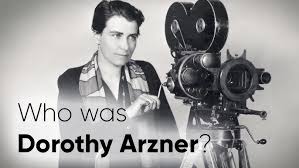
In 1929, Hollywood was in the throes of a technological revolution: the transition to sound. Most directors struggled with the bulky, stationary microphones that limited actors to standing in one spot. Dorothy Arzner, a former editor who had just been handed her first sound film, reportedly solved the problem by mounting a microphone on a fishing rod and dangling it over the actors’ heads—an early version of the boom mic. Whether or not the story is entirely true, it captures the ingenuity of a woman who repeatedly found creative solutions to the obstacles placed in her path.
Arzner directed about 20 feature films between 1927 and 1943, making her the only woman directing movies in Hollywood’s studio system during the 1930s. She was the first woman to join the Directors Guild of America, and she directed Katharine Hepburn, Lucille Ball, and Rosalind Russell in some of their most memorable roles. Then she vanished from the industry’s memory—until feminist film scholars in the 1970s rediscovered her work and re-established her as a pioneering filmmaker whose films still resonate today.
From Typist to Director
Arzner’s path to the director’s chair was anything but typical. She started at Paramount as a script typist, then moved up to script clerk, and then to editor. Her editing skills—she was known for her technical precision—earned her a promotion to director when the studio needed someone to take over a silent film, Fashions for Women (1927).
She didn’t just survive in the male-dominated industry; she thrived. Arzner was known for delivering films on time and on budget, a reputation that kept her employed even as other women directors were pushed out. She worked primarily at Paramount, then at RKO and Columbia, navigating the rigid studio system where directors were essentially contract employees with little creative freedom.
The Sound Innovation (and the Dispute)
When Arzner directed The Wild Party (1929), starring Clara Bow, she faced a unique challenge: the technology for sound film was primitive. Microphones were fixed in place, often hidden in props, which meant actors had to stay close to them to be heard. This severely limited their movement and made scenes feel static.
Arzner’s solution, according to legend, was to attach a microphone to a long pole—essentially inventing the boom microphone. This allowed actors to move more freely while still being recorded. Some film historians dispute this claim, pointing out that other crew members may have developed similar devices around the same time. But the story persists, and it illustrates Arzner’s willingness to think outside the box to get the best performance from her actors.
A Body of Work with a Feminist Edge
Arzner’s films often centered on women’s lives, and she approached them with a perspective that was rare for the era. In Christopher Strong (1933), Katharine Hepburn plays an aviator who has an affair with a married man and ultimately dies by suicide—a tragic ending that was typical for women in Hollywood films, but Arzner frames it with a sense of consequence and critique rather than simple moralizing.
Her most studied film today is Dance, Girl, Dance (1940), starring Lucille Ball as a ballet dancer and Maureen O’Hara as a burlesque performer. The film includes a famous scene where O’Hara’s character, Judy, confronts the male audience that has been leering at her. She delivers a speech that directly challenges the male gaze: “You’re all of you—you’re all of you—wrong!” It’s a moment that feels decades ahead of its time and has made the film a cornerstone of feminist film theory.
The Limitations of a “Compromised” Career
For all her achievements, Arzner’s career was not without its constraints. She directed only about 20 films over 16 years—a modest output compared to her male peers. Many of her assignments were “women’s pictures,” a genre that was often dismissed by critics as melodrama. Some scholars argue that her legacy has been inflated by feminist critics who read subversion into every frame, and that her work is actually uneven in quality.
The tension between the “barrier-breaker” and the “compromised career” narratives is real. Arzner did open doors, but she also worked within a system that limited what she could do. She often had to fight for projects, and she left studio directing in 1943 after a dispute with Columbia Pictures over The Man Who Wouldn’t Talk. Her retirement from features was not entirely voluntary.
Leaving Hollywood, Shaping Future Filmmakers
After leaving the studio system, Arzner directed training films for the Women’s Army Corps during World War II. Then, in the late 1940s, she became the first woman to teach film at UCLA. Her students included Francis Ford Coppola and Eleanor Coppola, among others. She passed on her knowledge to a new generation, even as her own contributions were being forgotten.
Rediscovery and Legacy
The 1970s brought a renewed interest in Arzner’s work, thanks to feminist film scholars like Claire Johnston, Pam Cook, and Judith Mayne. They argued that Arzner’s films offered a unique perspective on female subjectivity and gender performance, and they placed her in the canon of important directors. This revival was part of a broader movement to recover the contributions of women artists who had been marginalized by history.
Today, Arzner is recognized as a trailblazer—not just for being a woman in a male-dominated field, but for making films that challenged gender norms in subtle and not-so-subtle ways. Her work is studied in film courses, and her influence can be seen in the work of contemporary women directors who, like her, have had to navigate a system that often doesn’t make room for them.
Dorothy Arzner’s story is not a simple tale of triumph. She was a pioneering woman in a field that didn’t want her, and she made films that pushed back against the constraints of her time. Her legacy is complicated—she was both a barrier-breaker and a product of a system that limited her. But that complexity is precisely what makes her worth remembering. She didn’t just break through; she left a body of work that still has the power to challenge and inspire.
Summary
- Dorothy Arzner was the only woman directing films in Hollywood’s studio system during the 1930s, directing about 20 features from 1927 to 1943.
- She started as a script typist and worked her way up through editing to become a director, a rare path in the studio era.
- Arzner reportedly invented the boom microphone for her first sound film, The Wild Party (1929), though the claim is disputed.
- Her films, especially Dance, Girl, Dance (1940), are now studied for their feminist critique of the male gaze.
- After leaving Hollywood in 1943, she taught at UCLA, where her students included Francis Ford Coppola, and she was rediscovered by feminist scholars in the 1970s.
FAQ
Q: How many films did Dorothy Arzner direct?
A: She directed approximately 20 feature films between 1927 and 1943, including The Wild Party, Christopher Strong, Dance, Girl, Dance, and Craig’s Wife.
Q: Did Dorothy Arzner really invent the boom microphone?
A: The story is that she mounted a microphone on a fishing rod to allow actors to move freely during the filming of The Wild Party (1929). While some film historians dispute this, the anecdote is widely cited.
Q: What is Dorothy Arzner’s most famous film?
A: Dance, Girl, Dance (1940) is her most studied film today, particularly for its feminist critique of the male gaze in a famous scene where the protagonist confronts the male audience.
Q: Why did Dorothy Arzner leave Hollywood?
A: She left feature directing in 1943 after a dispute with Columbia Pictures over the film The Man Who Wouldn’t Talk. She then directed training films for the Women’s Army Corps during WWII.
Q: Where did Dorothy Arzner teach?
A: She taught film at UCLA, where she was the first woman in the film department. Her students included Francis Ford Coppola and Eleanor Coppola.
Leave a Reply