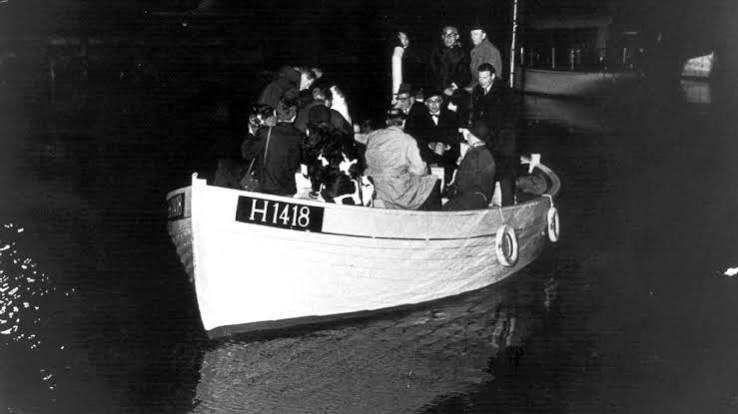
In the early hours of October 2, 1943, as German troops began their roundup of Danish Jews, the streets of Copenhagen were eerily quiet. The homes they targeted were empty. A leak had triggered the largest single act of rescue in the Holocaust—a desperate, improvised ferry operation that would carry 7,200 Jews and 700 of their non-Jewish relatives across the narrow Øresund strait to safety in Sweden. This is the story of how a small nation, under occupation, chose solidarity over compliance.
A Warning in the Night
The deportation order came from SS-General Werner Best on September 28, 1943, timed for the night of October 1–2—Rosh Hashanah, when Jewish families would be gathered at home. But Best, skeptical of the operation’s practicality, made a calculated move: he leaked the plan to Georg Duckwitz, a German maritime attaché who had deep ties to Danish politicians. Duckwitz, who would later be honored by Yad Vashem as Righteous Among the Nations, passed the warning to Hans Hedtoft, a Social Democratic leader. Within hours, a network of synagogues, community leaders, and ordinary citizens began spreading the alarm.
A Government That Said No
Denmark’s unique position under occupation made this possible. When Germany invaded on April 9, 1940, they granted Denmark a lenient “model protectorate” status: the government stayed in office, the king remained, and the parliament continued to function. In exchange for agricultural exports, Danes retained internal autonomy. Crucially, the government refused to enact anti-Jewish laws. When the Germans pushed, Danish officials stalled, citing constitutional obstacles. No Danish Jew was forced to wear a yellow star. No Danish Jew was deported before 1943. This was not a policy of resistance—it was a policy of quiet obstruction that preserved a fragile normalcy.
The arrangement collapsed in August 1943 when the Danish government resigned rather than accept German demands for the death penalty for saboteurs. Martial law followed, and Berlin pressed for action. Best’s leak was a cynical move: he could report compliance to Berlin while avoiding a political disaster that might cripple Denmark’s cooperation. The result was a three-week window of chaotic, heroic improvisation.
The Great Ferry
The Øresund strait is narrow—as little as 4 kilometers wide at some points—but heavily patrolled by German naval vessels. Fishermen, doctors, police, and clergy turned their communities into waystations. Jews were hidden in private homes, hospitals, and churches, then moved to coastal towns like Gilleleje, Snekkersten, and Dragør. From there, they were ferried across in fishing boats, rowboats, and even canoes.
Some fishermen charged exorbitant fees; others worked for free. The resistance soon stepped in to regulate prices, ensuring that no one was turned away for lack of money. The Danish police, who largely refused to cooperate with the Germans, often warned Jews of impending raids. German patrols were sometimes lax, but the danger was real: patrol boats, mines, and the risk of betrayal hung over every crossing.
Sweden, which had officially offered asylum on October 2, became the beacon. The Swedish government publicly announced it would accept all Danish Jews, a crucial signal that encouraged the operation and reassured those who hesitated.
The Numbers: Rescue and Tragedy
By the end of October, approximately 7,200–7,800 Jews and 700 non-Jewish relatives had reached Sweden. The commonly cited “7,000” is a rounded approximation—the actual figure is higher. But not everyone escaped. About 480–500 Jews were captured and deported to Theresienstadt concentration camp. Sustained Danish political pressure and Red Cross interventions ensured that all but roughly 50 of them survived the war. Compared to the fate of Jews elsewhere in occupied Europe, this survival rate was nothing short of extraordinary.
Myths and Realities
A popular story claims that King Christian X wore a yellow star in solidarity with Danish Jews. It is not true. There is no historical evidence for this, and Danish Jews were never required to wear the star. The king’s role was symbolic and supportive—he remained in the country and his presence buttressed Danish morale—but the rescue was carried out by ordinary Danes, not royal decree.
Another misconception is that the rescue happened overnight. In fact, it unfolded over several weeks, with the most intense activity in the first 48 hours after the leak. The “overnight” framing captures the urgency but obscures the sustained effort required to move thousands of people across a heavily guarded strait.
Why Denmark Acted
The Danish Jewish community was tiny—about 7,500–8,000 people, largely assimilated, middle-class, and integrated into civic life. This integration was key. When the roundup began, Jews were not strangers; they were neighbors, colleagues, and friends. The rescue was not a single organized operation but a spontaneous, collective act of defiance. It is a reminder that under the right conditions, ordinary people can choose decency over complicity—and that even a small nation can make an outsized difference.
The rescue of the Danish Jews was not a single night’s work, but it was a single decision: that Denmark would not hand its Jewish citizens over. It was a decision made by fishermen, doctors, and homemakers, often at great personal risk. And it was a decision that, for a brief moment, turned the machinery of genocide into a story of human solidarity. That story endures not as a myth, but as a challenge—a reminder that resistance is possible, even in the darkest times.
Summary
- In October 1943, approximately 7,200–7,800 Danish Jews and 700 non-Jewish relatives were ferried across the Øresund strait to neutral Sweden, with the most intense activity in the first 48 hours after a leak of the deportation order.
- The rescue was triggered by a warning from German maritime attaché Georg Duckwitz, who leaked the plan to Danish politician Hans Hedtoft, sparking a community-wide alert network.
- Denmark’s unique “model protectorate” status (1940–1943) meant the Danish government remained in office and refused to enact anti-Jewish laws, allowing a culture of quiet obstruction to develop.
- The escape involved hundreds of ordinary Danes—fishermen, police, clergy, and civilians—who hid Jews and transported them across the strait, despite German naval patrols.
- About 480–500 Jews were captured and deported to Theresienstadt, but due to Danish political pressure and Red Cross interventions, all but ~50 survived.
- The story of King Christian X wearing a yellow star is a myth; the rescue was carried out by ordinary Danes, not royal symbolism.
FAQ
Q: Did King Christian X really wear a yellow star to show solidarity?
A: No. There is no historical evidence for this story. Danish Jews were never required to wear the yellow star, and the king’s role was symbolic, not heroic in that specific way. The rescue was carried out by ordinary Danes.
Q: How many Jews were rescued, and how many were deported?
A: Approximately 7,200–7,800 Jews and 700 non-Jewish relatives were rescued to Sweden. Around 480–500 were captured and deported to Theresienstadt; of those, all but about 50 survived.
Q: Why did the Germans deport Danish Jews only in 1943?
A: The deportation was triggered by the Danish government’s resignation in August 1943, which ended the cooperative “model protectorate” status. Under martial law, SS-General Werner Best was pressured by Berlin to act, but he leaked the plan to avoid a political disaster—a calculated move that enabled the rescue.
Q: What role did Sweden play?
A: Sweden publicly announced it would grant asylum to all Danish Jews, which was crucial. This official welcome encouraged the operation and gave escapees a clear destination.
Q: Was the rescue really an “overnight” operation?
A: No. While the initial warning and first wave of escapes happened within 48 hours, the full rescue unfolded over several weeks in October 1943. The “overnight” framing simplifies a sustained, complex effort.
Leave a Reply