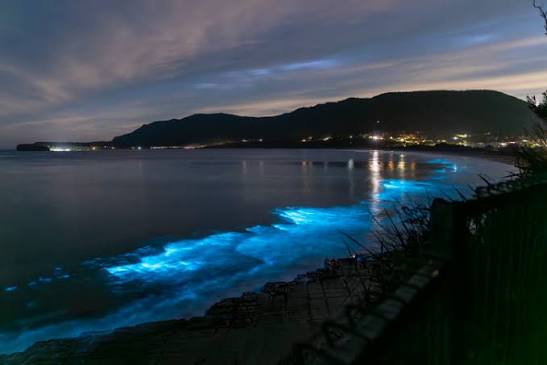
Imagine dipping your hand into the ocean and watching it ignite with blue sparks. That’s not magic it’s chemistry. In a few rare bays around the world, water literally lights up when disturbed. The effect is so bright that swimmers look like they’re trailing liquid stars.
These are bioluminescent bays, or bio bays. They’re among the rarest ecosystems on Earth, with fewer than ten consistent examples worldwide. The most famous is Mosquito Bay in Puerto Rico, certified by Guinness World Records as the brightest. But what makes these bays glow? It comes down to tiny single-celled organisms, a chemical reaction, and a very special set of environmental conditions.
Meet the Glowing Plankton: Pyrodinium bahamense
The main light-makers in tropical bio bays are dinoflagellates single-celled plankton that drift in the water. The star species is Pyrodinium bahamense. In a healthy bay, you might find over a million of these cells in a single liter of water. That’s like a million tiny flashlights packed into a milk carton.
Each dinoflagellate contains a small amount of a light-emitting pigment called luciferin and an enzyme called luciferase. When the water is still, these two chemicals are kept separate. But when something—a wave, a paddle, a fish—disturbs the water, it triggers a reaction. Luciferin and luciferase combine with oxygen, producing oxyluciferin and, most importantly, a photon of light.
This is how the glow happens. The reaction is incredibly efficient: almost all the energy comes out as light, not heat. That’s why it’s called “cold light.” The color is typically blue-green, around 490 nanometers, which is the wavelength that travels farthest through water.
Bioluminescent bays are a rare intersection of biology, chemistry, and geography. They remind us that even the smallest organisms can create awe-inspiring displays. But they’re also fragile. Protecting them means understanding the delicate balance that keeps them glowing—and making sure our visits don’t snuff out their light.
Summary
- Bioluminescent bays glow due to dinoflagellates like Pyrodinium bahamense.
- The light comes from a chemical reaction between luciferin and luciferase, triggered by movement.
- These bays are rare because they require a specific mix of geography, mangroves, and clean, dark nights.
- The glow is a defensive behavior, serving as a “burglar alarm” to startle predators.
- Human activities, such as pollution and light pollution, threaten these delicate ecosystems.
FAQ
Q: Why does the water glow only when you move it?nA: The dinoflagellates keep their light-producing chemicals separate until disturbed. Movement mixes them, triggering the reaction. Still water appears dark because the organisms are at rest.nnQ: Is the glow harmful to humans?nA: No, the bioluminescent dinoflagellates in these bays are not toxic to humans, unlike some red tide species. Swimming is generally safe, though it may be restricted to protect the bay.nnQ: Can you see bioluminescence during the day?nA: No, dinoflagellates only glow at night. Their bioluminescence is suppressed during daylight hours due to an internal biological clock.nnQ: Why are there so few bioluminescent bays?nA: They require a rare combination: a sheltered inlet with a narrow mouth, surrounding mangroves for nutrients, stable warm saline water, and minimal pollution and artificial light. This perfect storm occurs in only a handful of places.nnQ: What threatens bioluminescent bays?nA: Coastal development, sewage runoff, boat traffic, chemical sunscreens, and even too much artificial light can harm the dinoflagellates. Hurricanes, like Maria in 2017, can also temporarily dim the glow.
Leave a Reply