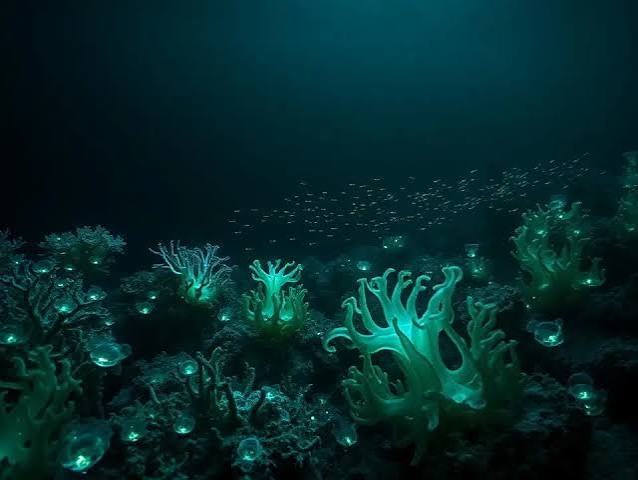
Imagine a world where darkness is absolute, yet life thrives in a silent, shimmering spectacle. Below 1,000 meters in the ocean, sunlight never reaches, and the only light comes from the creatures themselves. This is the deep sea, a realm where bioluminescence—the production of light by living organisms—is not just a curiosity but a fundamental tool for survival.
Bioluminescence is overwhelmingly a marine phenomenon. While fireflies and glowworms are familiar terrestrial examples, they are exceptions. In the ocean, an estimated 76% of species—from fish and squid to jellyfish and bacteria—can produce their own light. This glowing toolkit has evolved independently dozens of times, shaping predator-prey interactions, communication, and even the ocean’s carbon cycle. In this article, we’ll dive into the twilight zone and beyond to explore how living light rules the deep.
The Chemistry of Living Light
Bioluminescence is a chemical reaction that produces light without heat. In most marine organisms, an enzyme called luciferase acts on a substrate called luciferin, often in the presence of oxygen and ATP. The result is ‘cold light’—a glow that can be blue, green, or even red, depending on the organism.
This is a stark contrast to the warm, yellow light of a lightbulb, which wastes energy as heat. In the cold, dark depths, producing light efficiently is crucial. The chemical machinery is so effective that some organisms can control the intensity and pattern of their glow, flashing in precise sequences.
The Twilight Zone: A World of Shadows
Bioluminescence is most common in the mesopelagic zone, between 200 and 1,000 meters deep. This is the ‘twilight zone,’ where sunlight fades but is still detectable. Here, organisms use light for a variety of purposes, but one of the most ingenious is counter-illumination.
Predators below look up and see the silhouettes of prey against the dim surface light. To hide, many fish, squid, and shrimp have evolved ventral photophores—light-producing organs on their bellies that emit light matching the intensity and color of the downwelling sunlight. This effectively erases their silhouette, making them invisible from below. It’s a form of camouflage that requires constant adjustment as the light changes with depth and time of day.
Defense: Light as a Weapon
Bioluminescence is also a powerful defense mechanism. Some species use decoy lures: the vampire squid, for instance, emits glowing mucus that distracts predators while the squid escapes. Others use a ‘burglar alarm’ strategy: when attacked, they flash brightly, attracting even larger predators to the attacker. This is a risky move, but it can turn the tables on a would-be predator.
Some organisms go a step further. The anglerfish, for example, uses a bioluminescent lure (the esca) to attract prey right to its jaws. The lure glows in the darkness, and the fish waits patiently, invisible except for that tiny, tempting light.
Communication and Reproduction
In the lightless depths, bioluminescence is the primary medium for communication. Species-specific flashing patterns allow individuals to find mates, coordinate schools, and signal territory. The firefly squid (Watasenia scintillans) takes this to an extreme: each spring, millions of squid gather in Toyama Bay, Japan, to spawn, creating a spectacular glowing display that can be seen from the surface.
These light shows are not just beautiful—they are essential for reproduction. In a vast, dark ocean, finding a mate is a monumental challenge. A flash of light can be a beacon that says, ‘I am here, and I am ready.’
The Deepest Glow: Record-Holders and Mysteries
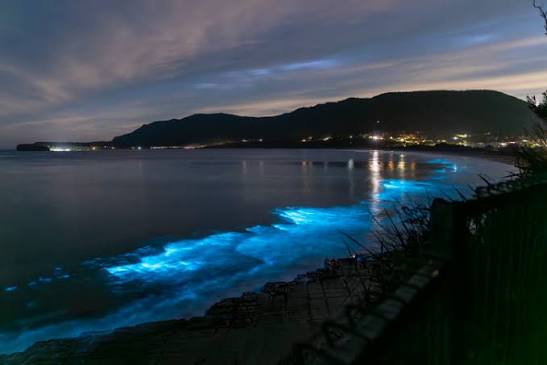
The deepest known bioluminescent fish live at around 4,000 meters, where the pressure is crushing and the darkness is absolute. Yet even here, light is produced. And at the surface, there is the phenomenon of ‘milky seas’—massive patches of glowing water, sometimes covering thousands of square kilometers, caused by luminous bacteria. These are rarely observed, but satellite imagery confirmed their existence in 1995 and 2005.
These milky seas are a reminder of how little we know about the deep sea. The ocean is the largest habitat on Earth, but we have explored only a fraction of it. As technology advances—with submersibles, low-light cameras, and DNA sequencing—we are discovering new bioluminescent species and novel chemical pathways.
Why So Many? The Evolution of Light
Bioluminescence has evolved independently at least 40 to 50 times in marine lineages. This is a classic example of convergent evolution: different organisms, facing similar challenges in the dark, have arrived at the same solution—light production.
The chemical diversity is staggering. While many marine animals use a compound called coelenterazine, some use different luciferins, and others rely on symbiotic bacteria, like Vibrio fischeri in the Hawaiian bobtail squid. This bacteria-host relationship is a model for quorum sensing, a form of bacterial communication.
Some animals even acquire luciferin from their diet. Krill-eating fish, for example, may get the necessary chemicals from their prey, effectively recycling the glow.
A Window into Ecosystems
Bioluminescence is not just a biological curiosity—it has practical applications. Recent studies have shown that bioluminescent signals can be used to estimate the biomass of mesopelagic fish, which play a crucial role in the ocean’s carbon cycle. By understanding where and when organisms glow, scientists can better understand the health and dynamics of the deep sea.
The deep sea is a world of extremes, and bioluminescence is its language. From the anglerfish’s lure to the firefly squid’s courtship display, light is the thread that weaves life together in the darkness. As we continue to explore, we are sure to uncover even more secrets of this living light.
The deep sea is not a silent, lifeless void—it is a vibrant, glowing ecosystem where light is the currency of survival. Bioluminescence has shaped the evolution of countless species, influencing how they hunt, hide, and reproduce. As we develop new tools to explore the depths, we are beginning to understand just how integral this living light is to the health of our planet. Next time you see a wave glowing with dinoflagellates, remember: you are witnessing a phenomenon that dominates the largest habitat on Earth.
Summary
- Bioluminescence is the production of light by living organisms, most commonly in the ocean, with ~76% of marine species capable of glowing.
- The mesopelagic zone (200–1,000 m) is where bioluminescence is most prevalent, used for counter-illumination, defense, predation, and communication.
- Bioluminescence has evolved independently at least 40–50 times, showcasing convergent evolution.
- Notable examples include the anglerfish’s lure, vampire squid’s glowing mucus, and the firefly squid’s mating displays.
- Deep-sea bioluminescence is now studied using advanced technology, with recent discoveries of new species and potential biomedical applications.
FAQ
Q: What is bioluminescence?
A: Bioluminescence is the production and emission of light by a living organism through a chemical reaction. In most marine organisms, this involves the enzyme luciferase acting on a substrate luciferin, producing ‘cold light’ without heat.
Q: How common is bioluminescence in the ocean?
A: It is very common: an estimated 76% of marine species, including fish, squid, jellyfish, crustaceans, and bacteria, are bioluminescent. In contrast, terrestrial bioluminescence is rare.
Q: Why is bioluminescence more common in the deep sea?
A: In the deep sea, where sunlight is absent or very dim, light becomes a valuable resource for communication, predation, and defense. The dark environment creates strong selective pressure for organisms to evolve light-producing capabilities.
Q: What is counter-illumination?
A: Counter-illumination is a camouflage technique where organisms that live in the mesopelagic zone emit light from their ventral side to match the downwelling sunlight, making their silhouettes invisible to predators below.
Q: Can bioluminescence be used for scientific research?
A: Yes, bioluminescent signals can be used to estimate biomass of mesopelagic fish, and bioluminescent proteins (like luciferase) are used in biomedical research as markers. Recent discoveries of new luciferases have potential applications in imaging and diagnostics.