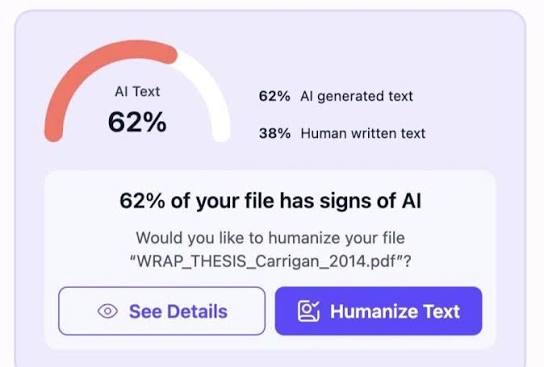
Since ChatGPT launched in November 2022, a new question has crept into our digital lives: “Is this AI-written?” Whether you’re a teacher grading essays, a recruiter reading cover letters, or just someone scrolling through social media, you’ve probably wondered which parts of the internet were crafted by a human and which were generated by a machine. Google searches for “AI detector” and “how to tell if text is AI-generated” have skyrocketed, and a whole industry of detection tools has sprung up to answer the call. But here’s the uncomfortable truth: these detectors are far from perfect, and the race to catch AI-generated text is more complicated than it seems.
The Surge in AI Detection Searches
Interest in AI detection exploded right after ChatGPT went public. Before November 2022, almost nobody was searching for “AI detector.” Now, millions of people are trying to figure out if the text they’re reading or writing is machine-made. This interest has stayed high, with spikes whenever a new AI model like GPT-4 or Gemini hits the market.
Why the sudden concern? Because AI-generated content has flooded the internet. From blog posts and product reviews to academic papers and news articles, machines are now writing at scale. This has created what some call an “authenticity crisis”: we can no longer assume that words were written by a human. That matters for trust in journalism, fairness in education, and even personal communication like dating profiles and emails.
How Do AI Detectors Actually Work?
Most detectors rely on two main signals: perplexity and burstiness. Perplexity measures how “surprised” a language model is by a piece of text. AI-generated text tends to be more predictable, so it has lower perplexity. Burstiness looks at variation in sentence length and structure. Humans naturally mix long and short sentences, while AI text tends to be more uniform.
Some newer tools use watermarking, which involves embedding invisible statistical patterns in AI output. But that only works if the AI provider cooperates, and it’s not widely deployed yet.
The Problem: Detectors Are Not Reliable
Here’s the catch: no AI detector is definitively reliable. OpenAI itself shut down its AI Classifier in July 2023, admitting it had a “low rate of accuracy.” Independent studies have found that detectors frequently misclassify non-native English writing as AI-generated. This has real consequences. Students have been falsely accused of cheating, and freelance writers have lost clients because a detector flagged their human-written work.
The tools claim accuracy rates of 80–99%, but those numbers are contested. In practice, the results can be wildly inconsistent. A text that one detector flags as AI-written might be cleared by another. And as AI models improve, they get better at mimicking human quirks, making detection even harder.
The Arms Race Between Detectors and AI
This is a cat-and-mouse game. As detectors get better, AI models are trained to produce more “human-like” text. Users also use paraphrasing tools to evade detection. It’s a continuous loop: one side builds a better trap, the other side finds a way around it.
Some researchers argue that reliable detection is fundamentally impossible in the long run. As models improve, AI text will become indistinguishable from human text. They advocate for a shift from detection to provenance—cryptographic signing of human-authored content. That way, you could verify a human wrote something, rather than trying to guess if a machine did.
Who’s Searching, and Why?
Different groups search for AI detection for different reasons:
- Students and educators: Teachers want to catch AI-generated essays; students want to avoid false accusations.
- Employers and recruiters: They check whether cover letters or resumes were AI-written.
- Content consumers: People want to know if news articles, reviews, or social media posts are machine-made.
- Writers and creators: They self-check their own work to make sure it passes filters, especially for SEO or academic submission.
The Educator’s Dilemma
Teachers and professors are on the front lines. Many see AI detection as a necessary tool to preserve academic integrity. But false positives are a major frustration. Students who write in a straightforward, formulaic style—especially non-native English speakers—are often flagged as AI, even when their work is entirely human.
Some educators argue that detection is the wrong approach entirely. They say education should adapt to an AI world by emphasizing the process over the product: in-class writing, oral defenses, and project-based assessments. This might be a more sustainable solution than an endless technological arms race.
The Student’s Double Bind
Students face a tough situation. Many use AI as a legitimate learning tool—for brainstorming, outlining, or grammar checking. But they fear being falsely accused of cheating. Some report being forced to “prove” their humanity, which is an absurd burden to place on a student.
Non-native English speakers are disproportionately affected. Their natural writing style often triggers false positives, which is deeply unfair. Imagine writing an essay in a second language, only to be told it’s too “robot-like” to be human.
The Writer’s Burden of Proof
Freelance writers and journalists are also caught in the crossfire. Clients increasingly ask them to run their work through AI detectors, even when the work is entirely human-written. This creates a burden of proof and can lead to lost income if a detector falsely flags their work. It’s a strange world where a human has to prove they’re not a machine.
Platform Responses: Labeling and Enforcement
Major platforms like Google, Meta, and TikTok have started requiring or encouraging AI-content labeling. But enforcement and detection remain inconsistent. Google has said it will penalize “scaled content abuse,” meaning mass-produced AI content that manipulates search rankings. But distinguishing between helpful AI-assisted writing and spam is tricky.
As AI-generated content becomes more common, platforms will need clearer policies. But given the unreliability of detectors, any automated enforcement will likely have false positives and negatives.
What Should You Do?
If you’re trying to decide whether a piece of text is AI-written, here’s some practical advice:
- Don’t rely solely on detectors. Use them as one signal, not the final word.
- Look for context clues. Is the text unusually uniform in tone? Does it lack personal anecdotes or specific examples? These can be hints, but they’re not definitive.
- Consider the source. If the content comes from a known AI-heavy site, it’s more likely AI-written.
- When in doubt, ask. If you’re an educator, have a conversation with the student. If you’re a recruiter, talk to the candidate. A human conversation can reveal authenticity better than any algorithm.
The Future: Detection vs. Provenance
The AI detection industry is booming, but its future is uncertain. As AI models get better, detectors will struggle to keep up. The most promising long-term solution might be provenance: a way to cryptographically sign human-authored content, so we can verify origin rather than guess.
For now, the honest answer to “Can you tell if text was written by AI?” is: sometimes, but not reliably. The tools are improving, but they’re not perfect. And as the arms race continues, the question itself might become obsolete.
The surge in searches for “is this AI-written” reflects a real shift in how we consume and produce text. AI detectors are helpful tools, but they’re not infallible. The best approach is to use them with caution, combine them with human judgment, and push for broader solutions like provenance. As AI becomes even more integrated into our lives, the ability to navigate this new landscape with critical thinking will matter more than any single detection tool.
Summary
- Google searches for AI detection terms have surged since ChatGPT’s release, with interest remaining high.
- Detectors use perplexity and burstiness to identify AI text, but these methods are unreliable and often produce false positives.
- OpenAI shut down its own AI Classifier due to low accuracy, and studies show detectors disproportionately flag non-native English writing.
- Different groups—educators, students, employers, writers—use detectors for various reasons, but many face unfair consequences from false positives.
- The long-term solution may be provenance (cryptographic signing) rather than detection, but for now, we must use detectors with caution.
FAQ
Q: How accurate are AI detectors?
A: Most detectors claim 80–99% accuracy, but these claims are contested. Independent studies have found significant error rates, especially for non-native English speakers. OpenAI’s own classifier was shut down due to low accuracy.
Q: Can I get falsely accused of using AI?
A: Yes. Many students and writers have been falsely flagged by detectors. False positives are a known issue, particularly for text that is clear, formulaic, or written by non-native speakers.
Q: What’s the difference between perplexity and burstiness?
A: Perplexity measures how predictable the text is to a language model. Burstiness measures variation in sentence length and structure. AI text tends to have lower perplexity and burstiness than human writing.
Q: Will AI detectors ever be perfect?
A: Many researchers doubt it. As AI models improve, they become better at mimicking human writing. Some argue that reliable detection is impossible in the long run, and we should focus on provenance instead.
Q: What should I do if my work is flagged as AI?
A: If you wrote the text yourself, you can explain the context, show drafts or notes, and discuss your process. Tools like history logs or timestamps can also help prove authorship.
Leave a Reply