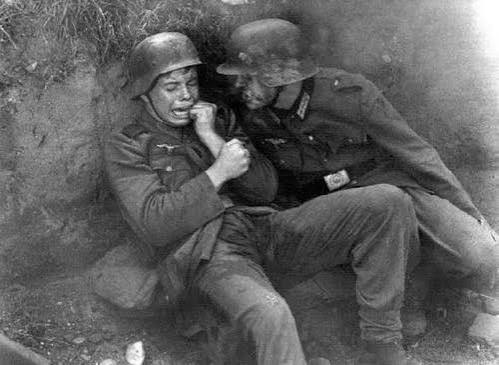
In 1926, Ernest Hemingway opened The Sun Also Rises with a line he’d heard from Gertrude Stein: “You are all a lost generation.” The phrase captured a cohort that had survived the Great War but seemed permanently adrift. Yet behind the literary glamour of Paris cafés lay a more painful reality: millions of veterans returned home with minds shattered by what they’d seen. The war didn’t end for them at the Armistice—it followed them into peacetime.
The War That Broke the Mind
World War I mobilized about 65 million men across all belligerent nations. The death toll—between 8.5 and 10 million—was staggering, but the wounded numbered more than twice that: 21 to 23 million. Among those wounded were tens of thousands whose injuries weren’t visible.
The British Army alone recorded over 80,000 official cases of “shell shock” by 1918, and some estimates put the true figure at 200,000. France and Germany saw comparable numbers, though incomplete records make exact counts impossible.
Before the war, military psychiatry barely existed. The prevailing view held that psychological collapse in battle reflected cowardice or weak character. Punitive treatment was standard: courts-martial, imprisonment, or worse. The British executed 306 soldiers for desertion or cowardice, many of whom likely suffered from shell shock.
The war itself was unlike anything before. Industrialized, attritional warfare meant weeks in muddy trenches under constant artillery bombardment. Soldiers witnessed comrades blown apart, lived in filth, endured sleep deprivation, and faced death from unseen enemies. The scale of trauma was unprecedented.
The Shell Shock Debate
Initially, doctors believed shell shock was a physical injury—microscopic damage to the brain or spinal cord from exploding shells. The term itself, coined by British psychologist Charles Samuel Myers in 1915, reflected this theory.
But by 1916–17, physicians realized many cases occurred in men who had never been near an explosion. This forced a shift toward psychological explanations, though the name stuck.
Class bias permeated diagnosis and treatment. Officers were more likely to receive a diagnosis of “neurasthenia”—a respectable nervous condition—and were sent to rest homes. Enlisted men were more often labeled “hysterical” or “cowardly” and treated harshly.
Treatments: From Talking Cure to Torture
Britain’s Dr. W.H.R. Rivers pioneered a “talking cure” at Craiglockhart War Hospital, using dream analysis to treat officers—including poets Siegfried Sassoon and Wilfred Owen. Other approaches included hypnosis, electrical stimulation, rest, and occupational therapy.
France took a similar path, with Dr. Jean Lhermitte using “persuasion” and re-education. Germany was more brutal: some doctors used “active therapy,” exposing patients to war sounds, while others applied painful electrical shocks to “cure” malingerers.
The U.S. initially denied shell shock existed, but after entering the war in 1917, adopted British methods. Thomas Salmon, the AEF’s chief psychiatrist, advocated for “forward psychiatry”—treating men close to the front with rest and reassurance so they could return to duty quickly.
The Post-War Fallout
When the guns fell silent on November 11, 1918, veterans returned to societies eager to forget. Pensions for psychological disability were often denied or minimal. Suicide rates among veterans spiked in the 1920s and 1930s across Britain, France, Germany, and the U.S.
Many veterans remained institutionalized for decades. In the U.S., the Veterans Bureau (later the VA) reported that over 50% of its hospital beds in the 1920s were occupied by neuropsychiatric cases.
The Great Depression compounded the misery. Economic collapse left many veterans destitute, with no support from governments that preferred to move on.
A Generation’s Literary Echo
The psychological toll found expression in literature. Hemingway, F. Scott Fitzgerald, T.S. Eliot, and others wrote of disillusionment and fragmentation. Eliot’s The Waste Land (1922) and Hemingway’s The Sun Also Rises (1926) captured a generation’s alienation.
These works weren’t just artistic statements—they were testimony. The “Lost Generation” label stuck because it described something real: men and women who had seen too much, too young, and couldn’t find their way back to normal life.
The Legacy
Today, we recognize shell shock as a combination of PTSD, combat fatigue, survivor’s guilt, and moral injury. The term itself faded, but the condition didn’t. The war’s psychological casualties were the first mass demonstration that war breaks minds as surely as bodies.
The Lost Generation’s experience reshaped military psychiatry and public attitudes toward mental health. But for the veterans themselves, the war was never truly over. They carried it with them, as Hemingway wrote, “in all the ways you can’t talk about.”
The Lost Generation’s psychological scars were not a metaphor—they were measured in hospital beds, suicide rates, and broken lives. The war didn’t end in 1918; it persisted in the minds of millions. Recognizing shell shock as a legitimate wound was the first step, but for many veterans, healing never came. Their story remains a sobering reminder of war’s true cost.
Summary
- Shell shock affected hundreds of thousands of WWI veterans; the British Army alone recorded 80,000+ cases.
- Initial theories blamed physical injury, but psychological explanations emerged by 1916–17.
- Treatment varied widely, from talking cures to brutal electrical shocks, reflecting class and national biases.
- Post-war, many veterans faced denied pensions, institutionalization, and rising suicide rates.
- The literary works of the Lost Generation captured this psychological fragmentation for posterity.
FAQ
Q: What was ‘shell shock’?
A: Shell shock was a term coined during WWI to describe psychological breakdown in soldiers. It’s now understood as a combination of PTSD, combat fatigue, survivor’s guilt, and moral injury.
Q: How many soldiers suffered from shell shock?
A: The British Army recorded over 80,000 official cases, with estimates up to 200,000. France and Germany had comparable numbers, though records are incomplete.
Q: How was shell shock treated?
A: Treatments varied: Britain used talking cures and rest; France used persuasion; Germany used sometimes brutal methods like electric shocks. The U.S. favored forward psychiatry near the front.
Q: Why is it called the ‘Lost Generation’?
A: The term was popularized by Gertrude Stein and used by Hemingway in The Sun Also Rises. It refers to the generation that came of age during WWI, marked by disillusionment and psychological damage.
Q: What happened to shell-shocked veterans after the war?
A: Many faced denied pensions, institutionalization, and higher suicide rates. Over 50% of VA hospital beds in the 1920s were occupied by neuropsychiatric cases.
Leave a Reply