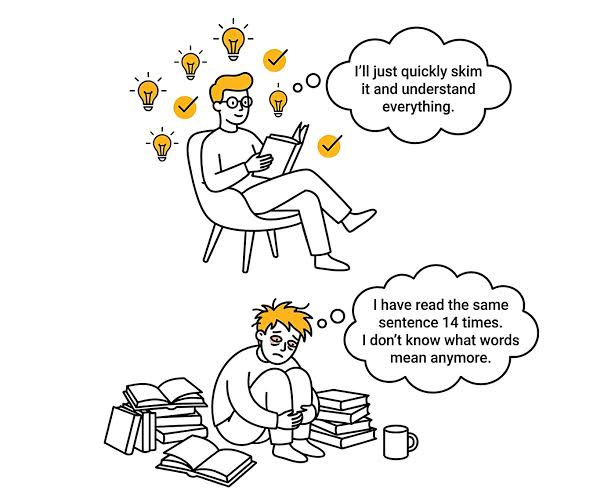
You’ve got a stack of unread books on your nightstand, and it’s weighing on you. The guilt is real—you bought them with good intentions, but there’s simply not enough time to read every page. What if you didn’t have to?
Skimming—the rapid extraction of main ideas, key arguments, and structural highlights—is a technique that many successful professionals, academics, and thinkers use to get through more books in a fraction of the time. It’s not speed reading, and it’s not scanning for a specific fact. It’s a strategic approach to reading that prioritizes understanding over completion.
In this article, we’ll explore why skimming is not only acceptable but often more effective than full reading, especially for nonfiction. You’ll learn how to do it well, and you’ll see why the guilt you feel is a psychological relic that no longer serves you.
The Case for Skimming
Time is finite, books are abundant
Imagine you live to be 80 and read one book a week, every week. That’s roughly 4,000 books. It sounds like a lot, but there are millions of books in print, and new ones are published every day. The average person will never even come close to reading a tiny fraction of them.
Skimming changes the math. By spending 20–30 minutes on a book instead of 8–10 hours, you can cover 10–20 times more books. That means you’re far more likely to stumble upon the one idea that changes how you think or work. As venture capitalist Naval Ravikant puts it, “I’d rather read 100 books and get one great idea than read one book cover-to-cover and get nothing.”
Most books are padded
The publishing industry has a dirty secret: many nonfiction books are deliberately stretched to hit a marketable page count. A solid 30-page article’s worth of content gets blown up into a 250-page book. Tim Ferriss has openly said that he often reads a book’s table of contents, introduction, and conclusion, and skims the rest, because that’s where the substance lives.
So when you skim, you’re not cheating—you’re cutting through the filler to get to the actual value. The author’s main thesis can usually be found in the introduction, the conclusion, and the first and last sentences of each chapter. Good writers signpost their work; skimming is just following the signs.
Your memory is already leaky
Here’s a hard truth: you forget most of what you read anyway. Studies on the forgetting curve show that without active review, we lose a large portion of new information within days or weeks. So reading a book cover-to-cover doesn’t guarantee retention—it just takes longer to lose.
Skimming gets you the gist, and if the gist is valuable, you can go back and read deeply. If not, you’ve saved hours. Research on comprehension (like the 2016 review in Psychological Science in the Public Interest) shows that comprehension drops at very high speeds, but skimming for gist-level understanding of expository texts can be nearly as effective as full reading. You’re not losing as much as you fear.
The Psychology of the “Completion Bias”
So why does the idea of not finishing a book feel so uncomfortable? It’s the Zeigarnik effect—our brain’s tendency to obsess over unfinished tasks. We’re wired to want closure. That unfinished book on your shelf is like an open loop in your mind, nagging at you.
But this psychological bias is not rational. It’s the same reason people binge-watch mediocre TV shows to the end—they’ve invested time, and they want to finish. But with books, the investment is much larger, and the opportunity cost is huge. Every hour you spend finishing a mediocre book is an hour you could have spent on a genuinely transformative one.
Adler himself, in his classic How to Read a Book, called the first pass “inspectional reading”—a quick skim to decide if a book deserves deeper attention. He didn’t advocate reading everything deeply; he advocated tiered reading, where most books get a superficial pass and only the best get full focus.
How to Skim Effectively (Without Feeling Guilty)
Step 1: The pre-read (5 minutes)
Read the title, subtitle, table of contents, and the back cover. These are the author’s own summary of what the book is about. If the book has an introduction or preface, read that too—it usually lays out the main argument.
Step 2: The structural skim (15–20 minutes)
Flip through the chapters. Read the first and last paragraphs of each chapter, and scan the headings, bolded terms, and any lists or callouts. This gives you the skeleton of the book. You’ll know the main points and how they’re organized.
Step 3: The targeted deep dive (optional)
Now decide: does this book deserve a full read? If yes, go back and read the chapters that were most interesting, or that you didn’t fully grasp. If no, you’re done. You’ve extracted the core value, and you can move on with a clear conscience.
Some people take notes during the skim—a few bullet points per chapter, or a mind map. This helps retention and creates a “second brain” that you can revisit later.
The Traditionalist’s Objection
Of course, not everyone agrees. Traditionalists argue that skimming loses the nuance, the counterarguments, the evidence that builds the case. And they’re right—if you skim a legal document or a scientific paper, you might miss critical details. But for most nonfiction aimed at a general audience—business books, self-help, popular science—the core idea can be grasped without wading through every anecdote.
And here’s the thing: skimming is not a one-way door. You can always go back. The traditionalist’s fear is that skimming becomes a habit that prevents deep reading entirely. But that’s a misuse of the technique, not the technique itself.
The reality is that many of the most successful readers—from Mortimer Adler to Paul N. Edwards to modern productivity figures like Shane Parrish—all advocate some form of skimming. It’s not a lifehack; it’s a professional skill.
Skimming in the Age of Information Overload
Your average day contains more text than a medieval scholar encountered in a lifetime—emails, news headlines, social media, documents. The idea that you should read every book cover-to-cover is a relic from a time when books were scarce and reading was slow.
Today, books are just one of many information sources. They’re competing with podcasts, articles, and videos. Skimming is a way to keep books in the mix without sacrificing everything else. Plus, with e-readers and audiobooks at 2–3x speed, the definition of “reading” is already changing.
And if you’re worried about retention, the “second brain” movement—using tools like Obsidian, Roam, or even a simple notebook—treats books as raw material. You extract what’s useful to you, and you leave the rest. That’s not lazy; it’s smart.
The next time you pick up a book, ask yourself: why am I reading this? If the answer is “to learn something useful,” then skimming is probably the most efficient path. If the answer is “to enjoy the prose” or “to understand every nuance,” then read deeply. But don’t let the guilt of an unfinished book dictate your reading habits. Skimming isn’t a lesser form of reading—it’s a smarter one for the world we live in.
Summary
- Skimming is a strategic technique for extracting the main ideas and structure of a book, not a lazy shortcut.
- Most nonfiction books are padded; the core content can often be captured in 20–30 minutes of targeted reading.
- The Zeigarnik effect makes us feel guilty about unfinished books, but this bias is irrational—time is finite, and books are abundant.
- Studies show that comprehension for gist-level understanding is nearly as good with skimming as with full reading, while full reading doesn’t guarantee retention.
- Effective skimming involves a pre-read, a structural skim, and a targeted deep dive if needed—embrace it as a professional skill.
FAQ
Q: Is skimming the same as speed reading?
A: No. Speed reading aims to maintain comprehension at high speeds over all text, while skimming is selective reading—you intentionally skip parts to get the main ideas. Skimming is more about triage than speed.
Q: Won’t I miss important details by skimming?
A: You might miss some details, but for most nonfiction, the key arguments and takeaways are repeated and emphasized. If a book is truly dense and important, you can always go back and read it fully after skimming to decide if it’s worth the time.
Q: How do I overcome the guilt of not finishing a book?
A: Remind yourself that your goal is learning, not completion. The Zeigarnik effect makes you uncomfortable with unfinished tasks, but you can reframe it as “task completed” once you’ve extracted the value. Keep a list of books you’ve skimmed and what you learned from them to see the productivity.
Q: Can I skim fiction?
A: Generally, no. Fiction is about the experience, the prose, and the plot twists—skimming ruins the enjoyment. Skimming is best for nonfiction where the goal is information extraction.
Q: What if I skim and still don’t understand the book?
A: That’s a sign the book might be beyond your current level of background knowledge, or it’s poorly written. Try reading a summary online, or put it aside and come back later. Not every book is worth your time.
Leave a Reply