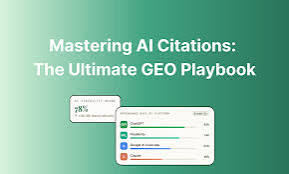
When a shopper asks ChatGPT for the best eco-friendly running shoes under $100, the answer rarely lists the biggest athletic brands. Instead, the AI often cites a niche startup with a detailed blog post and a clear spec table. That shift from blue links to AI-generated answers is creating a new competitive arena called Generative Engine Optimization (GEO).
GEO is the practice of making your content more likely to be cited by AI answer engines like ChatGPT, Perplexity, and Google AI Overviews. For small brands with limited budgets, this is more than a trend: it’s a cost-effective way to appear in front of high-intent shoppers at the exact moment they’re making a decision without paying for clicks.
What Exactly Is GEO? A Quick Definition
Generative Engine Optimization (GEO) is the process of structuring and positioning your online content so that AI-powered search tools recognize it as a credible, relevant source to quote in their answers. Unlike traditional SEO, which targets search engine result pages (SERPs) with links, GEO focuses on being the cited source inside an AI-generated response.
For example, if someone asks Perplexity, “What are the best organic cotton baby clothes?” and your brand’s blog post is quoted in the answer, you’ve won a GEO placement. The user sees your brand name and a snippet of your content often without ever clicking through to your site. That’s the “zero-click” moment, and for small brands, being the named source in that moment is the new currency of visibility.
Why Small Brands Have an Edge Over Big Retail
Intuition suggests that large retailers with massive domain authority would dominate AI answers. But research from Princeton and Georgia Tech shows that AI models don’t simply favor the highest-authority domains. They prioritize content that is well-structured, statistically specific, and frequently cited by other trusted sources. That’s a bar small brands can meet.
Consider a niche brand selling hypoallergenic dog food. A big retailer’s generic “What is dog food?” page won’t answer a specific query like “best grain-free food for a golden retriever with skin allergies.” But a small brand that publishes a detailed article with data, a comparison table, and clear answers can become the go-to source for that exact question. AI models love specificity—it makes their answers more useful.
Small brands also move faster. A corporate site might take weeks to update a product page or publish a new article. A small team can react to a trending query in days. That agility allows them to capture emerging topics before larger competitors even notice.
The Technical Side: Structuring Content for Machines
GEO isn’t about tricking AI—it’s about making your content easy for machines to parse and quote. Three technical elements matter most:
- Schema markup: Adding structured data (like FAQPage or Product schema) helps AI engines understand the context of your content.
- Clear formatting: Use concise paragraphs, bullet points, and tables to break up information. AI models often extract snippets from these structures.
- Direct answers: Include a succinct answer to a common question near the top of your page, then elaborate below. This increases the chance your exact phrasing gets quoted.
For example, a small skincare brand could add a table comparing ingredients across its products. That table becomes an easy-to-cite element for an AI answering “What’s the difference between hyaluronic acid and niacinamide?”—even if the user isn’t specifically asking about the brand.
Digital PR: Building Citations Without High Domain Authority
Traditional SEO often requires backlinks from high-authority sites—a costly and time-consuming process. GEO shifts the focus to citations. If your brand is quoted in a niche industry newsletter, a podcast, or a respected blog, AI models recognize that as a signal of trust. Small brands can build these citations through targeted digital PR, without needing a massive domain authority.
For instance, a small coffee roaster could pitch a quote about sustainable sourcing to a specialty coffee podcast. If that podcast’s transcript gets indexed by AI, your brand’s name and expertise become part of the model’s knowledge base. When someone asks an AI about ethical coffee brands, your roaster is now a candidate for citation.
The Financial Case: GEO’s ROI for Tight Budgets
Paid social and search advertising costs are climbing, and small brands often can’t match the ad budgets of big retail. GEO, by contrast, is less capital-intensive. It requires time and content restructuring more than money. The potential return is high because you’re reaching users at the moment of decision—without paying per click.
If a small brand’s article gets cited in 100 AI answers that lead to 10 sales, that’s a measurable ROI. And unlike a paid ad that stops when the budget runs out, GEO placements can compound over time as AI models continue to reference your content.
The Skeptic’s View: Not a Silver Bullet
Not everyone is convinced that small brands are “crushing” big retail. Critics note that large brands still dominate the transactional end of the funnel—where users click to buy. GEO’s impact is mostly limited to the informational top of the funnel. A user might learn about a brand through an AI answer, but they may still go to Amazon to make the purchase.
Additionally, GEO is not a replacement for SEO. It’s a complement. If a user does click through to your site, you still need a well-optimized site to convert them. And while GEO can level the playing field, it doesn’t eliminate the need for quality products and customer service.
Common Pitfalls to Avoid
- Don’t try to spam AI models: Flooding with low-quality content won’t work. AI engines are designed to filter spam, and being flagged can harm your credibility.
- Don’t ignore SEO entirely: GEO works alongside traditional SEO. Ensure your site is still optimized for conventional search.
- Don’t neglect the human reader: Content that’s only designed for machines will fail. Write for people first; make sure your content is genuinely useful.
- Don’t expect overnight results: GEO is a long-term strategy. It takes time for AI models to recognize your brand as a trusted source.
GEO represents a genuine opportunity for small brands to gain visibility in an increasingly AI-driven search landscape. By focusing on specific, structured, and citable content, and by building citations through digital PR, smaller players can compete with—and sometimes outrank—big retail in AI answers. The key is to start now, before the window of low competition closes.
Summary
- GEO (Generative Engine Optimization) is the practice of optimizing content to be cited by AI answer engines like ChatGPT and Perplexity.
- AI models prioritize specificity, structure, and citations, giving small brands a chance to outrank high-authority domains.
- Key technical tactics include schema markup, clear formatting, and direct answers to common questions.
- Digital PR—getting quoted in niche publications—helps build the citations AI models trust, without needing high domain authority.
- GEO is not a replacement for SEO, and it primarily targets the informational top of the funnel, not the transactional end.
FAQ
Q: What is the difference between SEO and GEO?
A: SEO targets traditional search engines to improve ranking in ‘blue link’ results. GEO targets AI answer engines to become the cited source within an AI-generated response, often without the user clicking through to your site.
Q: Is GEO only useful for small brands?
A: No, but small brands can benefit disproportionately because they can be more agile and specific. Big brands also use GEO, but their size often makes it harder to produce the niche, hyper-detailed content that AI models favor.
Q: How long does it take to see results from GEO?
A: It varies, but typically several months. AI models need to index and recognize your content as a trusted source. Consistency and quality are more important than speed.
Q: Can GEO work for local businesses?
A: Yes. Hyper-local content (e.g., ‘best coffee shop in Austin for remote work’) is often exactly what AI models quote. Small local brands can create location-specific guides that big chains overlook.
Q: What are the risks of GEO?
A: The main risks are investing time and resources without guaranteed results, and the potential for AI models to change their algorithms. It’s also not a replacement for other marketing channels, so it should be part of a broader strategy.
Leave a Reply