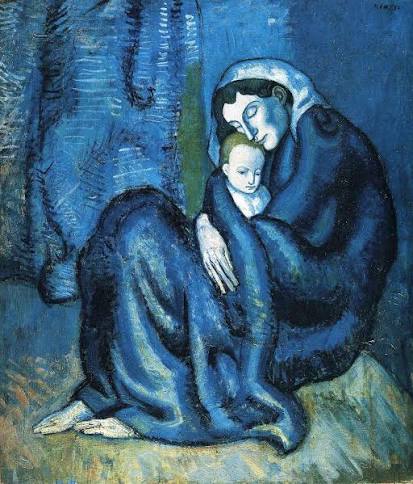
Blue is everywhere now from the jeans you’re wearing to the icons on your phone screen. But for most of human history, blue was the most elusive color in the artist’s palette. Unlike the ochre from earth or the charcoal from fire, true blue pigments were so rare and expensive that they were worth more than gold. This is the story of how a color once reserved for the Virgin Mary’s robes became the world’s favorite hue.
The Impossible Color
Try to imagine a world without blue. Not just the sky or the sea those were always there—but blue as a color you could paint with. For ancient artists, blue was a luxury beyond reach. The earliest pigments came from easy sources: red and yellow from ochre, black from charcoal. But blue? There was no blue earth, no blue wood ash. The few natural minerals that held a true blue, like lapis lazuli, were rare and buried in remote mountains.
Lapis lazuli was mined in the Sar-e-Sang mines of Badakhshan, Afghanistan, as early as 6,000 BCE. It was so precious that it was ground into pigment for Egyptian tomb paintings by 3,000 BCE, but the journey from Afghanistan to Egypt was thousands of miles. This made ultramarine from the Latin ultramarinus, meaning ‘beyond the sea’—the most expensive pigment in the world. In 15th-century Florence, it cost 100 to 200 times more than other paints. Artists would sign contracts specifying exactly how much ultramarine they could use, and patrons often paid for the pigment separately, like a precious gem.
The Egyptians, ever resourceful, invented the first synthetic blue around 2,500 BCE. Egyptian blue, a calcium copper silicate, was created in kilns and used in tomb paintings to represent the Nile and the heavens. But this technology was lost with the Roman Empire’s decline, and the secret wouldn’t be rediscovered until the modern era. So for centuries, Europeans relied on imported lapis, and blue remained a rare, divine color.
The Price of Piety
In medieval and Renaissance Europe, ultramarine was more expensive than gold. It was so costly that its use was a display of both wealth and devotion. The most famous application was the Virgin Mary’s robe. Starting in the 12th century, painters reserved the most intense blue for her mantle, symbolizing purity, heaven, and divine grace. The result was a visual hierarchy in religious art: the most expensive pigment went to the most holy figure.
But this was a source of frustration for artists. Michelangelo, Leonardo da Vinci, and others reportedly complained about the cost. Sometimes they would cheat, using cheaper azurite—a copper mineral that fades to green over time—for less important areas, saving the true ultramarine for the Virgin. This practice was so widespread that “Marian blue” became a technical term in painting contracts.
Meanwhile, in France, the monarchy adopted a deep blue as a symbol of royal power. Bleu de France appeared in heraldry and royal regalia, further cementing blue’s association with nobility and divine right. But not all cultures shared this reverence. In ancient Rome, blue was seen as a ‘barbarian’ color, linked to the Celts and Germans who dyed their bodies with woad. In East Asia, the Japanese word ao covers both blue and green, and blue held less sacred weight than in the West. In Islamic art, however, turquoise and cobalt blues became central to ceramics and mosque tiles, symbolizing paradise.
The Accidental Revolution
The turning point came in 1704, in a Berlin workshop. A dye-maker named Johann Jacob Diesbach was trying to create a red lake pigment when his batch accidentally turned a deep blue. This was Prussian blue, the first modern synthetic blue. It was cheap, stable, and didn’t fade. Suddenly, blue was no longer a luxury.
The 19th century brought even more options. In 1802, Louis Jacques Thénard developed cobalt blue, a more vibrant and stable pigment. Then, in 1826, Jean-Baptiste Guimet finally synthesized ultramarine, making the ‘royal’ blue affordable for the first time. The democratization of blue had begun.
Artists seized the opportunity. The Impressionists used blue in ways that shocked tradition—Monet painted the Rouen Cathedral in hazy blue light, Renoir captured the dappled blues of the Seine. Picasso’s Blue Period (1901–1904) used the color to express melancholy, not divinity. And in the 20th century, Yves Klein created his own patented International Klein Blue, a matte, ultramarine-like pigment that he declared the essence of space itself. Blue had transformed from a symbol of the divine to a medium for personal expression.
The Science of Blue
The scarcity of blue in the natural world is striking. Few animals produce true blue pigments. Blue jays, butterfly wings, and even blue eyes get their color from structural color—light scattering off microscopic structures, not from pigment molecules. This is why blue is so rare in nature: it’s a physical trick, not a chemical one.
This rarity made the search for new blues a scientific quest. In 2009, a team at Oregon State University accidentally discovered a new blue while experimenting with materials for electronics. YInMn blue, named for its components (yttrium, indium, manganese), is highly reflective and heat-resistant, making it useful for energy-efficient coatings. It was the first new blue pigment in over 200 years.
Blue for Everyone
Today, blue is everywhere. Indigo, once a prized dye for royal robes and elite textiles, now colors billions of pairs of jeans. National flags adopted blue en masse in the 19th century, from the United States to France. Corporate brands like IBM and Facebook chose blue to project trust and stability. The color that once took a fortune to produce now costs pennies per pound.
The journey of blue—from a rare mineral in Afghan caves to a universal favorite—mirrors the story of human innovation and cultural change. It shows how a color’s meaning is shaped by its economics, technology, and beliefs. And it reminds us that the colors we take for granted have extraordinary histories.
Blue’s story is one of extremes: from the most expensive pigment in history to the most common color in modern branding. Its rarity made it sacred, and its democratization made it ordinary. But its power remains. The next time you see a blue sky in a painting or a blue logo on your screen, remember: you’re looking at a color that once cost more than gold.
Summary
- Blue was historically the hardest color to produce, with natural pigments like lapis lazuli being rare and costly.
- Ultramarine, made from lapis lazuli, was more expensive than gold in medieval Europe and reserved for the Virgin Mary’s robe.
- The first synthetic blue, Prussian blue, was discovered accidentally in 1704, leading to a democratization of the color.
- Modern blues like cobalt, French ultramarine, and YInMn blue made blue accessible to all, transforming its cultural meaning.
- Blue is rare in nature, often resulting from structural color, not pigment.
FAQ
Q: Why was blue so hard to produce historically?
A: True blue pigments were rare because most natural minerals that appear blue, like lapis lazuli, were scarce or impure. Plant-based dyes like indigo faded quickly, and stable synthetic blues required advanced chemistry that wasn’t available until the 18th century.
Q: What is the difference between Egyptian blue and ultramarine?
A: Egyptian blue was the first synthetic pigment, created in Egypt around 2,500 BCE, but its technology was lost. Ultramarine, made from lapis lazuli, was a natural pigment imported from Afghanistan and used in Europe from the medieval period onward.
Q: How did blue become associated with the Virgin Mary?
A: Starting in the 12th century, the Catholic Church promoted blue as a symbol of purity and heaven, and ultramarine was so expensive that it was used only for the most sacred figures, like Mary. This made the color a symbol of divine grace.
Q: When did blue become affordable for everyone?
A: The invention of Prussian blue in 1704 was the first step, but it became truly affordable after the synthesis of French ultramarine in 1826. This allowed artists and manufacturers to use blue freely.
Q: Why is blue rare in nature?
A: Few organisms produce true blue pigments. Most blue in nature, such as in blue jays or butterfly wings, is structural color, created by light scattering off microscopic structures rather than by pigments.
Leave a Reply