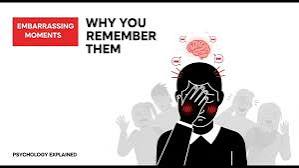
You’re lying in bed, years later, and suddenly it hits you: that time you tripped up the stairs in front of your entire class, or called your teacher ‘Mom.’ Your face flushes as if it happened yesterday. Why does your brain hold onto these moments with such stubborn clarity, while forgetting where you put your keys five minutes ago?
The answer isn’t that these moments were important. It’s that your brain is wired to treat social blunders as high-stakes learning events. Here’s what happens beneath the surface when you cringe at a memory from a decade ago.
The Spotlight Effect: You’re Not as Visible as You Think
Psychologist Thomas Gilovich coined the term “spotlight effect” to describe our tendency to overestimate how much others notice us. In a classic study, participants wore an embarrassing t-shirt (featuring Barry Manilow) into a room of strangers. They estimated that nearly half the group would notice the shirt; in reality, only about a quarter did. When it comes to your own mistakes, you assume the spotlight is on you—but everyone else is too busy worrying about their own blunders.
This bias doesn’t just make embarrassment feel worse in the moment; it also signals to your brain that the event matters. The more intensely you feel the emotion, the stronger the memory trace. You remember the moment vividly because you thought it was a catastrophe, even if no one else remembers it at all.
Your Brain on Embarrassment: A Chemical Cocktail
Embarrassment is a high-arousal emotion, on par with fear or joy. When you experience it, your amygdala—the brain’s emotional alarm system—fires, and your body releases stress hormones like adrenaline and cortisol. These hormones act on the hippocampus, the region responsible for forming new memories, essentially telling it: “Save this one.”
The stronger the emotional spike, the more durable the memory. This is why embarrassing moments can feel as vivid as flashbulb memories—like where you were when you heard about 9/11—even though they’re personally trivial. Your brain doesn’t distinguish between “important for survival” and “socially mortifying”—it just knows the event triggered a big response.
The Self-Reference Effect: It’s All About You
Your brain has a special filing system for anything involving yourself. The self-reference effect shows that we encode self-related information more deeply than information about others. An embarrassing moment is, by definition, self-focused: you’re the star of the disaster. That self-focus deepens the memory trace, making the event stickier than a neutral observation of someone else’s mistake.
Rumination: The Rehearsal You Can’t Control
You replay the moment. You think about what you should have said. You wince. This mental replay is a form of rehearsal, and each time you recall the memory, your brain re-encodes it—a process called reconsolidation. Instead of fading, the memory gets reinforced, often with the same emotional intensity. That’s why the cringe doesn’t diminish with time; you’re actively strengthening the neural pathway every time you think about it.
An Evolutionary Safety Net
Why would evolution design a brain that torments us with awkward moments? Because social rejection was a survival threat for early humans. Being ostracized from the group meant losing access to food, protection, and mates. Remembering social mistakes helped our ancestors avoid future blunders that could lead to exclusion. Your brain isn’t trying to punish you—it’s trying to protect you from repeating a costly error.
Neuroscience supports this: social pain activates many of the same brain regions as physical pain. Your brain treats a social blunder like a wound, and it wants you to remember how to avoid getting hurt again.
The Myths: Why You’re Not Remembering It “Right”
You might assume that because you remember the moment vividly, you remember it accurately. Not necessarily. Emotional memories are more vivid but not more accurate. Details can be distorted, and your brain may fill in gaps with plausible fiction. The feeling of certainty, however, remains high—you’d bet money on a memory that’s partially reconstructed.
You also might think other people remember it as clearly as you do. The spotlight effect says otherwise. They’re too busy replaying their own embarrassing moments.
When the Cringe Becomes a Problem
For most people, embarrassing memories are just a nuisance. But for some, they become intrusive and distressing, contributing to social anxiety disorder. Therapies like cognitive reappraisal—reframing the memory to reduce its emotional charge—and exposure therapy can help. By repeatedly recalling the event in a safe context, the emotional intensity fades, and the memory loses its grip.
So the next time you find yourself wincing at a memory from high school, remember: it’s not a sign that you’re broken. Your brain is doing exactly what it evolved to do—prioritizing social lessons to keep you safe. The memory is vivid because it was emotionally charged, not because it was objectively important. And in the grand scheme, the only person still replaying that moment is you.
Summary
- Embarrassing moments are remembered vividly because of emotional intensity, not objective importance.
- The spotlight effect makes us overestimate how much others notice our mistakes, intensifying the emotional response.
- Stress hormones released during embarrassment boost memory consolidation in the hippocampus.
- The self-reference effect and rumination (mental replay) further strengthen these memories.
- Evolutionary psychology suggests the brain prioritizes social errors as survival-relevant learning events.
FAQ
Q: Why do I remember embarrassing moments from years ago as if they happened yesterday?
A: High emotional arousal triggers stress hormones that enhance memory consolidation. The self-reference effect and rumination also reinforce the memory over time.
Q: Do other people remember my embarrassing moments as vividly as I do?
A: No. The spotlight effect causes us to overestimate how much others notice. Most people are too focused on themselves to remember your blunders in detail.
Q: Are my embarrassing memories accurate?
A: Not necessarily. Emotional memories are more vivid but not more accurate. Details can be distorted, and your confidence in them doesn’t guarantee accuracy.
Q: Can I make these memories less painful?
A: Yes. Cognitive reappraisal (reframing the memory) and exposure therapy can reduce the emotional charge. Over time, recalling the event in a safe context can weaken its intensity.
Q: Why does my brain focus on embarrassing moments instead of positive ones?
A: Your brain prioritizes social information because social acceptance was crucial for survival. It tags social mistakes as high-stakes lessons, making them stickier than neutral or positive events.
Leave a Reply