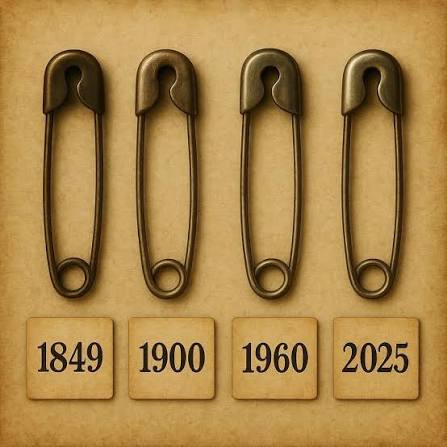
In April 1849, Walter Hunt, a New York mechanic, was $15 in debt. To settle it, he twisted a piece of wire into a coil, added a clasp, and created what would become the safety pin. He sold the rights for $100 (or $400, depending on the account) and never saw another cent. Today, the safety pin is so ubiquitous that we rarely think about its origin but its design has barely changed in 175 years, and its invention was a direct answer to a very 19th-century problem: the corset.
Hunt wasn’t just any tinkerer. He was a prolific inventor with over 100 patents, including an early sewing machine and a fountain pen. Yet he died without wealth, and his safety pin became a staple in every household. The story of its creation is a mix of ingenuity, debt, and a stroke of practical genius that solved a daily annoyance for millions of women.
The Debt That Sparked an Idea
Walter Hunt was a man of many inventions, but his motivation in 1849 was simple: he owed a friend $15 and needed quick cash. According to the story, he sat down with a piece of wire and, within three hours, had twisted it into a coiled spring at one end and a clasp at the other. The design was so effective that he filed for a patent on April 10, 1849, under the title “Dress Pin.” The patent, U.S. Patent No. 6,281, described a pin that would “secure the point” to prevent injury a feature that set it apart from every straight pin before it.
Hunt sold the patent rights to W.R. Grace & Company for $100 (some sources say $400). The company likely profited enormously as the safety pin became a mass-market item. Hunt, meanwhile, never received royalties. He was a brilliant mechanic but a poor businessman—a pattern that repeated throughout his life. He had also invented a sewing machine in 1834 but didn’t patent it, fearing it would put seamstresses out of work. Elias Howe later patented a similar machine and became wealthy. Hunt’s story is a classic case of genius without commercial sense.
Why the Safety Pin Was a Breakthrough
Before 1849, pins were dangerous. Straight pins had been around for centuries, used in ancient Egypt and Rome, and by the 19th century they were essential for fastening clothing—especially women’s dresses and undergarments. But they had serious flaws: they could prick the wearer, fall out, get lost in fabric, and rust easily. For women wearing corsets, the problem was acute.
The corset was a structural garment that shaped the torso, made of stiff whalebone, steel, or cord. It required tight lacing and frequent adjustment. Pins were used to hold the corset closed before lacing, secure the busk (the stiff front piece), and attach petticoats and chemises. A broken or slipped pin could scratch skin, tear fabric, or cause embarrassment. The safety pin’s spring-loaded clasp was specifically designed to cover the sharp point when closed, significantly reducing the risk of injury. It was a simple but revolutionary solution to a daily problem.
The Industrial Context
The mid-19th century was a time of rapid industrialization. Wire-drawing technology had improved, making it cheaper and easier to produce fine wire—the essential material for Hunt’s invention. The U.S. patent system, established in 1790, encouraged “useful arts,” and Hunt was part of a wave of self-taught inventors like Samuel Morse and Charles Goodyear. The sewing machine, which Hunt himself had a hand in, was about to transform clothing production, but in 1849 most clothing was still made at home or by hand. Pins were indispensable tools for dressmakers and homemakers, and a safer version was a genuine need.
A Woman’s Technology
While Hunt was a man, the safety pin was invented to solve a problem faced primarily by women. In the 1840s, corsets were a central piece of women’s fashion, and pins were a constant source of frustration. The term “pin money”—a small allowance for a woman—derives from the cost of pins, which were sold in paper packets and were a common household expense. The safety pin’s design, with its coiled spring and clasp, was a direct response to the needs of women’s dress. It was a women’s technology, even if its inventor was male.
The Design That Endured
The safety pin’s basic design has remained essentially unchanged since 1849. Modern versions are typically made of stainless steel or brass (often nickel-plated) to resist corrosion, and they come in a range of sizes, from tiny pins for delicate fabrics to large kilt pins. The coiled spring provides tension, and the clasp covers the point, making it safe. It’s a design so efficient that it hasn’t needed improvement.
The Reluctant Genius
Hunt’s story is often told as a cautionary tale: a man of immense creativity who lacked business acumen. He invented the safety pin to pay a debt, sold it for a pittance, and watched others profit. But some historians argue this narrative is overstated. Hunt was a working mechanic who needed quick cash; $100 in 1849 was roughly equivalent to $3,000 to $12,000 today—a significant sum. He may have made a rational choice, not a foolish one. Still, the irony is hard to ignore: a man who invented so many things, including the sewing machine, died without wealth, while his safety pin became a household essential.
The Safety Pin Today
Today, the safety pin is everywhere. It’s used for everything from securing baby diapers (before disposable diapers) to hemming pants, from punk fashion to emergency repairs. It’s a tool that’s so simple we take it for granted. But its invention was a direct result of a specific problem—the dangers of straight pins in corsets—and a man who needed $15. The next time you use a safety pin, think of Walter Hunt: a genius who solved a problem, sold his solution for a song, and left a legacy that’s still with us.
The safety pin is a testament to the power of simple solutions. It was born out of a debt, a piece of wire, and a moment of inspiration. Walter Hunt may not have profited from his invention, but his design has endured for 175 years, outlasting the corsets that inspired it. It’s a reminder that great ideas often come from everyday problems—and that genius isn’t always rewarded in the way we expect.
Summary
- Invented by Walter Hunt in 1849 to pay off a $15 debt; he sold the patent for $100 and never got royalties.
- Key innovation: a coiled spring and a clasp that covers the sharp point, making it safe to use.
- Motivated by the corset: straight pins were dangerous and caused injuries, especially in women’s fashion.
- Design unchanged: modern safety pins are still made of stainless steel or brass and come in various sizes.
- Hunt’s legacy: a prolific inventor with over 100 patents, but he died without wealth, a cautionary tale of genius without business sense.
FAQ
Q: Why was the safety pin invented?
A: It was invented to solve the problem of straight pins pricking and injuring people, particularly women wearing corsets. Walter Hunt created it in 1849 to pay off a $15 debt.
Q: How much did Walter Hunt sell the safety pin patent for?
A: He sold it to W.R. Grace & Company for $100 (some sources say $400). He didn’t receive royalties, so he missed out on long-term profits.
Q: What was the safety pin originally called?
A: The patent was titled “Dress Pin.” The term “safety pin” came into common use later.
Q: How has the safety pin design changed over time?
A: The basic design has remained essentially unchanged since 1849. Modern versions are made of stainless steel or brass (often nickel-plated) to resist corrosion and come in various sizes.
Q: What else did Walter Hunt invent?
A: Hunt was a prolific inventor with over 100 patents, including a sewing machine (which he didn’t patent), a fountain pen, a breech-loading rifle, a knife sharpener, and a streetcar bell.
Leave a Reply