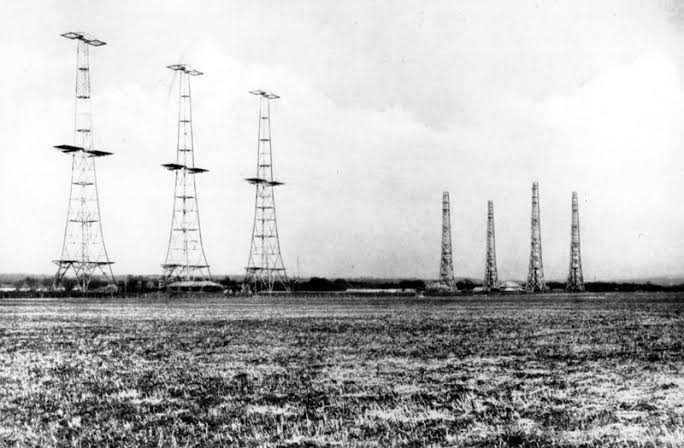
In the summer of 1940, as Luftwaffe bombers droned across the English Channel, a handful of men and women in wooden towers and underground bunkers held the key to Britain’s survival. They weren’t pilots or gunners, but radar operators and plotters, armed with little more than cathode-ray tubes and telephone lines. Their work gave Fighter Command a precious gift: time.
Before radar, defending against an air raid was like fighting in the dark. Sound locators giant concrete ears and binoculars gave at best five to eight minutes of warning, often less, and were useless in cloud or at night. The bomber, it was said, would always get through. But a secret network of steel towers, code-named Chain Home, would shatter that assumption and rewrite the rules of aerial warfare.
The Daventry Experiment
On a damp February morning in 1935, a young scientist named Robert Watson-Watt stood beside a van in a field near Daventry, England. Inside the van, a receiver was tuned to the BBC’s shortwave broadcast from nearby Daventry. As a bomber flew through the radio beam, the receiver detected a sudden fluctuation the aircraft had reflected the radio waves. The Daventry Experiment was a success, proving that radio waves could detect aircraft.
Watson-Watt, who had been tasked by the Air Ministry’s Committee for the Scientific Survey of Air Defence to investigate a “death ray,” had instead delivered something far more practical. Within weeks, his team began developing a system that would become Chain Home.
Building the Chain Home Network
By 1939, a chain of 21 coastal radar stations stretched from the Orkney Islands to the Isle of Wight, later expanding to about 30. Each station featured 350-foot steel transmitter towers emitting 25-meter wavelength pulses, with wooden receiver towers set back from the coast. Operators measured the time delay of reflected pulses to determine the range and bearing of incoming aircraft.
The system could detect planes up to 120 miles away enough to provide 10 to 15 minutes of warning before German formations reached the coast. But it had limitations: it couldn’t accurately determine altitude, and once aircraft crossed the coastline, they were lost to the radar. Overland tracking fell to the Royal Observer Corps, whose 1,000 posts fed information to a central command.
The Dowding System: Brains and Brawn
The real innovation wasn’t just radar; it was the integration of radar into a single command-and-control network, known as the Dowding System, after Air Chief Marshal Hugh Dowding. Radar stations telephoned their data to Filter Rooms, where WAAF plotters moved markers across a large table with croupier-style rakes. Controllers then scrambled fighters and vectored them via radio to intercept the enemy.
This closed loop—detection, filtering, decision, interception—was unprecedented. It allowed Fighter Command to conserve its limited aircraft and pilots by launching them only when and where they were needed, rather than keeping standing patrols that burned fuel and exhausted crews.
German intelligence knew of the radar masts but severely underestimated their capability. They believed the towers were navigation beacons or crude early-warning devices, easily jammed. They didn’t grasp the sophistication of the Dowding System, and their attempts to bomb the radar stations in August 1940 were brief and not sustained. Göring’s decision to shift attacks to London, aiming to break British morale, is often cited as a critical error—it gave the RAF’s airfields a reprieve.
The Numbers Behind the Victory
During the height of the Battle in August and September 1940, the Dowding System processed information from over 1,000 Observer Corps posts and more than 21 radar stations. The warning time it provided was decisive: fighters could be scrambled and climb to altitude before the Luftwaffe arrived, turning what could have been a slaughter into a defensive victory.
Without radar, Fighter Command would have been forced to maintain standing patrols, exhausting pilots and fuel, and would have been caught on the ground during raids. Radar allowed the RAF to meet the enemy at the right place, at the right time, and with the right numbers. It was a contest of attrition, and radar tipped the balance.
Radar didn’t win the Battle of Britain alone—the pilots, ground crews, WAAF plotters, and Observer Corps volunteers were equally vital. But without the Chain Home network and the Dowding System, the RAF would have been fighting blind. The technology didn’t just give Britain an edge; it gave them the ability to fight another day, and in the summer of 1940, that was everything.
Summary
- Chain Home, a network of 21+ coastal radar stations, gave Fighter Command 10–15 minutes of warning before German raids reached the coast.
- The Dowding System integrated radar data, Observer Corps reports, and fighter control into a single command network, enabling precise interception.
- German intelligence underestimated British radar, believing it crude and easily jammed, and failed to sustain attacks on radar stations.
- Radar allowed the RAF to conserve resources by scrambling fighters only when needed, avoiding standing patrols that would have exhausted pilots and fuel.
- The Battle of Britain was a contest of attrition; radar provided the strategic advantage that made victory possible.
FAQ
Q: What was the Daventry Experiment?
A: It was a February 1935 test where a bomber flying through a BBC radio beam was detected by a receiver, proving radio waves could detect aircraft. This led to the development of Chain Home.
Q: How did Chain Home radar work?
A: It used 350-foot steel towers to emit radio pulses; receivers measured the time delay of reflected pulses to determine aircraft range and bearing. It could detect planes up to 120 miles away.
Q: What was the Dowding System?
A: It was an integrated command-and-control network linking radar stations, Observer Corps posts, operations rooms, and fighter airfields, allowing centralized tracking and vectoring of fighters.
Q: Why didn’t the Germans destroy the radar stations?
A: German intelligence underestimated their importance, believing they were navigation beacons or crude early-warning devices. Their attacks in August 1940 were brief and not sustained; Göring then shifted focus to London.
Q: Could the RAF have won without radar?
A: Without radar, Fighter Command would have had to maintain standing patrols, exhausting pilots and fuel, and would have been caught on the ground. Radar was necessary, though not sufficient, for victory.
Leave a Reply