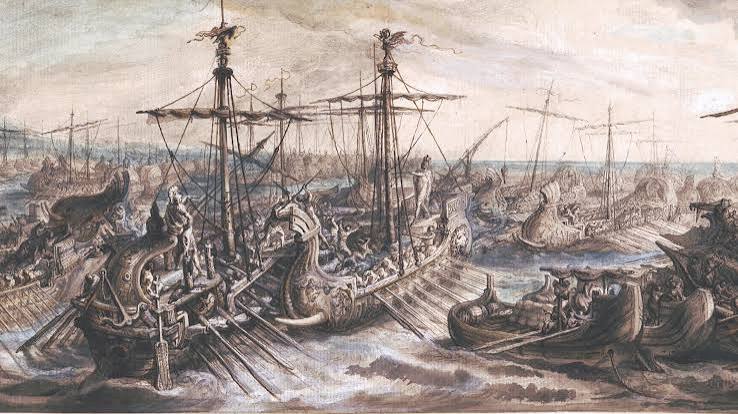
Rome was not always a maritime power. In 264 BCE, the Roman Republic had conquered the Italian peninsula but owned not a single warship. Carthage, by contrast, ruled the waves with a professional navy and mercenary armies. Yet over the next century, Rome not only defeated its rival but erased it from the map. This is the story of the Punic Wars: a conflict that killed over a million people, tested Rome’s institutions to their limits, and ultimately set the template for Western empire.
The Spark: A Mercenary Dispute in Sicily
The trigger for the First Punic War was not a grand strategic ambition but a plea from a band of Italian mercenaries called the Mamertines. They had seized the city of Messana on Sicily’s northeastern tip, only to find themselves besieged by Carthage and Syracuse. In desperation, they appealed to Rome for help. The Roman Senate hesitated—they had no treaty with the Mamertines and no experience fighting overseas. But the people’s assembly, swayed by the promise of plunder and the fear of Carthaginian power so close to Italy, voted to intervene. Rome’s first overseas campaign began almost by accident.
Rome Learns to Fight at Sea
Carthage was a maritime commercial empire, descended from Phoenician colonists. Its navy was the best in the Mediterranean. Rome had no fleet at all. According to the historian Polybius, the Romans found a Carthaginian warship wrecked on their coast and used it as a blueprint. Within 60 days, they built a fleet of 100 ships—though the quality was rough, and their crews were landsmen.
To compensate, they invented the corvus, a boarding bridge with a spike that could be dropped onto enemy ships, locking them together. This turned naval battles into land battles, where Roman soldiers excelled. At the Battle of Mylae in 260 BCE, the corvus helped Rome win its first naval victory. By 241 BCE, after 23 years of war, Rome had exhausted Carthage and forced it to surrender Sicily—Rome’s first province. The war also cost Rome hundreds of ships and thousands of men, but it had learned to dominate the sea.
Hannibal’s Bold Gambit
Carthage did not accept defeat gracefully. To recover, it expanded into Spain under the Barcid family—Hamilcar Barca and his son Hannibal. Hamilcar made his young son swear an oath of eternal hatred against Rome. In 218 BCE, Hannibal provoked the Second Punic War by besieging Saguntum, a Roman ally in Spain. Then he did what no one expected: he marched his army, including 37 war elephants, over the Alps.
The crossing was catastrophic. Winter storms, treacherous terrain, and Gallic attacks reduced his force from about 40,000 infantry and 6,000 cavalry to roughly 26,000 men. Only a fraction of the elephants survived. Yet Hannibal still managed to win three crushing victories in Italy: at the Trebia, Lake Trasimene, and, most famously, Cannae in 216 BCE.
Cannae: The Bloodiest Day Before World War I
At Cannae, Hannibal executed a perfect double envelopment. He placed his weakest troops in the center, who gradually fell back as the Romans pushed forward. Meanwhile, his cavalry drove off the Roman horse and circled behind, surrounding the Roman infantry. The result was a massacre. Estimates of Roman casualties range from 50,000 to 70,000 dead in a single day. No other battle in history would match that toll until the trenches of World War I. The Roman Republic was on the brink of collapse.
Yet Hannibal did not march on Rome. He expected Rome’s Italian allies to defect, but they largely remained loyal. The Romans, meanwhile, turned to a new strategy.
The Fabian Strategy: Winning by Not Fighting
The Roman dictator Fabius Maximus understood that Hannibal was unbeatable in a pitched battle. So he avoided them entirely. He shadowed Hannibal’s army, harassing its foragers, cutting off supplies, and refusing to engage. This “Fabian strategy” was deeply unpopular with Romans who demanded revenge, but it worked. Hannibal’s army, stranded in Italy without reinforcement, began to weaken.
Fabius was eventually replaced by more aggressive commanders, who suffered defeats. But his principle—that time and attrition could defeat a superior general—eventually proved correct. It became a model for later commanders like George Washington and Wellington.
Scipio Africanus and the Battle of Zama
Rome’s ultimate victory came from a different approach. A young general named Scipio Africanus proposed an audacious plan: instead of fighting Hannibal in Italy, Rome would invade Carthage’s homeland in North Africa. The gamble worked. Carthage was forced to recall Hannibal from Italy, and in 202 BCE, the two greatest generals of the age met at Zama.
Scipio had learned from Cannae. He arranged his infantry in a checkerboard formation, leaving gaps that Hannibal’s war elephants could pass through harmlessly. Then his cavalry, which had been trained to outflank, won the day. Hannibal was defeated for the first time. Carthage sued for peace, surrendering its fleet, its empire, and its pride.
The Third Punic War: The Destruction of Carthage
The peace lasted 50 years, but Rome’s fear and hatred of Carthage never died. The statesman Cato the Elder ended every speech—on any topic—with the phrase “Carthago delenda est”: “Carthage must be destroyed.” In 149 BCE, Rome found a flimsy pretext in a border dispute with Carthage’s neighbor, and declared war.
The Third Punic War was less a war than a siege and slaughter. In 146 BCE, after three years, Roman forces under Scipio Aemilianus broke through the city walls. Carthage was burned to the ground. The surviving population of about 50,000 was sold into slavery. The legend that the Romans sowed the fields with salt is debated by historians, but the symbolic point stands: Rome did not just defeat Carthage; it annihilated it.
The Legacy: How the Punic Wars Shaped the West
The Punic Wars transformed Rome from a regional Italian power into a Mediterranean empire. By destroying Carthage, Rome eliminated its only serious rival for dominance. The result was an unprecedented period of Roman expansion that would eventually encompass the entire Mediterranean basin and beyond, spreading Latin language, Roman law, and Greek culture across Europe, North Africa, and the Middle East.
But the wars also sowed the seeds of Rome’s own decline. The acquisition of overseas provinces created new sources of wealth and power for generals, leading to political instability and civil wars. The citizen-soldier army that had fought so bravely was eventually replaced by professional legions loyal to their commanders, not the state—a shift that would culminate in the rise of emperors.
The Punic Wars also left a cultural legacy. The story of Hannibal crossing the Alps remains one of the most celebrated feats in military history. The duel between Hannibal and Scipio inspired countless later generals. And the Fabian strategy became a byword for patient, indirect warfare.
Conclusion
The Punic Wars were not merely a series of battles. They were a clash between two radically different models of society: Carthage’s commercial, maritime, mercenary-based empire versus Rome’s agrarian, land-focused, citizen-soldier republic. The outcome determined which model would dominate the Mediterranean, and by extension, the future of Western civilization. Rome’s victory did not just create an empire; it set a precedent for how the West would project power for the next two millennia—through disciplined citizen armies, technological adaptation, and an unyielding determination to eliminate rivals. The ruins of Carthage, lying silent near modern Tunis, are a reminder that history is written by the victors, but also that victory can carry costs that shape the future in unexpected ways.
The Punic Wars ended with Carthage in ashes and Rome supreme. Yet the cost was immense: a million dead, a century of conflict, and the transformation of a republic into an empire. The rivalry with Carthage forced Rome to become a naval power, a colonial ruler, and ultimately a conqueror of the Mediterranean. In doing so, Rome forged the cultural and legal foundations of the West, but also sowed the seeds of its own imperial destiny. The lesson of the Punic Wars is that great powers are often shaped by their enemies—and that destruction, even of an enemy, can have consequences far beyond the battlefield.
Summary
- The Punic Wars were three conflicts between Rome and Carthage (264–146 BCE) that determined control of the Mediterranean.
- Rome’s first major naval war forced it to build a fleet from scratch, using the corvus boarding bridge to turn sea battles into land battles.
- Hannibal’s audacious crossing of the Alps and victory at Cannae (216 BCE) nearly destroyed Rome, but the Fabian strategy of attrition saved it.
- Scipio Africanus defeated Hannibal at Zama (202 BCE), making Rome the dominant power in the western Mediterranean.
- The Third Punic War ended with the complete destruction of Carthage, removing Rome’s last rival and paving the way for its empire.
FAQ
Q: What were the Punic Wars?
A: The Punic Wars were a series of three wars between the Roman Republic and the Carthaginian Empire, fought from 264 BCE to 146 BCE, primarily over control of Sicily and dominance in the Mediterranean.
Q: Who was Hannibal and why is he famous?
A: Hannibal Barca was a Carthaginian general renowned for his tactical genius. He famously led his army, including war elephants, across the Alps to invade Italy, winning major victories like the Battle of Cannae before being defeated by Scipio Africanus at Zama.
Q: What was the Fabian strategy?
A: The Fabian strategy, named after the Roman dictator Fabius Maximus, involves avoiding pitched battles and instead using attrition, harassment, and scorched-earth tactics to weaken a stronger enemy over time. It was used to counter Hannibal’s superior tactical skills.
Q: How did the Punic Wars affect Rome’s rise to power?
A: The wars transformed Rome from a regional Italian power into a Mediterranean empire by giving it its first overseas provinces (Sicily, Sardinia, Spain), a powerful navy, and a reputation for military invincibility. They also led to social and political changes that eventually contributed to the fall of the Republic.
Q: Why did Rome destroy Carthage in the Third Punic War?
A: Rome’s destruction of Carthage was driven by long-standing fear and hatred of its rival, revived by Cato the Elder’s persistent calls of “Carthage must be destroyed.” The immediate cause was a minor territorial dispute, but the underlying motive was to eliminate a potential threat to Rome’s dominance.
Leave a Reply