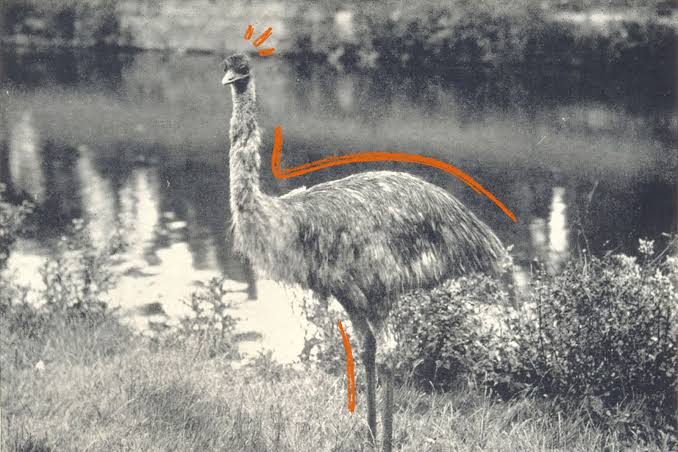
In 1932, the Australian military deployed soldiers with machine guns to fight a war against emus. The enemy was fast, resilient, and utterly unimpressed by modern weaponry. After a month of combat, the military withdrew, having killed fewer than 1,000 of an estimated 20,000 emus. The birds won.
This wasn’t a joke to the farmers of Western Australia. They were facing ruin as emus trampled and ate their wheat crops during the Great Depression. The government’s solution—sending in the army—seemed reasonable on paper but turned into a humiliating defeat that still makes headlines today.
The Problem: 20,000 Birds That Wouldn’t Budge
Emus are the second-largest living birds by height, reaching up to 1.9 meters (6.2 feet) and weighing as much as 60 kilograms (132 pounds). They’re native to Australia and can sprint at 50 kilometers per hour (31 mph). In 1932, a perfect storm of drought and a booming breeding season pushed an estimated 20,000 emus into the wheat belt of Western Australia.
The birds migrated toward water, devouring and trampling newly planted crops. For farmers already struggling through the Depression, this was a disaster. They petitioned the government for help, and under the Defence Act 1903, the military could be called in for civil matters—including pest control.
Sir George Pearce, the Minister for Defence and a Western Australian himself, approved the deployment. It was politically savvy: he faced pressure from rural voters and the opposition. So, on November 2, 1932, Major G.P.W. Meredith of the Royal Australian Artillery led the 7th Heavy Battery into the Campion district, about 200 kilometers (124 miles) northeast of Perth.
Their weapons: two Lewis light machine guns, capable of firing 500–600 rounds per minute, mounted on trucks. The plan seemed simple: mow down the birds.
The Battle: Emus Outrun the Army
The first major engagement came on November 8. The soldiers spotted a flock of around 50 emus. They opened fire, but the birds scattered and ran—some at speeds that outpaced the trucks. The Lewis guns jammed. The emus escaped with few casualties.
Major Meredith quickly realized the problem: emus didn’t gather in large herds like cattle. They moved in small, scattered groups, making machine-gun fire inefficient. He later compared them to “Zulu warriors” in their tactical dispersal, noting they were “more elusive than the Boer”—a reference to the Boer War.
The media latched onto the story. Newspapers in Perth and Sydney ran near-daily updates, often mocking the operation. The term “Emu War” was coined by the press, and the public ate it up. The soldiers became a laughingstock.
Over the next month, the military fired approximately 2,500 rounds of ammunition. The confirmed kill count: 986 emus. That’s roughly one bird for every 2.5 rounds—a staggeringly poor ratio. Some estimates put the kill count as high as 2,000, but even then, it was a fraction of the 20,000 emus in the area.
By December 10, the military withdrew. The operation was a failure, and the government was embarrassed.
The Aftermath: Bounties and Lessons Learned
The government pivoted to a bounty system, paying farmers to kill emus. This proved more effective—though not decisive—than the military operation. Further culls were attempted in 1934 and 1943, but the 1932 event remains the one remembered as the “war.”
Today, emus are a protected species in Australia, though controlled culling is still allowed in some areas. The Great Emu War serves as a case study in how not to handle wildlife management.
But it’s also a story about desperation. The farmers weren’t fools; they were people watching their livelihoods vanish. The government wasn’t corrupt; it was trying to respond to a crisis. The military wasn’t incompetent; it was using inappropriate tools for the job.
The real lesson? Nature doesn’t follow military strategy. Emus adapted to the threat, and the army couldn’t adapt fast enough.
Why We Still Talk About It
The Great Emu War has become a staple of internet culture, a reminder that even superpowers can lose to birds. It’s a story that combines absurdity with genuine human struggle, making it perfect for memes and history podcasts alike.
But it’s also a cautionary tale about overreaching solutions. When faced with a complex problem, quick fixes—like sending in the army—often fail. The bounty system worked better because it was flexible and localized.
In the end, the emus won the battle, but the farmers eventually found a way to coexist. The war may be over, but its legacy lives on as one of history’s strangest conflicts.
The Great Emu War is a reminder that not all problems can be solved with force. It’s a story of human desperation, bureaucratic missteps, and the resilience of nature. And it’s a reminder that sometimes, the best response to a crisis is to step back, reassess, and try a different approach—before you end up firing 2,500 rounds at birds and losing.
Summary
- In 1932, Australian farmers, facing crop destruction, petitioned the government for military help against emus.
- The military deployed Major Meredith and soldiers with Lewis machine guns; they killed fewer than 1,000 emus out of an estimated 20,000.
- The operation lasted about a month, fired ~2,500 rounds, and cost £100–£200, with zero human casualties.
- The media mocked the operation, coining the term “Emu War.”
- The government later switched to a bounty system, which proved more effective.
FAQ
Q: Why did the military get involved in killing emus?
A: Under the Defence Act 1903, the Australian military could be called out for civil matters, including pest control. Farmers petitioned the government after emus devastated their wheat crops, and the Minister for Defence, Sir George Pearce, approved the deployment.
Q: How many emus were killed?
A: Confirmed kills were around 986, though estimates range from 500 to 2,000. This was out of an estimated population of 20,000 in the area.
Q: How many soldiers were injured or killed?
A: Zero. The only casualties were emus—and the military’s pride.
Q: What weapons did the military use?
A: Two Lewis light machine guns, capable of firing 500–600 rounds per minute, mounted on trucks. They used approximately 2,500 rounds.
Q: Are emus still a problem in Australia?
A: Emus are protected, but controlled culling is permitted in some areas. The 1932 event remains a unique historical footnote, though emus can still cause agricultural damage.
Leave a Reply