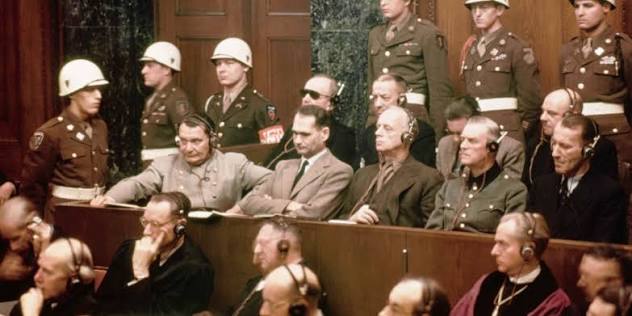
On November 20, 1945, in a partially bombed-out courthouse in Nuremberg, Germany, the world’s first international war crimes tribunal convened. The defendants were not anonymous soldiers but the most powerful men of the Nazi regime: Hermann Göring, Rudolf Hess, Joachim von Ribbentrop, and 19 others. They sat in the dock accused of crimes so vast they needed new legal definitions to describe them.
This was no show trial, though many expected one. The Allied powers the United States, Britain, the Soviet Union, and France had debated whether to simply execute these men. Instead, they chose to build a courtroom, hire prosecutors, and let evidence speak. Over the next year, the world watched as the horrors of the Holocaust were laid out in documents, films, and testimony, and as the principle of individual accountability for atrocities was tested for the first time.
A Court Built on Ruins
Nuremberg was not chosen by accident. The Palace of Justice stood largely intact amid the rubble of a city that had hosted massive Nazi party rallies. Its courthouse and adjacent prison were secure, and its symbolism was unmistakable: justice would be served in the very heart of the regime’s propaganda machine.
The legal foundation was the London Agreement, signed on August 8, 1945, by the four Allied powers. Each supplied a judge and an alternate. The chief American prosecutor was Robert H. Jackson, a U.S. Supreme Court Justice who had helped shape the proceedings. His British counterpart was Sir Hartley Shawcross. The Soviet judge, Major-General Iona Nikitchenko, had stated before the trial that the defendants were already guilty a remark that unsettled Western jurists and foreshadowed the tensions to come.
Four Charges That Redefined Law
The indictment contained four counts, each a legal innovation. Crimes against peace covered planning and waging wars of aggression. War crimes meant violations of the laws of war, such as murdering prisoners of war or destroying property without military necessity. Crimes against humanity a phrase coined for this trial encompassed murder, extermination, enslavement, and deportation of civilian populations. The fourth count was conspiracy to commit the others.
These charges had roots in earlier attempts at international law. The 1919 Treaty of Versailles had tried to prosecute Kaiser Wilhelm II, but the effort fizzled. The 1928 Kellogg-Briand Pact had outlawed war as an instrument of national policy. Nuremberg was the first time these principles were actually enforced against individuals.
The Evidence of Genocide
The prosecution’s case rested heavily on documents. The Nazis were meticulous record-keepers, and the Allies had captured vast archives. Over 100,000 documents were entered into evidence, along with thousands of affidavits and millions of pages of testimony. The court also screened film footage from liberated concentration camps.
The effect was devastating. In the courtroom, the scale of the Holocaust the systematic murder of approximately 6 million Jews and millions of others became undeniable. For many, this was the first time they saw the emaciated bodies, the mass graves, the gas chambers. The evidence was not abstract; it was concrete, and it demanded a response.
The Defense and Its Rejection
German defense attorneys mounted several arguments. They claimed the tribunal was ex post facto law punishing acts that were not crimes when committed. They argued that the defendants were following orders, a defense known as “superior orders.” And they pointed out, with some justification, that the Allies themselves had committed acts that could be considered war crimes, such as the firebombing of Dresden and the atomic bombings of Hiroshima and Nagasaki.
The tribunal rejected the ex post facto argument, holding that the crimes were so universally condemned that they were already implicit in international law. The “superior orders” defense was dismissed as an absolute shield, though it could be considered as a mitigating factor in sentencing. The court also rejected the “victor’s justice” critique implicitly, by insisting on due process, allowing defense counsel, and acquitting three defendants for lack of evidence.
The Verdicts and Their Aftermath
On October 1, 1946, after nearly a year of testimony, the judges delivered their verdicts. Twelve defendants were sentenced to death. Ten were hanged on October 16, 1946; Hermann Göring cheated the gallows by swallowing cyanide the night before. Martin Bormann, tried in absentia, was also sentenced to death—his remains were later found and identified. Three men were acquitted: Hjalmar Schacht, Franz von Papen, and Hans Fritzsche. Seven received prison terms ranging from 10 years to life.
Rudolf Hess was sentenced to life imprisonment and spent the rest of his life in Spandau Prison. Albert Speer, Hitler’s architect and armaments minister, received 20 years. He served his full term, released in 1966.
The Aftermath: A Double-Edged Legacy
The Nuremberg Trials left a complicated legacy. On one hand, they established the principle of individual criminal responsibility—that individuals, not just states, can be held accountable for atrocities. This principle directly informed the creation of the International Criminal Court decades later and the tribunals for Rwanda and the former Yugoslavia. The trials also produced an enormous documentary record that became the foundational archive for Holocaust historiography.
On the other hand, the “victor’s justice” critique has never fully dissipated. The Allies prosecuted only the defeated, not their own wartime actions. The Soviet Union, a co-prosecutor, had itself committed atrocities, including the Katyn Massacre, which Soviet prosecutors tried to blame on Germany. This hypocrisy cast a shadow over the proceedings.
Yet the defendants were not innocent. The evidence was overwhelming. The trials forced Germany and the world to confront the Holocaust in a legal setting, establishing a historical record that could not be denied. As Robert Jackson said in his opening statement, “The wrongs which we seek to condemn and punish have been so calculated, so malignant, and so devastating, that civilization cannot tolerate their being ignored because it cannot survive their being repeated.”
The Nuremberg Trials were not perfect. They were shaped by the politics of their time, and their flaws are easy to see in hindsight. But they were also a genuine attempt to replace vengeance with law, to let evidence and argument determine guilt or innocence. The trial record remains a monument to that effort, and the principles established there—that leaders are accountable for their crimes, that following orders is not a defense—remain the cornerstone of international justice.
Summary
- The Nuremberg Trials ran from November 20, 1945, to October 1, 1946, for the major war criminals, with 12 subsequent trials through 1949.
- The tribunal was established by the London Agreement of August 8, 1945, signed by the U.S., UK, USSR, and France.
- Defendants faced four charges: crimes against peace, war crimes, crimes against humanity, and conspiracy.
- Verdicts: 12 death sentences (10 executed), 3 acquittals, 7 prison terms.
- The trials established individual criminal responsibility and rejected the “superior orders” defense, but faced criticism as “victor’s justice.”
FAQ
Q: Why were the trials held in Nuremberg?
A: The Palace of Justice was largely intact, the adjacent prison was secure, and the city was symbolic as the site of Nazi rallies.
Q: What were the four charges?
A: Crimes against peace, war crimes, crimes against humanity, and conspiracy to commit these crimes.
Q: How many defendants were there?
A: 24 were indicted, 22 stood trial (one committed suicide, one was unfit).
Q: What was the “superior orders” defense?
A: The argument that defendants were just following orders, which was rejected as an absolute defense but allowed as a mitigating factor.
Q: Was there criticism of the trials?
A: Yes, the main critique was “victor’s justice”—only the defeated were tried, while Allied actions like the bombings of Dresden and Hiroshima were not examined.
Leave a Reply