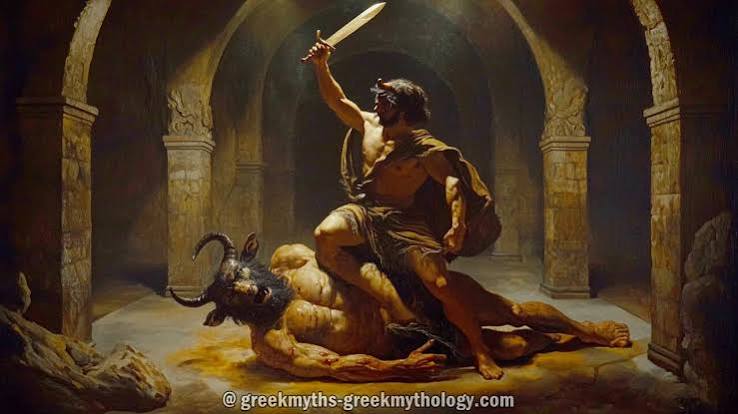
In the heart of the Mediterranean, on the island of Crete, lies the ruins of a palace so complex that it gave birth to one of the most enduring myths of Western civilization. Here, according to legend, a monstrous creature—half man, half bull—lurked in a labyrinth, devouring sacrificial youths. But the Minotaur is more than a monster; it’s a cultural cipher, a symbol that has evolved from a Bronze Age ritual to a modern metaphor for the darkest corners of the human mind.
The story of the Minotaur is a tale of gods and kings, of curses and courage, but it’s also a story deeply rooted in history. The palace of Knossos, excavated by Sir Arthur Evans in the early 20th century, revealed a sophisticated civilization that flourished around 2700–1450 BCE. With running water, vibrant frescoes, and a bull-leaping ritual that defies gravity, the Minoans were not the barbaric backdrop of myth, but a advanced culture that left an indelible mark on the Greek imagination.
Today, the Minotaur has escaped its ancient stone maze to roam freely in our collective psyche. It appears in psychology, in feminist retellings, and in philosophical debates about monstrosity. This article explores how a mythical beast, born of divine punishment and human ingenuity, became one of the most versatile metaphors in our cultural toolkit.
The Myth: A Story of Gods, Curses, and Heroism
The classical version of the myth is well-known. King Minos of Crete, in a bid to secure his throne, prayed to Poseidon for a sign. The god sent a magnificent white bull, intended for sacrifice. But Minos, entranced by the beast’s beauty, kept it for himself. This act of defiance provoked Poseidon’s wrath, and the god cursed Minos’ wife, Pasiphaë, with an unnatural desire for the bull.
Daedalus, the legendary craftsman, built a hollow wooden cow for Pasiphaë to hide inside, enabling her to mate with the bull. The offspring was the Minotaur—a being with the body of a man and the head of a bull. To contain this monstrous embarrassment, Minos commissioned Daedalus to construct an inescapable labyrinth beneath his palace.
Meanwhile, Athens, after a war with Crete, was forced to send a tribute of seven youths and seven maidens every nine years to be devoured by the Minotaur. The hero Theseus, son of King Aegeus, volunteered to be among the tributes. With the help of Ariadne, Minos’ daughter, who gave him a ball of thread to trace his path, Theseus navigated the labyrinth, killed the Minotaur, and escaped with Ariadne and the other tributes.
The story has a tragic coda. Theseus abandoned Ariadne on the island of Naxos, and in his haste to return home, forgot to change his ship’s sails from black to white—the signal of his success. His father Aegeus, seeing the black sails, threw himself into the sea, giving the Aegean Sea its name.
The Labyrinth: Memory or Myth?
The word “labyrinth” may derive from the labrys, the double-headed axe, a sacred symbol of Minoan religion. Carvings of the labrys are found throughout the palace of Knossos, which is appropriately maze-like, with hundreds of rooms, staircases, and light wells. Sir Arthur Evans, who excavated the site from 1900 to 1935, believed this complex structure was the historical Labyrinth. But was it?
Some scholars propose a different origin. The labyrinth might not have been a building at all, but a dance floor—a spiral pattern traced on the ground for ritual dances. Homer’s Iliad describes a dance floor on Achilles’ shield that resembles a labyrinth, and Roman sources mention the “Troy Game,” a labyrinthine dance. Alternatively, a cave at Gortyn, Crete, with a natural maze of tunnels, could have inspired the myth.
Whatever its physical reality, the labyrinth has become a powerful symbol of confusion and entrapment. But for the Minoans, it might have been a place of ritual and transformation, not a prison. The famous bull-leaping fresco at Knossos, which shows acrobats vaulting over a bull’s horns, suggests that bulls were central to Minoan culture—perhaps as objects of worship rather than fear.
The Minotaur as History: A Coded Memory of Minoan Crete
Historians see the Minotaur myth as a distorted memory of Minoan civilization. The Minoans, a sophisticated Bronze Age culture, dominated the Aegean for centuries. Their religion centered on a mother goddess and involved bull worship. The Mycenaean Greeks, who eventually conquered Crete, may have reinterpreted Minoan rituals they no longer understood, turning a sacred bull into a monster.
The name “Minos” might have been a title, like “Pharaoh,” rather than a single king’s name. This explains inconsistencies in the myth, such as Minos’ death in Sicily in some versions. The myth, therefore, may encode political history: the tribute of Athenian youths could reflect Minoan dominance over mainland Greece, and Theseus’ victory could symbolize the Mycenaean takeover.
The Minotaur as Metaphor: From Freud to Feminism
In the modern era, the Minotaur has become a potent metaphor, particularly in psychology and literature. Sigmund Freud saw the labyrinth as the unconscious mind, and the Minotaur as the repressed id—primal desires that must be confronted. Carl Jung interpreted the Minotaur as the shadow archetype, the dark, animalistic side of the human psyche that we must integrate to become whole.
Feminist retellings have also reclaimed the myth. In Jennifer Saint’s novel Ariadne, Pasiphaë is not a monstrous figure but a victim of divine cruelty, and Ariadne is a betrayed heroine, not a mere plot device. The Minotaur, given the name Asterion, is portrayed as a child born of rape and imprisonment, a victim of the gods and of Minos’ pride. These reinterpretations challenge the traditional reading of the myth, asking who the real monsters are.
The Minotaur Today: A Symbol of Otherness and the Human Condition
Today, the Minotaur appears in countless films, books, and artworks, often representing the “other”—the beast within, the outsider, the misunderstood. It questions what it means to be human, blurring the line between civilization and savagery. The myth’s endurance lies in its flexibility: it can be a story about political power, about the human psyche, or about the nature of monstrosity.
The Minotaur is more than a monster from a bygone era. It is a mirror that reflects our anxieties, our hidden desires, and our capacity for both cruelty and compassion. As long as we struggle with these questions, the Minotaur will continue to roam our collective imagination.
The Minotaur has traveled a long path from the stone corridors of Knossos to the abstract corridors of the mind. It began as a religious symbol, became a political metaphor, and now serves as a psychological and feminist icon. Yet at its core, the myth remains a story about the human condition—our struggles with power, desire, and identity. Perhaps that is why it endures: the Minotaur is not just a monster we fear, but a part of ourselves we must confront.
Summary
- The Minotaur myth originates from ancient Crete, where a bull was central to Minoan religion and power.
- The historical palace at Knossos, with its maze-like structure, may have inspired the labyrinth legend.
- The myth served political purposes, symbolizing Athenian superiority over Crete.
- Modern interpretations view the Minotaur as a metaphor for the unconscious, the shadow, or societal otherness.
- Feminist retellings reframe Pasiphaë and Ariadne as complex victims, not villains.
FAQ
Q: Was the Minotaur real?
A: No, the Minotaur is a mythological creature. However, the myth likely has historical roots in Minoan bull worship and the palace of Knossos.
Q: Why did Athens send tribute to Crete?
A: According to the myth, Athens sent seven youths and seven maidens as tribute to be devoured by the Minotaur, either as a result of a lost war or as punishment for the death of Minos’ son.
Q: What does the labyrinth symbolize?
A: Symbolically, the labyrinth represents confusion, complexity, and the journey of self-discovery. In psychology, it can represent the unconscious mind.
Q: Who was Ariadne?
A: Ariadne was the daughter of King Minos. She helped Theseus navigate the labyrinth by giving him a ball of thread. She was later abandoned by Theseus on Naxos.
Q: What is the significance of the Minotaur in modern culture?
A: The Minotaur is often used as a metaphor for the ‘other’—the beast within, the outsider, or the repressed aspects of the human psyche.
Leave a Reply