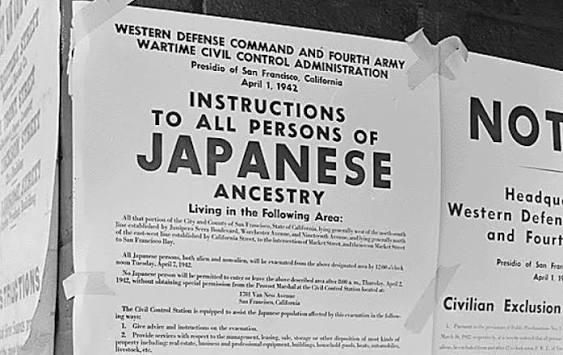
On February 19, 1942, President Franklin D. Roosevelt signed Executive Order 9066, a single page of paper that would uproot over 120,000 people. They were not spies or saboteurs—no Japanese American was ever convicted of such crimes. They were farmers, shopkeepers, and fishermen, two-thirds of them U.S. citizens, living on the West Coast. The order gave military commanders the power to exclude “any or all persons” from designated areas, and though it never named Japanese Americans, it was used exclusively against them.
Within months, families were given days to dispose of their homes and businesses, then herded onto buses and trains bound for remote camps ringed with barbed wire. The internment lasted until 1945–46, but its scars legal, financial, and moral endure. This is the story of how fear overrode the Constitution, how the courts failed, and how a nation eventually apologized.
The Machinery of Exclusion
Executive Order 9066 did not mention Japanese Americans, but its target was unmistakable. The military designated the entire West Coast as a “military area,” and by June 1942, nearly all 120,000 people of Japanese descent including 70,000 U.S. citizens had been removed. They were sent to ten remote sites: Manzanar and Tule Lake in California, Heart Mountain in Wyoming, Topaz in Utah, Gila River and Poston in Arizona, Minidoka in Idaho, Rohwer and Jerome in Arkansas, and Granada in Colorado.
The speed was staggering. Families had as little as 48 hours to settle their affairs. They sold homes, businesses, and heirlooms at pennies on the dollar, or simply abandoned them. The financial losses, measured in 2023 dollars, range from $1.3 billion to $4 billion. One fisherman in Terminal Island, California, lost his boat, his nets, and his cannery all confiscated or ruined while he was behind barbed wire.
The government called these places “relocation centers.” The internees called them concentration camps. Armed guards patrolled the perimeters, and searchlights swept the grounds at night. Families slept in cramped barracks furnished with straw mattresses and a single lightbulb. The mess halls served institutional food, and privacy was nonexistent.
The Legal Failure
In 1944, the Supreme Court heard the case of Fred Korematsu, a 23-year-old U.S. citizen who had refused to report for relocation. In a 6–3 decision, the Court upheld his conviction, ruling that the exclusion orders were constitutional because of “military necessity.” The majority accepted the government’s claim that Japanese ancestry itself posed a risk of espionage an assertion with no supporting evidence.
Justice Robert Jackson dissented in words that would haunt the Court for decades. He warned that the ruling was “a loaded weapon” ready for future misuse. He wrote, “The principle then lies about like a loaded weapon, ready for the hand of any authority that can bring forward a plausible claim of an urgent need.”
The same year, the Court decided Ex parte Endo, ruling that loyal U.S. citizens could not be detained indefinitely. That decision effectively ended the internment, but it did not overturn Korematsu. The exclusion orders were technically upheld, and Korematsu’s conviction stood until his conviction was vacated in 1983 long after the war.
The Loyalty Questionnaire and the No-No Boys
In 1943, the government ordered all internees over age 17 to complete a loyalty questionnaire. Questions 27 and 28 asked whether they would serve in combat and whether they would forswear allegiance to Japan. For Issei—first-generation immigrants barred from U.S. citizenship by law—the questions were a trap. Answering yes could mean renouncing their only legal status; answering no branded them disloyal.
Thousands answered no, not out of loyalty to Japan but in protest of their treatment. They were labeled “No-No Boys” and sent to Tule Lake, the segregation camp for “disloyals.” More than 5,000 internees refused the draft from the camps, and 263 were convicted and imprisoned for their refusal. Among them was Frank Emi, who organized resistance at Heart Mountain, arguing that it was illegal to draft men from behind barbed wire.
Meanwhile, more than 33,000 Japanese Americans served in the U.S. military. The 442nd Regimental Combat Team, composed largely of Nisei, became the most decorated unit for its size in American history. They fought in Italy and France, earning thousands of Purple Hearts and Distinguished Service Crosses. Their valor did not stop their families from being incarcerated.
The Unfounded Justification
For decades, the government maintained that internment was a military necessity. But post-war documents, including from the Army’s own Western Defense Command, revealed a different story. Military leaders knew there was no evidence of disloyalty. The FBI and Naval Intelligence had investigated Japanese American communities before Pearl Harbor and found no threat.
In 1983, the Commission on Wartime Relocation and Internment of Civilians (CWRIC) issued its report. It condemned the internment as “not justified by military necessity” and cited “race prejudice, war hysteria, and a failure of political leadership.” The report was a turning point. It gave survivors the validation they had long been denied.
The Apology and Reparations
In 1988, President Ronald Reagan signed the Civil Liberties Act, formally apologizing on behalf of the nation. The act acknowledged a “grave injustice” and authorized $20,000 in reparations to each surviving internee. About 82,000 people received payments, totaling roughly $1.6 billion. President George H.W. Bush sent a formal letter of apology in 1991, and President Bill Clinton did the same for Tule Lake survivors in 1993.
But the payments came with a catch. To receive the $20,000, survivors had to sign a statement that they would not sue the government. Many refused, arguing that the amount was a fraction of their losses. Others accepted, not for the money, but for the official acknowledgment of what had been done to them.
The internment left a legacy of silence. Many survivors did not speak about their experiences for decades, ashamed of what had happened to them. It was only in the 1970s and 1980s, as the redress movement grew, that they began to share their stories. The oral histories, photographs, and documents preserved by survivors and their descendants are now a vital record of this chapter in American history.
The Modern Echo
Korematsu v. United States has never been formally overturned, but its authority is in tatters. In 2018, in Trump v. Hawaii, the Supreme Court cited Korematsu approvingly—then Chief Justice John Roberts explicitly disavowed it, writing that its holding was “gravely wrong the day it was decided.” But Roberts stopped short of overturning it, leaving the precedent technically alive.
The case remains a warning. Justice Jackson’s “loaded weapon” has been cited in debates over detention, surveillance, and the treatment of Muslim Americans after 9/11. The internment is a reminder that constitutional protections can evaporate in times of fear, and that the courts do not always stand in the way.
The internment of Japanese Americans was a legal and moral failure. It punished people for their ancestry, not their conduct, and it did so with the full weight of the law. The apologies and reparations of the 1980s were a necessary step, but they cannot undo the lost years, the broken businesses, or the humiliation of being treated as enemies in your own country. The story of Executive Order 9066 is not just a historical footnote—it is a warning about what can happen when fear overrides the Constitution.
Summary
- Executive Order 9066 led to the forced relocation of 120,000 Japanese Americans, two-thirds of them U.S. citizens, during World War II.
- No Japanese American was ever convicted of espionage or sabotage, and the government’s “military necessity” claim was later deemed unfounded.
- The Supreme Court upheld the internment in Korematsu v. United States (1944), but the ruling has been widely repudiated, including by Chief Justice Roberts in 2018.
- The Civil Liberties Act of 1988 formally apologized and provided $20,000 in reparations to each surviving internee.
- More than 33,000 Japanese Americans served in the U.S. military during the war, with the 442nd Regimental Combat Team becoming the most decorated unit for its size.
FAQ
Q: How many Japanese Americans were interned during World War II?
A: Approximately 120,000 people of Japanese descent were forcibly relocated and incarcerated. Of these, roughly 70,000 were U.S. citizens.
Q: What was the legal justification for the internment?
A: The government claimed military necessity—that removing Japanese Americans from the West Coast was needed to prevent espionage. But post-war documents and the 1983 CWRIC report found no evidence to support this claim.
Q: Was the internment ever ruled unconstitutional?
A: The Supreme Court upheld the exclusion orders in Korematsu v. United States (1944). That ruling has never been formally overturned, but it has been publicly repudiated, including by Chief Justice Roberts in 2018.
Q: Did Japanese Americans receive reparations?
A: Yes. The Civil Liberties Act of 1988 provided $20,000 in reparations to each surviving internee. About 82,000 people received payments.
Q: What was the loyalty questionnaire?
A: In 1943, all internees over age 17 were required to answer questions about their willingness to serve in the U.S. military and forswear allegiance to Japan. Those who answered “no” were labeled “No-No Boys” and sent to Tule Lake segregation camp.
Leave a Reply