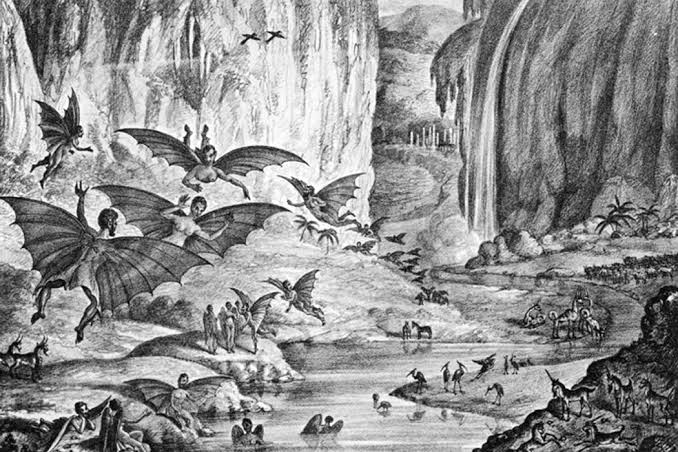
In late August 1835, readers of the New York Sun opened their papers to an astonishing story. Sir John Herschel, the most respected astronomer of his day, had reportedly built a telescope so powerful it could see the Moon’s surface in detail. And there, he had found life: bison, unicorns, and even winged human-like creatures. The public devoured the story, and the Sun’s circulation skyrocketed. There was just one problem: none of it was true.
The series ran for six days, from August 21 to August 31, 1835, and became one of the most famous hoaxes in journalism history. It showed how a fabricated story, wrapped in the authority of science, could fool thousands. But it also revealed something deeper about the era: a public hungry for wonder, a press willing to sell it, and the birth of mass media’s complicated relationship with the truth.
The Penny Press and the Hunger for Sensation
To understand the Moon Hoax, you have to understand the media landscape of 1830s New York. Before the penny press, newspapers were expensive—six cents or more—and aimed at merchants and elites. They were dense with shipping news and political debates. But in 1833, Benjamin Day launched the New York Sun, selling papers for just one cent. The price made it affordable to the working class, and Day filled it with crime stories, human-interest tales, and anything that would grab attention.
The Sun was a pioneer of what we now call sensationalism. Its goal was simple: sell more copies. And nothing sold copies like a good story, even if it wasn’t true. The Moon Hoax was the ultimate expression of that philosophy.
The Fabricated Telescope and Its ‘Discoveries’
The articles, attributed to a fictional supplement to the Edinburgh Journal of Science, described a colossal telescope built by Herschel with a 24-foot mirror, capable of magnifying objects up to 42,000 times. Through this telescope, Herschel had supposedly observed the Moon’s surface in exquisite detail: lush vegetation, seas, and forests. Then came the creatures.
First, there were bison, similar to those on Earth. Then, strange unicorns, with ‘a silvery hair, and a horn like a bright crystal.’ But the most sensational discovery was a race of winged beings, which the articles called ‘Vespertilio-homo’—bat-men. These creatures were described as ‘four feet high,’ with faces like those of humans, and wings that they used to fly. The descriptions were vivid, specific, and utterly invented.
The writing was so detailed, so matter-of-fact, that it carried the ring of truth. The Sun’s readers, many of whom had no scientific training, had no reason to doubt it.
Why Did People Believe It?
To modern eyes, it seems incredible that thousands of people believed in bat-men on the Moon. But in 1835, the public’s understanding of science was very different. Astronomy was a popular science, but telescopes were limited. The Moon’s surface had been mapped, but no one had seen any signs of life. The question of whether the Moon was inhabited was widely discussed, not just by scientists, but by theologians and the public.
One influential figure was the Reverend Thomas Dick, who had written popular books estimating the population of the solar system based on theological reasoning. He suggested that the Moon might be home to millions of inhabitants. Locke’s hoax was partly a parody of Dick’s speculative style—but the parody was too subtle. The public was already primed to believe in lunar life, and Herschel’s name gave the story unimpeachable authority.
Sir John Herschel was a legitimate celebrity scientist. His father, William Herschel, had discovered Uranus. John himself had done groundbreaking work on nebulae and double stars. When the articles claimed he had made these discoveries, the public had no way to verify them. And the Sun’s rivals, caught off guard, initially republished the story without checking.
The Aftermath: Exposure and Legacy
Within a few weeks, other newspapers began to investigate. They contacted the Edinburgh Journal of Science—and found it did not exist. The story was a fabrication. But the Sun never printed a formal retraction. The paper’s editor, Richard Adams Locke, eventually admitted he had written the series, claiming it was intended as a satire. The Sun, meanwhile, had already reaped the rewards: its circulation had soared from about 8,000 to over 19,000 copies per day, making it one of the best-selling papers in the world.
The hoax exposed the power of media to shape public belief, and the commercial incentives behind it. Sound familiar? The Moon Hoax is often cited as a precursor to modern ‘fake news’ and clickbait. In the 1830s, the Sun’s revenue depended on circulation, just as today’s digital media depend on clicks and ad views. The economic pressures are structurally similar: sensational stories, even false ones, sell.
The Satire That Wasn’t
Locke’s claim that the hoax was a satire is debated. The series was so detailed, so elaborate, that it seems unlikely it was purely a joke. But if it was satire, it failed spectacularly—because the public took it at face value. The line between satire and fraud is a thin one, and the Moon Hoax crossed it.
What’s more, the hoax had a lasting impact on science communication. It showed how scientific authority could be weaponized. Herschel, who was actually in South Africa at the time, doing real astronomical observations, was embarrassed by the affair. He reportedly dismissed it as a ‘silly hoax,’ but his name had been used to sell newspapers.
Lessons for Today
The Great Moon Hoax offers a cautionary tale that remains relevant. It reminds us that the public’s trust can be exploited, and that the desire for wonder can override skepticism. But it also highlights the importance of fact-checking and verification—skills that are as vital today as they were in 1835.
When you see a sensational claim, ask yourself: Who is making this claim? Can I verify it? The Sun’s readers didn’t ask those questions, and they were fooled. We can learn from their mistake.
The Great Moon Hoax of 1835 was more than a funny footnote in history. It was a landmark in the relationship between media, science, and the public. It showed how a fabricated story, dressed in the language of science, could captivate the world. And it revealed the economic pressures that can tempt journalists to prioritize sensation over truth. The bat-men of the Moon are long gone, but the lessons of the hoax remain: skepticism, verification, and the need to question what we read.
Summary
- The New York Sun published a six-part series in August 1835 claiming astronomer Sir John Herschel had discovered life on the Moon, including bison, unicorns, and winged humanoids.
- The story was entirely fabricated by Sun editor Richard Adams Locke, who later claimed it was intended as satire.
- The hoax boosted the Sun’s circulation from about 8,000 to over 19,000 copies per day.
- The public believed the story because of Herschel’s reputation, the plausibility of lunar life, and the lack of fact-checking in the era.
- The hoax is a foundational case study in journalism ethics and the dangers of sensationalism.
FAQ
Q: Who wrote the Great Moon Hoax?
A: The series was written by Richard Adams Locke, a British-born journalist and editor at the New York Sun. He later admitted authorship, though he claimed it was intended as a satire of astronomical speculation.
Q: Did anyone ever admit the hoax was false?
A: The Sun never printed a formal retraction. The hoax was exposed when other newspapers investigated and found that the Edinburgh Journal of Science, the supposed source, did not exist. Locke eventually admitted the fabrication.
Q: How did the hoax affect the New York Sun’s circulation?
A: The Sun’s circulation reportedly soared from about 8,000 to over 19,000 copies per day, making it one of the best-selling newspapers in the world at the time.
Q: Why did so many people believe the hoax?
A: People believed because Sir John Herschel was a trusted scientist, the claims seemed plausible given contemporary speculation about lunar life, and there was no infrastructure for fact-checking. The public’s desire for wonder also played a role.
Q: Is the Great Moon Hoax considered the first example of fake news?
A: It’s often cited as an early landmark in the history of fake news and tabloid journalism, demonstrating that sensational fabrication could drive circulation. However, it was not the first hoax, but it is one of the most famous.
Leave a Reply