In the spring of 1945, a lone American soldier stood on a bluff overlooking the Rhine River, puffing on a cigarette. Across the water, German artillery zeroed in on his position, sending shells whistling past. The soldier didn’t flinch. He was a decoy part of an elaborate ruse that had fooled the Germans into believing a massive Allied force was massing for an assault. In reality, he was one of 1,100 artists, actors, and sound engineers who had spent the past year staging the greatest theatrical production of World War II.
This was the Ghost Army, officially the 23rd Headquarters Special Troops, a unit so secret that its existence was classified for decades. Armed with inflatable tanks, fake radio traffic, and recordings of clanking armor, these men waged a war of illusion across Europe, saving thousands of lives without firing a shot. Their story, declassified in 1996 and honored with a Congressional Gold Medal in 2022, reveals how creativity became one of the Allies’ most potent weapons.
The Birth of a Deception
By early 1944, the Allies faced a brutal problem: how to invade Fortress Europe without being annihilated. The Germans had fortified the Atlantic Wall with millions of mines, concrete bunkers, and crack divisions. A successful landing required not just overwhelming force, but strategic surprise. The Allies needed to convince the Germans that the invasion would come somewhere other than Normandy.
Traditional deception—dummy camps, fake radio chatter—had been used before, but never with the sophistication the Allies now envisioned. So they assembled a unit unlike any other: the 23rd Headquarters Special Troops, activated in January 1944 in England. Its ranks were drawn from art schools, advertising agencies, and design firms. Among its members were fashion designer Bill Blass, painter Ellsworth Kelly, and photographer Art Kane. These were men trained to create beauty, not destruction—yet their canvas was the battlefield itself.
Three Kinds of Illusion
The Ghost Army operated in three parallel tracks, each designed to deceive a different German sense.
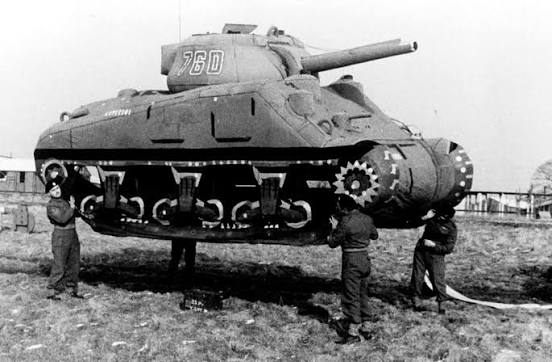
Visual Deception: The core of the unit’s arsenal was a collection of inflatable rubber tanks, trucks, artillery pieces, and even airplanes. From a distance—or through aerial reconnaissance—these balloons looked like real armor. The soldiers would carefully arrange them, draping them with camouflage netting, painting on shadows and highlights, and positioning them to mimic the chaotic layout of a genuine encampment. At night, they inflated them with air compressors; by dawn, a phantom division would appear where hours earlier there had been empty fields.
Radio Deception: The Germans were avid listeners to Allied radio frequencies. Ghost Army signalmen exploited this by creating fake radio traffic that mimicked the call signs, transmission patterns, and even the individual Morse code “fists” of real units. They would broadcast false orders, coordinate movements, and maintain a steady stream of chatter that made the phantom units seem alive. This was painstaking work—each operator had to learn the unique rhythms of the real operators they were impersonating.
Audio Deception: The most theatrical element was sound. Engineers recorded the roar of tanks, the rumble of artillery, and the shouts of troops—then played these recordings through massive speakers that could project sound up to 15 miles away. At night, the Ghost Army would broadcast the noise of a moving column: engines revving, tracks clanking, voices calling out. To German listening posts, it sounded like a full division was on the march.
The Theatrical Element
But the Ghost Army’s most audacious trick was human. Soldiers were trained to impersonate officers of real units. They would drive jeeps with the correct insignia, wear the right patches, and even visit local towns to be seen by German spies or sympathetic civilians. Some spoke fluent German and would spread false information in bars and cafes. One soldier, posing as a general, would drive past German observers with a map case full of fake documents.
This was not just camouflage—it was a performance. As one veteran later put it, “We were actors, and the stage was Europe.” The illusion was so convincing that German intelligence often reported Allied units in places where they had never set foot, and failed to spot the real units that were moving under the cover of their phantom counterparts.
Key Operations: Saving Lives with Illusion
The Ghost Army executed over 20 major operations between June 1944 and May 1945. Three stand out.
Operation Quicksilver (1944): The unit’s first major test came during the D-Day invasion. Their mission was to convince the Germans that the main Allied invasion would land at Pas-de-Calais, not Normandy. They deployed inflatable tanks and landing craft along the English coast, broadcast fake radio traffic, and even used sound effects to simulate the assembly of a massive invasion fleet. The ruse was so powerful that the Germans kept a full army group—nearly 200,000 troops—in reserve at Pas-de-Calais for weeks after the Normandy landings, waiting for an attack that never came.
Operation Viersen (March 1945): As the war neared its end, the Ghost Army executed one of its most critical deceptions. The U.S. 9th Army needed to cross the Rhine River, but the Germans held the opposite bank in strength. The Ghost Army deployed near Viersen, creating the illusion of a massive buildup across from a different section of the river. They inflated hundreds of dummy tanks, played recordings of bridging operations, and broadcast fake radio traffic. The Germans shifted their defenses to meet the phantom threat, leaving the real crossing point lightly guarded. The 9th Army crossed with minimal resistance—a success that likely saved thousands of lives.
Operation Bettembourg (1945): In the final weeks of the war, the Ghost Army drew German fire away from the real 6th Armored Division. By creating a fake armored column near Bettembourg, they tricked German artillery into wasting shells on empty fields. The real division moved unmolested, preserving its strength for the final push into Germany.
The Price of Secrecy
The Ghost Army’s work was so secret that even their own commanders struggled to acknowledge it. The unit’s existence was classified as top secret, and its members were sworn to silence. They were told that if they were captured, they would likely be executed as spies. After the war, the equipment was packed away, and the men returned to civilian life, carrying a secret they could not share.
For decades, the story remained unknown. The unit’s records were declassified in 1996, and veterans began to speak publicly. In 2022, the Ghost Army was awarded the Congressional Gold Medal, the highest civilian honor Congress can bestow. For the surviving members—and the families of those who had died—it was a long-overdue recognition of their extraordinary service.
Was It Effective? The Debate
While many historians credit the Ghost Army with saving thousands of lives, some caution against overstating its impact. The Germans were already plagued by intelligence failures and stretched thin across a collapsing front. Some operations, like Quicksilver, may have reinforced German misconceptions that were already forming. The exact number of lives saved is impossible to quantify.
Yet even skeptics acknowledge the unit’s uniqueness. The Ghost Army was the first dedicated tactical deception unit in American history, and its methods—combining visual, radio, and audio illusion—were revolutionary. Its legacy can be seen in modern psychological operations and the elaborate decoys used in conflicts from the Gulf War to the present day.
A Legacy of Artists and Illusionists
The Ghost Army’s story is also one of creative minds turned to destructive ends. Many of its members went on to become celebrated artists: Ellsworth Kelly became a pioneer of abstract painting, Bill Blass built a fashion empire, and Art Kane photographed some of the most iconic images of the 20th century. They brought to war the same skills that would later define their careers: an eye for detail, a talent for persuasion, and a deep understanding of how to make people see what they expect to see.
In that sense, the Ghost Army’s greatest deception was not on the battlefield—it was the irony that artists, trained to reveal truth, were turned into masters of falsehood. But as one veteran reflected, “In war, the lie that saves lives is the noblest truth.”
The Ghost Army remains one of World War II’s most extraordinary stories—a unit of 1,100 artists who fought with imagination instead of bullets. Their inflatable tanks never fired a shot, yet they helped divert German divisions, protect Allied crossings, and save countless lives. Declassified in 1996 and honored with a Congressional Gold Medal in 2022, their legacy endures as a testament to the power of creativity, even in the darkest of times.
Summary
- The Ghost Army (23rd Headquarters Special Troops) was a U.S. Army deception unit of about 1,100 men, active in Europe from June 1944 to May 1945.
- It used inflatable decoys, fake radio traffic, and sound recordings to fool German forces about Allied troop locations and movements.
- Key operations included Operation Quicksilver (D-Day cover), Operation Viersen (Rhine crossing), and Operation Bettembourg (drawing fire away from the 6th Armored Division).
- Members included notable artists like fashion designer Bill Blass, painter Ellsworth Kelly, and photographer Art Kane.
- The unit’s existence was top secret until 1996; it received the Congressional Gold Medal in 2022.
FAQ
Q: What was the Ghost Army?
A: The Ghost Army was the nickname for the U.S. Army’s 23rd Headquarters Special Troops, a tactical deception unit active in Europe during World War II. It used inflatable tanks, fake radio traffic, and sound effects to deceive German forces about Allied troop positions and strength.
Q: How did the Ghost Army fool the Nazis?
A: They used three main methods: visual deception (inflatable rubber tanks and artillery), radio deception (fake radio traffic mimicking real units), and audio deception (recordings of tank and troop movements played through speakers). They also used theatrical impersonation, with soldiers posing as officers of real units.
Q: What was the Ghost Army’s most famous operation?
A: Operation Quicksilver, which helped convince the Germans that the D-Day invasion would occur at Pas-de-Calais rather than Normandy. This deception kept German forces tied up in the wrong location for weeks.
Q: Was the Ghost Army successful?
A: Most historians credit it with saving thousands of lives by drawing enemy fire away from real units and creating confusion. Operations like Viersen helped the U.S. 9th Army cross the Rhine with minimal resistance. However, the exact strategic impact is debated.
Q: Why was the Ghost Army kept secret for so long?
A: The unit’s methods were classified as top secret to protect the techniques and the soldiers, who risked execution if captured. The story was declassified in 1996, and the unit received the Congressional Gold Medal in 2022.
Leave a Reply