Have you ever wondered why bread rises into a light, airy loaf while a flatbread stays dense? The answer lies in a series of chemical reactions that transform four basic ingredients into one of humanity’s oldest foods. This article unpacks the roles of flour, water, yeast, and salt, revealing the science of fermentation, gluten formation, and oven heat that creates the perfect loaf.
Understanding these processes not only satisfies curiosity but also helps bakers troubleshoot problems: why did my bread come out flat? Why is the crust pale? Why is the inside gummy? Each issue traces back to a chemical or physical principle. By the end, you’ll see bread as more than food—it’s a delicious experiment in chemistry.
The Four Essential Ingredients and Their Roles
Bread’s simplicity is deceptive. Flour, water, yeast, and salt combine in a delicate balance. Flour provides structure and food for yeast. Water hydrates proteins and enables enzymes. Yeast produces gas that leavens the dough. Salt strengthens gluten and controls fermentation.
Flour: The Foundation
Wheat flour stands out among grains because it contains two proteins—gliadin and glutenin—that form gluten when mixed with water. These proteins make up about 80% of wheat flour’s protein content. Other flours, like rye or corn, lack sufficient gluten-forming proteins, which is why they produce denser breads.
Water: The Activator
Water does more than moisten. It hydrates gliadin and glutenin, allowing them to bond. It also activates enzymes, such as amylases, which break down starch into sugars that yeast can consume. The amount of water relative to flour—called hydration—determines dough behavior. A 65% hydration dough is stiff and easy to handle, yielding a tight crumb. An 80% hydration dough is sticky and slack, but produces an open, airy crumb with large holes.
Yeast: The Leavening Agent
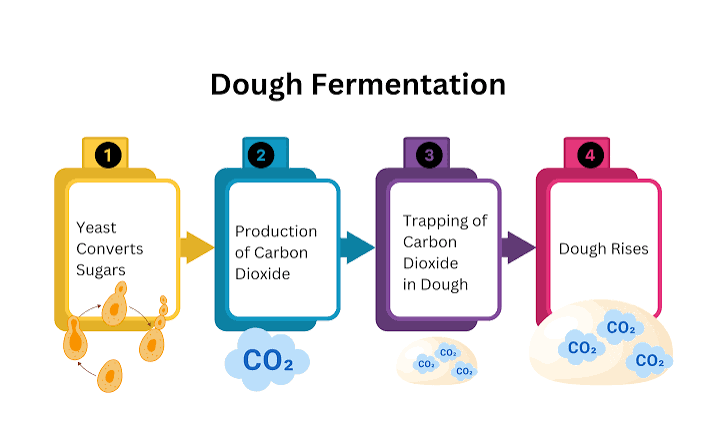
Yeast (Saccharomyces cerevisiae) is a single-celled fungus that feeds on sugars. When it metabolizes glucose, it produces carbon dioxide and ethanol. This process, called alcoholic fermentation, generates gas that becomes trapped in the gluten network, causing the dough to rise. Yeast also produces acids and other flavor compounds during fermentation.
Salt: The Regulator
Salt is often overlooked, but it has three key roles: it strengthens the gluten network, slows yeast activity (preventing over-fermentation), and enhances flavor. Without salt, dough ferments too quickly and becomes sticky and weak.
Fermentation: The Alchemy of Yeast
Fermentation is the heart of breadmaking. Yeast converts simple sugars—maltose, glucose, and fructose—into carbon dioxide and ethanol. The chemical equation is straightforward: C₆H₁₂O₆ → 2 C₂H₅OH + 2 CO₂ + energy. The carbon dioxide forms bubbles that inflate the dough.
Two Types of Fermentation
Most breads rely on alcoholic fermentation by yeast. But sourdough adds a second process: lactic acid fermentation by bacteria. These bacteria produce lactic and acetic acids, giving sourdough its tangy flavor and longer shelf life.
Temperature’s Influence
Yeast is temperature-sensitive. Its optimal activity range is 25–35°C (77–95°F). Below that, fermentation slows; above about 55°C (131°F), yeast dies. Bakers use this to their advantage: refrigerating dough (retardation) slows fermentation, developing flavor over hours or days. Conversely, a warm kitchen speeds proofing.
The Rise
During proofing, dough typically doubles or triples in volume as CO₂ accumulates. The gluten network stretches to contain the gas. If proofing goes too long, the gluten over-stretches and collapses, resulting in a flat loaf. If too short, the bread is dense.
Gluten: The Structural Marvel
Gluten is the protein network that gives bread its chew and structure. When water meets flour, gliadin and glutenin hydrate and bond. Gliadin contributes extensibility—the ability to stretch. Glutenin contributes elasticity—the ability to spring back. Together, they form a viscoelastic material that can trap gas and hold shape.
Kneading and Gluten Development
Kneading does two things: it aligns gluten proteins and promotes disulfide bond formation between them. These bonds create a strong, cross-linked network. Under-kneading leaves the dough weak and fragile. Over-kneading breaks the bonds, making the dough sticky and tearing easily.
Time as an Alternative to Kneading
You don’t have to knead to develop gluten. The no-knead method relies on time: over hours, enzymes and acids naturally strengthen the network. Similarly, autolyse—resting flour and water before adding yeast and salt—allows enzymes to break down proteins, improving extensibility without mechanical work.
The Oven: Where Chemistry Becomes Crust
Baking transforms the proofed dough into bread. The oven’s heat triggers several reactions, each at a specific temperature.
Oven Spring
In the first 10–15 minutes, CO₂ expands rapidly and water vaporizes, causing dough to spring upward. Steam in the oven—from a spray bottle or a Dutch oven—keeps the crust soft longer, allowing maximum expansion before the crust sets.
Maillard Reaction and Caramelization
The crust’s brown color and complex flavor come from two reactions. The Maillard reaction occurs between amino acids and reducing sugars at 140–165°C (285–330°F), producing hundreds of flavor compounds. Caramelization is the pyrolysis of sugars at higher temperatures (above 160°C/320°F). While both brown the crust, Maillard is the primary contributor to bread’s savory notes.
Gelatinization and Crumb Setting
As the interior heats, starches absorb water and swell at 60–70°C (140–158°F). This gelatinization sets the crumb structure. Proteins coagulate, and the dough firms into a loaf. The internal temperature of done bread reaches 93–96°C (200–205°F).
Practical Baking Tips from the Chemistry
Understanding these principles helps solve common issues:
- Dense crumb: Often under-proofing. Let the dough rise longer until it’s pillowy.
- Large, tunneled holes: Usually over-proofing. The gluten collapsed before baking.
- Pale crust: Oven too cool or no steam. Increase temperature and add steam.
- Burnt crust: Oven too hot or too much sugar in the dough. Lower temperature or reduce sugar.
Hydration and Crumb
Higher hydration doughs (80%) produce an open crumb with large, irregular holes—think ciabatta. Lower hydration (65%) yields a tight, fine crumb—like sandwich bread. Adjust water to achieve your desired texture.
The Role of Autolyse
Resting flour and water for 20–60 minutes before adding yeast and salt improves extensibility. This allows enzymes to break down proteins, making the dough easier to shape and giving a better rise.
Bread’s Rich History and Science
Bread has been made for at least 14,000 years, with leavened bread dating to around 4,000 BCE in Egypt, likely from wild yeast. Sourdough was the only leavening method until commercial yeast was isolated in the 19th century, following Louis Pasteur’s work on fermentation in 1857. The industrial revolution’s roller mills in the 1870s produced finer flour, changing gluten behavior and bread texture. Modern artisan baking revived long fermentations and sourdough, recognizing that time enhances flavor and digestibility.
Why This Matters Today
The COVID-19 lockdowns sparked a home-baking boom, with sourdough starters shared worldwide. People sought comfort and understanding in breadmaking. Meanwhile, gluten-free diets have created a demand to know what gluten actually does—and how to replace its structural role. Science demystifies bread, empowering bakers to create better loaves and appreciate the craft.
Bread is not just flour and water; it’s a symphony of chemistry. From yeast’s metabolic dance to gluten’s protein ballet and the oven’s heat-triggered reactions, every step is a precise chemical process. Next time you pull a golden loaf from the oven, remember: you’re not just baking—you’re conducting a delicious experiment.
Summary
- Fermentation: Yeast converts sugars into CO₂ and ethanol, making dough rise and creating flavor.
- Gluten: Gliadin and glutenin form a viscoelastic network that traps gas and gives structure.
- Oven heat: Maillard reaction and caramelization brown the crust; gelatinization sets the crumb.
- Temperature control: Yeast thrives at 25–35°C; oven spring needs steam; internal doneness at 93–96°C.
- Troubleshooting: Dense bread often under-proofed; pale crust needs higher heat or steam; open crumb requires higher hydration.
FAQ
Q: Why does my bread come out dense and heavy?
A: Dense bread usually results from under-proofing—the dough didn’t rise enough before baking. Let it proof until it’s pillowy and nearly doubled in volume. Also, ensure your yeast is fresh and active.
Q: What’s the difference between the Maillard reaction and caramelization?
A: Both brown food, but they’re different. Maillard requires amino acids and sugars, occurring at 140–165°C, producing savory flavors. Caramelization is pure sugar pyrolysis at higher temperatures, yielding nutty, sweet notes. In bread, Maillard is the main crust browning reaction.
Q: How does steam help bread in the oven?
A: Steam keeps the crust soft during the first minutes of baking, allowing the dough to expand fully (oven spring). Without steam, the crust sets too early, limiting rise. Use a Dutch oven or spray water to create steam.
Q: Why is sourdough bread more tangy?
A: Sourdough uses wild yeast and lactic acid bacteria. The bacteria produce lactic and acetic acids during fermentation, giving the bread its characteristic sour flavor and longer shelf life.
Q: Can I make bread without kneading?
A: Yes. The no-knead method uses time to develop gluten instead of mechanical kneading. Resting the dough for 12–18 hours allows enzymes and acids to strengthen the network naturally.
Leave a Reply