When you squeeze a balloon, the air molecules inside get closer together. But can we do the same to solids—pushing atoms so tight that they almost touch? The answer is both yes and no, and the reasons reveal some of the deepest truths about matter.
Atoms are not tiny billiard balls; they are fuzzy clouds of probability. The space between them is not empty but filled with electron waves and quantum fields. Understanding what limits compression—and what we can achieve with extreme pressure—is a journey into the heart of physics and materials science.
The Myth of Empty Space
It’s often said that atoms are 99.999% empty space. If you scaled a hydrogen atom to the size of a football stadium, the nucleus would be a pea at the center, and the electron would be a blur somewhere in the stands. But this picture is misleading. Electrons are not particles orbiting like planets; they are probability clouds. The ’empty’ space is actually filled with the electron’s wavefunction, which exerts real forces.
When two atoms approach each other, their electron clouds begin to overlap. Because electrons are fermions, they obey the Pauli exclusion principle: no two electrons can occupy the same quantum state. This creates a powerful repulsion that prevents atoms from merging. It’s like trying to push two magnets together with like poles facing—the closer you get, the harder it pushes back.
The Natural Distance: Equilibrium Spacing
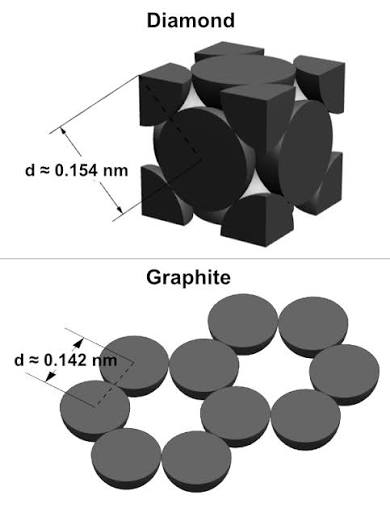
In a solid, atoms settle at a distance where attractive forces (like van der Waals or chemical bonds) balance the Pauli repulsion. This is called the equilibrium spacing. For most materials, it’s a few Ångströms—about 0.1 to 0.3 nanometers. For example, the distance between carbon atoms in a diamond is 1.54 Å, and in table salt (NaCl), it’s about 2.8 Å.
This spacing is not fixed. If you apply pressure, you can push atoms closer together, but only up to a point. The Pauli repulsion acts like a spring: the more you compress, the stronger it pushes back. Remove the pressure, and atoms spring back to their natural positions.
What We Can Do: Compression and Phase Changes
Everyday Compression
You don’t need a lab to see atoms squeezed together. When you pump air into a scuba tank, you’re compressing gas molecules from a spread-out state into a much smaller volume. The molecules are still far apart compared to a solid, but the space between them has decreased dramatically.
Extreme Pressure: Diamond Anvil Cells
For solids, scientists use diamond anvil cells—devices that squeeze a sample between two diamond tips. These can generate pressures over 500 GPa, which is about 5 million times atmospheric pressure. Under such conditions, materials undergo dramatic changes:
- Ice X: At about 60 GPa, water ice transforms into a superionic phase where hydrogen ions flow like a liquid through a solid oxygen lattice.
- Metallic Hydrogen: Predicted to form at around 400–500 GPa, hydrogen would become a metal and potentially a room-temperature superconductor. This remains one of the holy grails of high-pressure physics.
- Superhard Materials: Compressing boron nitride or other compounds can create materials harder than diamond, useful for cutting tools.
Phase Changes: Gas to Liquid to Solid
Changing temperature and pressure can also reduce interparticle spacing without ‘removing’ space. When a gas condenses into a liquid, molecules come much closer together. When a liquid freezes into a solid, they pack even tighter. This is a reversible process—no permanent ‘removal’ of space, but a rearrangement of matter into denser states.
What We Cannot Do: The Pauli Exclusion Principle
No matter how much pressure we apply, we cannot make atoms occupy the same volume. The Pauli exclusion principle is a fundamental law of quantum mechanics. It states that no two identical fermions (like electrons) can be in the same quantum state. When electron clouds overlap, this principle forces them to stay apart.
This is why matter doesn’t collapse. If it weren’t for Pauli repulsion, all atoms would collapse into a tiny, dense blob. The stability of everything—from your chair to your body—depends on this quantum effect.
Beyond the Limits: Degenerate Matter
In extreme astrophysical environments, gravity can compress matter so much that atoms lose their identity. In white dwarfs, electrons are squeezed into a degenerate gas, and the atoms are stripped of their electron clouds. In neutron stars, even protons and electrons merge to form neutrons. This is the ultimate compression, but it’s not something we can achieve on Earth—it requires the mass of a star.
The Future: Designing Dense Materials
Instead of just squeezing, scientists are learning to design materials with atoms packed more efficiently. Nanotechnology and crystal engineering allow us to create new structures with tailored properties. For example, graphene is a single layer of carbon atoms arranged in a honeycomb lattice—it’s incredibly strong and conducts electricity better than copper. By stacking layers or creating new arrangements, we can effectively ‘decrease spacing’ in a controlled way.
Machine learning is now helping predict how materials will behave under extreme pressure, opening up new possibilities for discovering superhard materials, high-temperature superconductors, and other exotic states.
Conclusion
So, can we remove or decrease spaces between atoms? We can decrease them—dramatically—by applying pressure or changing phase. But we cannot remove them entirely. The Pauli exclusion principle sets a hard limit that no amount of force can overcome. Understanding this limit not only explains why matter is stable but also guides us in creating new materials with extraordinary properties. The space between atoms is not empty; it’s a battleground of quantum forces, and we are just beginning to master it.
The space between atoms is not a void to be filled but a dynamic region governed by quantum mechanics. While we can compress matter to incredible densities, the Pauli exclusion principle ensures that atoms will never truly touch. This fundamental limit is not a barrier but a feature—it gives matter its solidity and stability. As we continue to explore extreme conditions and design new materials, we are learning to work within these quantum constraints to create technologies once thought impossible.
Summary
- Atoms never truly touch; the space between them is governed by quantum mechanics, specifically the Pauli exclusion principle.
- We can decrease interatomic spacing by applying pressure (e.g., diamond anvil cells) or changing phase (gas → liquid → solid).
- Extreme pressure can create exotic states like metallic hydrogen or superhard materials.
- The Pauli exclusion principle sets an absolute limit: atoms cannot occupy the same volume.
- Materials science and nanotechnology offer ways to design denser arrangements without brute force.
FAQ
Q: Can we make atoms touch each other?
A: No, atoms never truly touch in the classical sense. The electron clouds repel each other due to the Pauli exclusion principle, creating a ‘hard wall’ that prevents them from merging.
Q: What is the smallest distance between atoms?
A: The equilibrium spacing in a solid is typically 1–3 Ångströms (10⁻¹⁰ meters). Under extreme pressure, this can be reduced, but not to zero.
Q: How do diamond anvil cells work?
A: They squeeze a tiny sample between two diamond tips, generating pressures over 500 GPa. This compresses materials to a fraction of their normal volume, often creating new phases.
Q: Is metallic hydrogen real?
A: It’s predicted to exist at pressures around 400–500 GPa, but experimental confirmation is still debated. If created, it could be a room-temperature superconductor.
Q: Why don’t atoms collapse under pressure?
A: The Pauli exclusion principle prevents electrons from occupying the same quantum state, creating a repulsive force that resists compression. This is why matter is stable.
Leave a Reply