Tag: materials science

  • The Accidental Discovery of Teflon: How a Failed Refrigerant Experiment Revolutionized Materials Science

    The Accidental Discovery of Teflon: How a Failed Refrigerant Experiment Revolutionized Materials Science

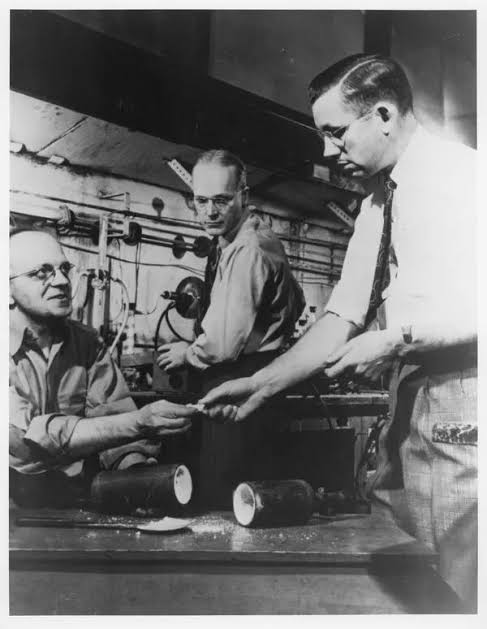
    On April 6, 1938, a 27-year-old chemist at DuPont’s Jackson Laboratory in Deepwater, New Jersey, opened a pressurized cylinder expecting to release a gas. Nothing came out. The cylinder weighed as much as it did when full, so the gas had to be inside—but it wouldn’t flow. Perplexed, Roy Plunkett and his assistant Jack Rebok sawed the cylinder open. Inside, they found a white, waxy powder coating the interior. That powder was polytetrafluoroethylene (PTFE), which would later become known as Teflon, one of the most versatile and non-stick substances ever discovered.

    This wasn’t the result of a carefully planned experiment; it was a failure. Plunkett had been trying to create a new chlorofluorocarbon refrigerant, not a miracle material. Yet his reaction to that failure—curiosity rather than frustration—turned a laboratory mishap into a world-changing discovery. The story of Teflon is a perfect example of how scientific breakthroughs often come from unexpected places, and how the ability to recognize the value of an accident can be just as important as the original goal.

    What Was the Experiment Supposed to Do?

    In the 1930s, the refrigerant industry was in a state of flux. The refrigerants used in household appliances—ammonia, sulfur dioxide, and methyl chloride—were toxic and flammable. A leak could sicken or even kill a family. DuPont was racing to develop safer alternatives, building on the work of Thomas Midgley Jr., who had created Freon (a chlorofluorocarbon) in 1928.

    Plunkett’s task was to synthesize a new CFC refrigerant. He was working with tetrafluoroethylene (TFE), a gas that under the right conditions could be polymerized into a solid. To prevent premature polymerization, he stored the TFE in pressurized cylinders kept in dry ice (solid carbon dioxide) at extremely low temperatures.

    The Day the Gas Disappeared

    On that April morning, Plunkett and Rebok opened a cylinder of TFE to add to their reaction setup. To their surprise, no gas came out. The pressure gauge showed zero, but the cylinder’s weight indicated it was still full. They checked the valve, thinking it might be clogged. It wasn’t. After weeks of troubleshooting, they finally resorted to sawing the cylinder open.

    What they found was a white, waxy powder lining the inside. The gas had spontaneously polymerized into a solid—polytetrafluoroethylene (PTFE)—without any catalyst or initiator. The molecules had linked together into long chains, forming a new material with extraordinary properties.

    Why Teflon Is So Special

    PTFE is a simple polymer: a carbon backbone with fluorine atoms attached. But that simplicity belies its remarkable characteristics. It has one of the lowest coefficients of friction of any known solid—things slide off it effortlessly. It is chemically inert, resisting nearly all acids, bases, and solvents. It can withstand temperatures from -200°C to +260°C, making it stable in extreme heat and cold. And it repels water and oils, which is why it’s hydrophobic.

    To understand why Teflon is so slippery, imagine a microscopic dance floor. The carbon-fluorine bonds are incredibly strong, and the fluorine atoms form a protective sheath around the carbon chain. This makes the surface non-reactive and gives it a low surface energy, so other molecules have a hard time grabbing on. It’s like a well-waxed floor: nothing sticks to it.

    From Laboratory Curiosity to Cold War Secret

    Plunkett recognized that he had stumbled onto something new, but he didn’t know what to do with it. DuPont filed a patent in 1939, which was granted in 1941. They trademarked the name “Teflon” in 1944. But the material might have languished as a novelty if not for World War II.

    The Manhattan Project needed to enrich uranium for the atomic bomb, a process that involved handling uranium hexafluoride (UF6)—a highly corrosive gas that ate through most materials. Scientists needed a substance that could withstand it for seals and gaskets in the gaseous diffusion equipment. Teflon was the only material that could do the job. Its chemical inertness made it perfect for this military application.

    This wartime use accelerated Teflon’s development and proved its worth in demanding conditions. It also meant that Teflon was classified as secret material during the war, hidden from public knowledge until the project declassified it.

    From Military Secret to Kitchen Staple

    After the war, DuPont began commercial production of Teflon in 1946. But finding civilian applications took time. It wasn’t until 1954 that French engineer Marc Grégoire, who had been using Teflon on fishing tackle to prevent tangles, had a eureka moment. His wife Colette suggested he try it on her frying pan. Grégoire developed a method to bond Teflon to aluminum cookware, and the “Tefal” brand was born.

    However, early Teflon cookware had a serious problem: the coating flaked off. It wasn’t until Grégoire perfected surface etching techniques that the coating adhered properly. In 1961, Teflon frying pans hit the U.S. market, and the “non-stick” revolution began.

    The Environmental and Health Legacy

    Teflon’s success came with a hidden cost. For decades, the manufacturing process used a chemical called perfluorooctanoic acid (PFOA), which is persistent in the environment and has been linked to kidney cancer, testicular cancer, and thyroid disease. DuPont phased out PFOA by 2013, but Teflon belongs to a broader class of chemicals called PFAS, often called “forever chemicals” because they don’t break down in the environment. This has led to ongoing concerns about their impact on ecosystems and human health.

    The story of Teflon is a reminder that every technological advance carries both benefits and risks. But it also highlights the power of scientific curiosity. Plunkett could have dismissed the failed cylinder as a waste of time. Instead, he investigated, and his willingness to follow the unexpected changed the world.

    Roy Plunkett’s discovery of Teflon was not a deliberate search for a non-stick substance or a corrosion-resistant material. It was a failed experiment that he chose to understand rather than discard. His story illustrates that scientific progress often depends not just on preparation and knowledge, but on the ability to recognize the potential in an accident. From refrigerants to atomic bombs to frying pans, Teflon’s journey shows how a single serendipitous moment can ripple through history in ways no one could have predicted.

    Summary

    • On April 6, 1938, Roy Plunkett discovered Teflon by accident when a cylinder of tetrafluoroethylene gas unexpectedly polymerized into a solid white powder.
    • Teflon (PTFE) has unique properties: extremely low friction, chemical inertness, heat resistance, and hydrophobicity.
    • Teflon’s first major use was in the Manhattan Project to handle corrosive uranium hexafluoride, accelerating its development.
    • It took 20 years for Teflon to become a consumer product, when Marc Grégoire applied it to cookware in 1954, leading to the Tefal brand.
    • Teflon manufacturing used PFOA, a harmful “forever chemical,” highlighting the environmental and health trade-offs of this discovery.

    FAQ

    Q: Was Teflon discovered completely by accident?
    A: Yes, the material was discovered by accident, but Roy Plunkett’s scientific training enabled him to recognize the significance of the unexpected polymerization. As Louis Pasteur said, “Chance favors the prepared mind.”

    Q: What is Teflon made of?
    A: Teflon is made of polytetrafluoroethylene (PTFE), a polymer consisting of carbon atoms bonded to fluorine atoms. This structure gives it its non-stick and heat-resistant properties.

    Q: Why was Teflon important during World War II?
    A: Teflon was critical for the Manhattan Project because it could withstand the corrosive effects of uranium hexafluoride (UF6), which was used in the process of enriching uranium for atomic bombs.

    Q: Is Teflon still used today?
    A: Yes, Teflon is used in a wide range of applications, including non-stick cookware, waterproof fabrics, electrical insulation, and industrial equipment. However, the use of PFOA in its manufacturing has been phased out due to health concerns.

    Q: What are the health concerns associated with Teflon?
    A: The main health concerns are linked to PFOA, a chemical formerly used in Teflon production. PFOA has been associated with kidney cancer, testicular cancer, and thyroid disease. Modern Teflon is produced without PFOA, but PTFE itself is generally considered safe for consumer use.
  • Can We Squeeze the Space Between Atoms? The Physics of Compression

    Can We Squeeze the Space Between Atoms? The Physics of Compression

    When you squeeze a balloon, the air molecules inside get closer together. But can we do the same to solids—pushing atoms so tight that they almost touch? The answer is both yes and no, and the reasons reveal some of the deepest truths about matter.

    Atoms are not tiny billiard balls; they are fuzzy clouds of probability. The space between them is not empty but filled with electron waves and quantum fields. Understanding what limits compression—and what we can achieve with extreme pressure—is a journey into the heart of physics and materials science.

    The Myth of Empty Space

    It’s often said that atoms are 99.999% empty space. If you scaled a hydrogen atom to the size of a football stadium, the nucleus would be a pea at the center, and the electron would be a blur somewhere in the stands. But this picture is misleading. Electrons are not particles orbiting like planets; they are probability clouds. The ’empty’ space is actually filled with the electron’s wavefunction, which exerts real forces.

    When two atoms approach each other, their electron clouds begin to overlap. Because electrons are fermions, they obey the Pauli exclusion principle: no two electrons can occupy the same quantum state. This creates a powerful repulsion that prevents atoms from merging. It’s like trying to push two magnets together with like poles facing—the closer you get, the harder it pushes back.

    The Natural Distance: Equilibrium Spacing

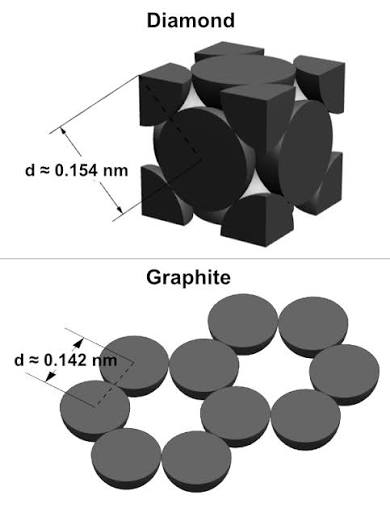
    In a solid, atoms settle at a distance where attractive forces (like van der Waals or chemical bonds) balance the Pauli repulsion. This is called the equilibrium spacing. For most materials, it’s a few Ångströms—about 0.1 to 0.3 nanometers. For example, the distance between carbon atoms in a diamond is 1.54 Å, and in table salt (NaCl), it’s about 2.8 Å.

    This spacing is not fixed. If you apply pressure, you can push atoms closer together, but only up to a point. The Pauli repulsion acts like a spring: the more you compress, the stronger it pushes back. Remove the pressure, and atoms spring back to their natural positions.

    What We Can Do: Compression and Phase Changes

    Everyday Compression

    You don’t need a lab to see atoms squeezed together. When you pump air into a scuba tank, you’re compressing gas molecules from a spread-out state into a much smaller volume. The molecules are still far apart compared to a solid, but the space between them has decreased dramatically.

    Extreme Pressure: Diamond Anvil Cells

    For solids, scientists use diamond anvil cells—devices that squeeze a sample between two diamond tips. These can generate pressures over 500 GPa, which is about 5 million times atmospheric pressure. Under such conditions, materials undergo dramatic changes:

    • Ice X: At about 60 GPa, water ice transforms into a superionic phase where hydrogen ions flow like a liquid through a solid oxygen lattice.
    • Metallic Hydrogen: Predicted to form at around 400–500 GPa, hydrogen would become a metal and potentially a room-temperature superconductor. This remains one of the holy grails of high-pressure physics.
    • Superhard Materials: Compressing boron nitride or other compounds can create materials harder than diamond, useful for cutting tools.

    Phase Changes: Gas to Liquid to Solid

    Changing temperature and pressure can also reduce interparticle spacing without ‘removing’ space. When a gas condenses into a liquid, molecules come much closer together. When a liquid freezes into a solid, they pack even tighter. This is a reversible process—no permanent ‘removal’ of space, but a rearrangement of matter into denser states.

    What We Cannot Do: The Pauli Exclusion Principle

    No matter how much pressure we apply, we cannot make atoms occupy the same volume. The Pauli exclusion principle is a fundamental law of quantum mechanics. It states that no two identical fermions (like electrons) can be in the same quantum state. When electron clouds overlap, this principle forces them to stay apart.

    This is why matter doesn’t collapse. If it weren’t for Pauli repulsion, all atoms would collapse into a tiny, dense blob. The stability of everything—from your chair to your body—depends on this quantum effect.

    Beyond the Limits: Degenerate Matter

    In extreme astrophysical environments, gravity can compress matter so much that atoms lose their identity. In white dwarfs, electrons are squeezed into a degenerate gas, and the atoms are stripped of their electron clouds. In neutron stars, even protons and electrons merge to form neutrons. This is the ultimate compression, but it’s not something we can achieve on Earth—it requires the mass of a star.

    The Future: Designing Dense Materials

    Instead of just squeezing, scientists are learning to design materials with atoms packed more efficiently. Nanotechnology and crystal engineering allow us to create new structures with tailored properties. For example, graphene is a single layer of carbon atoms arranged in a honeycomb lattice—it’s incredibly strong and conducts electricity better than copper. By stacking layers or creating new arrangements, we can effectively ‘decrease spacing’ in a controlled way.

    Machine learning is now helping predict how materials will behave under extreme pressure, opening up new possibilities for discovering superhard materials, high-temperature superconductors, and other exotic states.

    Conclusion

    So, can we remove or decrease spaces between atoms? We can decrease them—dramatically—by applying pressure or changing phase. But we cannot remove them entirely. The Pauli exclusion principle sets a hard limit that no amount of force can overcome. Understanding this limit not only explains why matter is stable but also guides us in creating new materials with extraordinary properties. The space between atoms is not empty; it’s a battleground of quantum forces, and we are just beginning to master it.

    The space between atoms is not a void to be filled but a dynamic region governed by quantum mechanics. While we can compress matter to incredible densities, the Pauli exclusion principle ensures that atoms will never truly touch. This fundamental limit is not a barrier but a feature—it gives matter its solidity and stability. As we continue to explore extreme conditions and design new materials, we are learning to work within these quantum constraints to create technologies once thought impossible.

    Summary

    • Atoms never truly touch; the space between them is governed by quantum mechanics, specifically the Pauli exclusion principle.
    • We can decrease interatomic spacing by applying pressure (e.g., diamond anvil cells) or changing phase (gas → liquid → solid).
    • Extreme pressure can create exotic states like metallic hydrogen or superhard materials.
    • The Pauli exclusion principle sets an absolute limit: atoms cannot occupy the same volume.
    • Materials science and nanotechnology offer ways to design denser arrangements without brute force.

    FAQ

    Q: Can we make atoms touch each other?
    A: No, atoms never truly touch in the classical sense. The electron clouds repel each other due to the Pauli exclusion principle, creating a ‘hard wall’ that prevents them from merging.

    Q: What is the smallest distance between atoms?
    A: The equilibrium spacing in a solid is typically 1–3 Ångströms (10⁻¹⁰ meters). Under extreme pressure, this can be reduced, but not to zero.

    Q: How do diamond anvil cells work?
    A: They squeeze a tiny sample between two diamond tips, generating pressures over 500 GPa. This compresses materials to a fraction of their normal volume, often creating new phases.

    Q: Is metallic hydrogen real?
    A: It’s predicted to exist at pressures around 400–500 GPa, but experimental confirmation is still debated. If created, it could be a room-temperature superconductor.

    Q: Why don’t atoms collapse under pressure?
    A: The Pauli exclusion principle prevents electrons from occupying the same quantum state, creating a repulsive force that resists compression. This is why matter is stable.