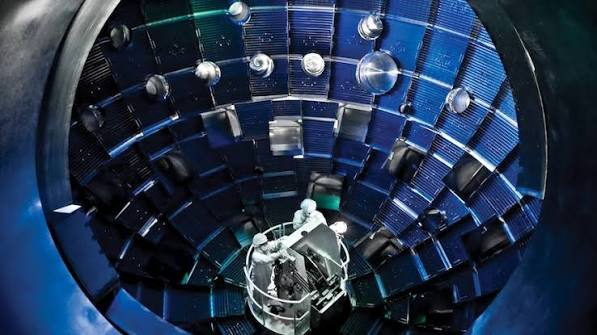
Every fusion experiment so far has needed a hefty external push like a car that needs to be push-started. But a ‘burning plasma’ flips that: the fusion reactions themselves provide enough heat to keep going, like an engine that’s finally turned over. This isn’t just a physics curiosity; it’s the essential bridge between proving fusion works and building a power plant that could light our cities.
In a deuterium-tritium (D-T) fusion reaction, two heavy forms of hydrogen merge to create a helium nucleus (an alpha particle) and a neutron. The alpha particle carries 3.5 MeV of energy, and the neutron takes 14.1 MeV. In a burning plasma, those alpha particles are trapped by the magnetic field and dump their energy into the surrounding fuel, becoming the dominant heat source. This self-heating is what could make fusion a practical, nearly limitless energy source. But we haven’t achieved it yet though ITER and private projects like SPARC are racing to be first.
The Promise of Self-Heating
Think of a campfire. You start with kindling and a match that’s your external heating, like the powerful antennas and particle beams used to heat fusion fuel. Once the logs catch, the fire sustains itself; the heat from burning wood keeps the fire going. A burning plasma is the fusion equivalent of the logs catching. The alpha particles—helium nuclei born from fusion—are the ‘burning wood.’ They collide with the plasma, transferring their energy and keeping the fuel at the 150-million-degree temperatures needed for fusion.
The key measure is Q, the ratio of fusion power to external heating power. A burning plasma typically needs Q > 5, meaning the fusion reactions produce at least five times more power than we put in. Ignition, the theoretical limit, is Q = ∞, where external heating is turned off entirely. Even reaching Q ~ 10, as ITER aims to do, would be a monumental leap from current experiments, which have only managed Q around 0.67.
Why We’ve Never Seen a Burning Plasma
No experiment to date has achieved a burning plasma. The closest was JET in the UK, which in 2022 set a record by producing 59 megajoules of fusion energy in a five-second pulse, reaching Q ≈ 0.67. That means external heating still provided about 60% of the power. The plasma was self-heating, but not dominant.
The challenge is meeting the Lawson criterion—a triple product of density, temperature, and energy confinement time. For D-T fusion, you need n·T·τ_E ≥ 3 × 10²¹ m⁻³·keV·s. This is like trying to hit a moving target: if you raise density, you risk instabilities; if you raise temperature, you lose energy faster; if you lengthen confinement, you must control turbulence. Every experiment so far has fallen short on at least one metric.
The Alpha Particle Balancing Act
Alpha particles are born with 3.5 MeV of energy—about a million times the thermal energy of the plasma. They must be confined long enough to slow down and heat the fuel. But they can also drive instabilities, like toroidal Alfvén eigenmodes (TAEs), which can kick them out prematurely. It’s like trying to keep a hot potato in your hands: if you hold it too tightly, you burn yourself; if you let go, you lose the heat. Researchers are studying these instabilities intensely, because they could make or break a burning plasma.
ITER: The Big Test
ITER, under construction in France, is designed to be the first burning plasma experiment. With a major radius of 6.2 meters, a plasma current of 15 million amperes, and a magnetic field of 5.3 tesla, it aims to produce 500 megawatts of fusion power from 50 megawatts of input—a Q of 10. That’s a tenfold return, a threshold that would prove self-heating can dominate.
But ITER has faced decades of delays and cost overruns. First plasma is now expected around 2034–2035, and D-T operation in the late 2030s. Some critics worry about the timeline, but ITER’s mission is not just to hit Q = 10; it’s to study the physics of burning plasmas in a sustained way. How do alpha particles behave over long pulses? Can we control the burn rate? These answers are crucial for designing DEMO, the first fusion power plant.
The Private Sector Sprint
While ITER plods along, private companies are pushing for faster timelines. Commonwealth Fusion Systems and MIT are building SPARC, a compact tokamak using high-temperature superconducting magnets. SPARC is designed to achieve Q > 2 in its first campaign, and Q > 10 later. If successful, it could demonstrate a burning plasma in the mid-2020s to early 2030s—years before ITER.
The private race isn’t just about speed; it’s about innovation. HTS magnets allow smaller, cheaper devices, which could accelerate the path to commercialization. But the physics remains the same. Even a compact device must tame the alpha particles.
What a Burning Plasma Will Teach Us
A burning plasma isn’t just a milestone; it’s a new regime. In sub-burning experiments, external heating dominates, and the plasma’s behavior is largely driven by those inputs. In a burning plasma, the fusion reactions themselves shape the plasma’s evolution. This could lead to self-organized states, where turbulence and instabilities adjust to maintain a stable burn. It might also enable ‘burn control’—adjusting fuel supply or injection to regulate fusion power in real time, like a throttle on a reactor.
These are phenomena we can’t study in today’s devices. They require a plasma where alpha heating is the main player. That’s why scientists are so eager to get there, despite the challenges.
A burning plasma is the moment when fusion stops being an expensive physics experiment and starts resembling a power source. It’s the difference between a prototype and a product. ITER and SPARC are racing to cross that line, but the journey is as important as the destination. Every instability they study, every alpha particle they track, brings us closer to a future where fusion could provide clean, abundant energy. The next decade will tell whether we finally light that fire.
Summary
- A burning plasma is one where alpha particles from fusion reactions provide the dominant heating, requiring Q > 5.
- No experiment has achieved it yet; JET’s 2022 record was Q ≈ 0.67.
- ITER aims for Q = 10 and will be the first burning plasma experiment, but faces delays.
- Private projects like SPARC use high-temperature superconductors to accelerate timelines.
- Understanding alpha particle confinement and instabilities is key to making burning plasmas work.
FAQ
Q: What is a burning plasma exactly?
A: A burning plasma is a fusion plasma where the energy from fusion reactions (specifically alpha particles) provides more heating than all external sources combined. It’s self-sustaining, like a log fire that has caught.
Q: Why hasn’t a burning plasma been achieved yet?
A: Because it requires meeting the Lawson criterion—a precise combination of density, temperature, and confinement time—which has been elusive. Experiments like JET have come close (Q ≈ 0.67) but haven’t crossed the threshold where alpha heating dominates.
Q: How does ITER plan to achieve a burning plasma?
A: ITER is designed to produce 500 MW of fusion power from 50 MW of input, a Q of 10. Its large size and powerful magnetic field are intended to meet the Lawson criterion and sustain a burning plasma.
Q: What is the significance of Q = 10?
A: Q = 10 means fusion produces ten times more power than is put in. This demonstrates that self-heating is dominant, a necessary condition for a practical power plant.
Q: What are the risks of alpha particles in a burning plasma?
A: Alpha particles can drive instabilities like toroidal Alfvén eigenmodes, which cause them to escape and reduce self-heating. Managing these instabilities is a major research challenge.
Leave a Reply