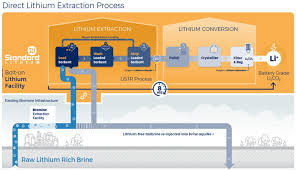
For over a century, the standard way to get lithium from salty underground water was to pump it into giant ponds and let the sun do the work. That process takes 12 to 24 months, and even then, it recovers only 30–50% of the lithium in the brine. Now, a suite of technologies collectively called Direct Lithium Extraction (DLE) promises to cut that time to hours or days and boost recovery to 70–90% or more. This matters because lithium is the backbone of the rechargeable battery revolution, and demand is projected to grow five to tenfold by 2040. DLE could unlock vast new sources of lithium, from geothermal brines in California’s Salton Sea to oilfield brines in Arkansas and Alberta, that were previously too dilute or too slow to process.
But DLE isn’t a single technology it’s a family of approaches, each with its own strengths and weaknesses. Adsorption uses materials that grab lithium ions like a sponge, ion exchange swaps ions on resin beads, solvent extraction dissolves lithium into organic liquids, and membranes or electric fields push lithium through selective barriers. Every brine is different, with varying amounts of magnesium, calcium, and silica that can clog or poison the equipment. As of 2024–2025, no DLE plant is yet running at full commercial scale for battery-grade lithium, but pilot plants are operating in Argentina, Arkansas, and elsewhere, with first commercial production projected between 2025 and 2027. The promise is enormous, but so are the engineering challenges.
The Problem with Evaporation Ponds
Imagine you have a huge, shallow swimming pool filled with salty water. You let the sun and wind evaporate the water for a year or two, and what’s left is a concentrated soup of minerals, including lithium. That’s the traditional method used in Chile’s Atacama Desert and other arid regions. It works, but it’s slow and land-hungry. A single operation can sprawl over thousands of acres, and the dry climate needed to speed evaporation isn’t available everywhere. Plus, the process loses a lot of lithium up to half of it stays in the brine or gets locked up in waste.
The lithium that does get recovered is then processed through chemical precipitation and carbonation to make lithium carbonate, which is typically 99.5% pure or better the “battery-grade” purity that goes into cathodes. That final product is what battery makers buy. DLE aims to skip the ponds entirely by pulling lithium directly out of the brine with engineered materials and processes, right at the source.
How DLE Works: Four Main Approaches
DLE technologies can be grouped into four families, each with its own mechanism:
Adsorption: The Sponge Method
Adsorption uses solid materials with a special affinity for lithium ions. A common type is lithium-aluminum layered double hydroxide, which has a crystal structure that traps lithium ions while letting other ions like sodium and magnesium pass by. When brine flows through a column packed with these sorbent granules, lithium sticks to the surface. Later, washing the sorbent with fresh water releases the lithium, producing a concentrated lithium solution. Companies like Eramet, Standard Lithium, and Rio Tinto are testing this approach. It’s relatively simple and low-energy, but the sorbents can be fragile and may need frequent replacement.
Ion Exchange: The Swap Meet
Ion exchange uses resin beads covered with chemical groups that specifically bind lithium. As brine flows over the beads, lithium ions swap places with other ions (like sodium or hydrogen) attached to the beads. When the beads are saturated, they’re regenerated with an acid or brine solution, which releases the lithium in a concentrated form. Schlumberger (SLB) and Summit Nanotech are among the companies developing ion-exchange resins. This method can be very selective, but the acids used for regeneration can be corrosive and create waste.
Solvent Extraction: The Liquid Lifter
Solvent extraction relies on organic solvents that preferentially dissolve lithium from brine. The brine is mixed with the solvent, which grabs the lithium, and then the lithium is stripped back into a clean water phase. Tenova Advanced Technologies and Sunresin are working on this. Solvent extraction can handle high flow rates and is already used in mining for other metals, but the organic solvents can be flammable or toxic, and they must be carefully managed.
Membrane and Electrochemical: The Filter and the Magnet
Membrane processes use physical barriers with tiny pores or selective coatings that let lithium pass while blocking other ions, often driven by pressure or an electric field. Electrochemical methods, like those from Lilac Solutions and Volt Lithium, use electric currents to pull lithium into electrode materials, similar to how a battery charges. These methods can be very fast and efficient, but they require a steady supply of electricity, and the membranes or electrodes can foul with silica or calcium scale.
Each technology has trade-offs between selectivity, speed, energy use, cost, and robustness. No single approach works for every brine, which is why the industry is hedging its bets across multiple types.
Why DLE Is a Big Deal Now
The push for DLE comes down to three factors: demand, supply bottlenecks, and new resources.
Demand: Electric vehicles and grid storage are driving an unprecedented need for lithium. By 2030, demand could be five to ten times higher than it is today. Current production from Australian hard-rock mines (spodumene) and South American brine ponds can’t scale fast enough.
Supply bottlenecks: Hard-rock mining involves drilling, blasting, crushing, and roasting—an energy-intensive process that can take years to permit. Evaporation ponds need dry, sunny climates and vast flat land, which limits where they can be built. Both methods have environmental impacts that draw community opposition. DLE offers a faster, smaller-footprint alternative that can be deployed modularly, almost like stacking shipping containers.
New resources: DLE can process brines that were previously considered too dilute or too contaminated to be economic. The geothermal brines beneath California’s Salton Sea are rich in lithium, but they’re also hot and full of silica—a nightmare for traditional processing. Oilfield brines from places like Arkansas’s Smackover Formation or Alberta’s oil sands contain lithium as a byproduct, but they’re not in arid climates, so evaporation ponds are out of the question. DLE can tap these stranded resources, potentially opening up huge new supply streams right in the United States and Canada.
The Hard Part: Real-World Brines Are Messy
Every brine is a unique cocktail of minerals. Some have high magnesium, which makes it hard to separate lithium. Others have lots of calcium, which can precipitate and clog equipment. Silica is a notorious troublemaker—it forms gummy deposits that foul membranes and sorbents. Then there’s boron, sulfate, and organic matter, all of which can interfere with extraction.
That’s why DLE isn’t a one-size-fits-all solution. Companies must tailor the technology to the specific brine chemistry, often with extensive pilot testing. For example, Standard Lithium’s project in Arkansas processes brine from an existing chemical plant, which already has some impurities removed. Rio Tinto’s Rincon project in Argentina is testing adsorption in the high-altitude puna desert, where the brine is cold and dilute.
Energy and chemicals are another trade-off. Adsorption and ion exchange may need fresh water to wash the sorbent, which can be scarce in arid regions. Solvent extraction and electrochemical methods need electricity, which might come from fossil fuels unless the project is paired with solar or geothermal power. And producing battery-grade lithium hydroxide directly from DLE is harder than making carbonate—many DLE outputs need a downstream polishing step to reach the purity and crystalline form that battery makers want.
Environmental Promise and Skepticism
DLE’s biggest selling point is environmental: it uses only 1–5% of the land area of evaporation ponds, and it doesn’t lose water to evaporation. The spent brine can be reinjected underground, reducing surface disposal and visual impact. That’s a big win in places like the Atacama, where water scarcity is a serious issue.
But skeptics raise valid concerns. Reinjection wells can cause induced seismicity or leak into aquifers if not properly sealed. Some DLE processes need fresh water to wash sorbents, which could actually increase freshwater consumption in water-stressed areas. And the energy and chemicals used in extraction may have a carbon footprint that isn’t as low as claimed. Indigenous communities and local groups have also questioned whether DLE really benefits them, or whether it’s just another form of resource extraction with its own risks.
These are open questions, not settled facts. The companies developing DLE are working on these issues, but the long-term sustainability of the technology will depend on how well they address them.
Where DLE Stands Today
As of 2024–2025, no DLE plant is operating at full commercial scale for battery-grade lithium. But several pilot and demonstration plants are running. Standard Lithium has been testing its adsorption system in Arkansas for years. Eramet is building a plant in Argentina’s Salar de Centenario. Rio Tinto is developing the Rincon project. SLB is piloting ion exchange in Arkansas, and Lilac Solutions is working on its electrochemical method in the Salton Sea. ExxonMobil entered the picture in 2023 by buying brine acreage in Arkansas, signaling that even the oil giants see DLE as the future.
The consensus target is that the first commercial DLE plants will come online between 2025 and 2027. But that schedule could slip, given the technical hurdles and the difficulty of scaling up from pilot to full production. The industry is also racing to cut costs, because DLE needs to be competitive with evaporation ponds and hard-rock mining.
The Road Ahead
DLE is not a silver bullet—it’s a set of tools that could complement existing production methods. For some brines, evaporation ponds might still make sense. For others, DLE will be the only viable option. The technology is young, and the first commercial plants will be a learning experience. But the potential is enormous: faster production, higher recovery, access to new resources, and a smaller environmental footprint.
If DLE delivers on its promise, it could help smooth the lithium supply chain and lower the cost of batteries, accelerating the transition to electric vehicles and renewable energy storage. That’s a future worth watching.
Direct Lithium Extraction is at a pivotal moment. The technology is proven in pilots, but the leap to commercial scale is the real test. Over the next few years, we’ll see whether DLE can overcome the messy realities of real-world brines and deliver on its speed and efficiency. If it does, the lithium industry could look very different by 2030, with new production hubs in places like Arkansas and California, and a more sustainable path to the metals that power our clean-energy future.
Summary
- DLE extracts lithium from brine in hours to days, versus 12–24 months for evaporation ponds.
- It recovers 70–90%+ of lithium, compared to 30–50% for ponds.
- Four main technology families: adsorption, ion exchange, solvent extraction, and membrane/electrochemical.
- No full-scale commercial DLE plant exists yet; first production expected 2025–2027.
- DLE unlocks new resources like geothermal and oilfield brines, but faces challenges with brine chemistry, scaling, and environmental trade-offs.
FAQ
Q: What is Direct Lithium Extraction (DLE)?
A: DLE is a group of technologies that pull lithium ions directly from salty underground water (brine) using selective materials or processes, instead of relying on large evaporation ponds.
Q: How fast is DLE compared to evaporation ponds?
A: Evaporation ponds take 12–24 months to concentrate lithium. DLE can extract lithium in hours to days.
Q: What are the main types of DLE?
A: The four main families are adsorption (using sorbent materials), ion exchange (using resin beads), solvent extraction (using organic liquids), and membrane or electrochemical methods (using selective barriers or electric fields).
Q: Is DLE commercially available now?
A: Not yet. As of 2024–2025, there are pilot plants but no full-scale commercial DLE plants producing battery-grade lithium. First commercial production is targeted for 2025–2027.
Q: What are the environmental benefits and concerns of DLE?
A: Benefits include much smaller land use, less water loss, and the ability to reinject spent brine. Concerns include potential well integrity issues, freshwater use in some processes, and the energy/chemical intensity of certain DLE methods.
Leave a Reply