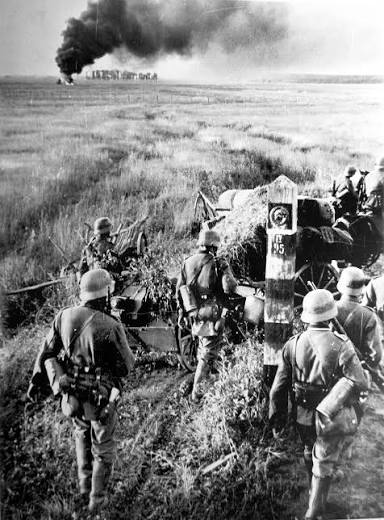
In the late summer of 1941, the largest encirclement in military history was not a single dramatic clash but a slow, grinding trap that closed over weeks. By the time it snapped shut, nearly 700,000 Soviet soldiers were caught inside, and the entire Southwestern Front had ceased to exist. The Battle of Kiev was not just a battle—it was a catastrophe that reshaped the Eastern Front and forced a bitter reckoning within the German High Command.
The Salient and the Stubborn Stand
By August 1941, the German Army Group South had slogged through the Ukraine, facing fierce Soviet counterattacks. The Soviet Southwestern Front, commanded by General Mikhail Kirponos, held a massive bulge around Kiev that jutted westward into German lines. This salient was a tempting target a huge concentration of Soviet forces ripe for envelopment.
But Stalin refused to yield. Despite repeated pleas from his generals to withdraw from the salient to avoid encirclement, Stalin ordered the defense of Kiev at all costs. He believed the Germans would not risk a major operation there. He was wrong.
The Great Debate
Within the German command, a furious argument raged. Hitler insisted on seizing Ukraine for its grain and coal, and destroying the Soviet forces in the Kiev salient before advancing on Moscow. His generals Heinz Guderian, Fedor von Bock, Franz Halder wanted to push straight for Moscow, the political and logistical heart of the USSR. They argued that diverting south would waste precious time and allow the Soviets to reinforce the capital.
Hitler overruled them. On August 21, he issued Directive No. 33, ordering the turn south. Guderian’s Panzer Group 2 was detached from Army Group Center and sent south to meet Ewald von Kleist’s Panzer Group 1 coming north. The plan was a classic double envelopment a Kesselschlacht, or cauldron battle.
The Trap Closes
From August 23 to September 12, Guderian’s tanks drove south from the Gomel area, while Kleist’s forces struck north from the Kremenchug bridgehead on the Dnieper River. The two pincers moved relentlessly, and on September 14–16, they met at Lokhvitsa, about 120 miles east of Kiev. The pocket was sealed.
Inside were five Soviet armies the 21st, 5th, 37th, 26th, and part of the 38th roughly 452,000 to 700,000 soldiers. They were trapped, but not yet defeated. For the next ten days, the Germans methodically reduced the pocket. The Soviets attempted breakout after breakout, but the ring held. On September 20, General Kirponos was killed in action. By September 26, the last organized resistance ended.
The numbers are staggering. The Germans claimed 665,000 prisoners a figure that even conservative Soviet-era estimates exceed 450,000. They also captured over 3,000 artillery pieces, 900 tanks, and 400 aircraft. Soviet losses for the entire operation reached roughly 600,000 to 700,000 killed, wounded, captured, or missing. German casualties were a fraction of that: about 100,000 to 128,000 total.
The Aftermath and the Controversy
Kiev fell on September 19, 1941. The victory opened the road to the Donbas and Crimea, and it secured the southern flank for the German advance. But it also delayed the drive on Moscow. Operation Typhoon, the assault on the capital, did not begin until October 2—a month later than originally planned.
That delay became one of the most debated strategic questions of the war. Guderian and Halder later argued that the Kiev detour was a fatal mistake, allowing the Red Army to bring fresh Siberian divisions west, which contributed to the German defeat at the gates of Moscow in December 1941.
But historian David Stahel and others counter that Army Group Center was too weak to take Moscow in 1941 regardless. The Kiev victory, they argue, was necessary to secure the southern flank and resources. The debate remains unresolved, but the scale of the encirclement is not in question.
The Human Cost
The Battle of Kiev was a catastrophe for the Soviet Union. The entire Southwestern Front was effectively destroyed, and the loss of life was immense. The prisoners taken at Kiev were marched into captivity, many to die in German camps. The battle stands as a grim reminder of the cost of strategic stubbornness and the brutality of the Eastern Front.
For the Germans, it was a triumph—a textbook example of operational art. But it was also a warning. The sheer number of prisoners taken was a sign of the Red Army’s resilience: even after losing hundreds of thousands of men, the Soviets continued to fight. The cauldron at Kiev was the largest encirclement in history, but it would not be the last.
The Battle of Kiev remains the largest encirclement in military history, a brutal demonstration of the scale of war on the Eastern Front. It was a German victory that came at a strategic cost, and a Soviet defeat that was avoidable. The cauldron at Kiev closed on nearly 700,000 men, and its legacy is a study in the consequences of high-stakes decision-making under fire.
Summary
- The Battle of Kiev (August 23 – September 26, 1941) was the largest encirclement in history, trapping over 450,000 Soviet soldiers.
- Hitler ordered a turn south to seize Ukraine, overriding his generals’ push for Moscow.
- Guderian’s and Kleist’s panzer groups met at Lokhvitsa, sealing the pocket.
- The Soviet Southwestern Front was destroyed, with ~600,000 total casualties and ~665,000 prisoners taken.
- The victory delayed the German assault on Moscow, sparking a lasting strategic debate.
FAQ
Q: What was the largest encirclement in military history?
A: The Battle of Kiev in 1941, where German forces trapped over 450,000 Soviet soldiers, with some estimates exceeding 665,000 prisoners.
Q: Why did Hitler divert forces to Kiev instead of Moscow?
A: Hitler prioritized Ukraine’s agricultural and industrial resources and wanted to destroy the Soviet forces in the Kiev salient before advancing on Moscow.
Q: How did the Soviets end up encircled?
A: Stalin refused to allow withdrawal from the Kiev salient, leaving the Southwestern Front in place, which allowed the Germans to execute a double envelopment.
Q: What was the outcome of the Battle of Kiev?
A: A decisive German victory, with the entire Soviet Southwestern Front destroyed, opening the road to the Donbas and Crimea.
Q: Did the Battle of Kiev contribute to the German defeat at Moscow?
A: Many historians argue that the delay caused by the Kiev operation allowed the Soviets to reinforce Moscow, contributing to the German failure in December 1941, though others dispute this.
Leave a Reply