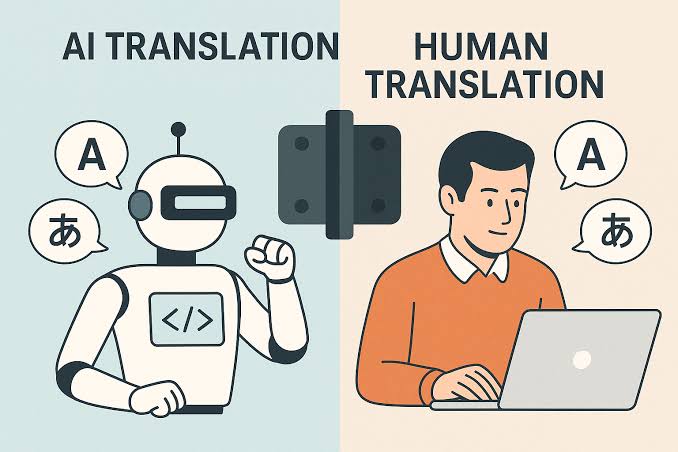
Open any browser, and you’ll find a translation tool that can render a French menu, a Japanese news article, or a Spanish email into flawless English in seconds. Neural machine translation has reached near-human fluency for many languages, handling idioms and slang that stumped earlier systems. But here’s the catch: fluency in words doesn’t equal success in communication. A grammatically perfect translation can still miss the point entirely—because meaning lives in tone, context, and culture, not just vocabulary.
This gap between what AI translates and what people actually communicate is becoming more critical as these tools spread into medicine, law, and diplomacy. Understanding why a fluent translation can fail is essential for anyone who relies on AI to bridge language gaps—and for the developers building the next generation of translation technology.
The Rise of Fluent Machines
Just a decade ago, machine translation was clunky. Statistical models produced word-for-word approximations that often read like robotic garble. Then came neural machine translation (NMT) in 2014, followed by the Transformer architecture in 2017, and suddenly AI could grasp context, idioms, and even some slang. Today, systems like Google Translate, DeepL, and GPT-based models score within a few points of professional human translators on standard benchmarks like BLEU and COMET for high-resource language pairs such as English↔French or English↔Chinese.
The speed and scale are staggering. Google Translate alone processes over 100 billion words daily across more than 100 languages. Real-time speech translation is now a feature on smartphones, and Meta is researching simultaneous interpretation. For travelers, students, and casual users, AI translation is a miracle—instant, free, and often impressively accurate.
The Fluency Illusion
But here’s the problem: fluency can be deceptive. When a translation reads smoothly, we naturally assume it’s correct. Researchers call this the “fluency illusion”—the tendency to over-trust output that looks polished, especially when you can’t verify it against the original. In human-computer interaction, this is a form of automation bias: we trust the machine because it sounds confident.
Consider a real-world example from a medical consultation. A patient might say, “I’m feeling a bit off,” which in some cultures is a euphemism for severe pain. A literal translation—”I feel slightly unwell”—loses the urgency. The AI produces a fluent sentence, but the doctor misreads the severity. The words are right; the meaning is wrong.
Communication Is More Than Words
Linguists and anthropologists have long known that language is only one layer of communication. Meaning also comes from non-verbal cues like tone and gesture, shared background knowledge, cultural norms about directness and politeness, and the situational context—who is speaking, to whom, and why.
For example, in high-context cultures (like Japan or Arab countries), much of the message is implicit, relying on the listener to read between the lines. In low-context cultures (like Germany or the U.S.), communication is more explicit. A literal translation from Japanese to English might strip away the indirectness that signals respect or hesitation, making a polite refusal sound like a hard “no.” In business negotiations, that can derail a deal.
Speech act theory adds another layer: we use words not just to convey information but to perform actions—promising, warning, apologizing, flattering. A translation that gets the propositional content right but misses the intended speech act fails communicatively. Sarcasm, humor, and irony are notoriously hard for AI because they rely on shared context and cultural cues that aren’t in the text itself.
Where AI Still Stumbles
Despite progress, AI translation has documented weaknesses:
- Low-resource languages: Languages with little training data still produce poor translations, perpetuating a digital divide.
- Culturally embedded expressions: Proverbs, idioms, and metaphors often have no direct equivalent. “It’s raining cats and dogs” doesn’t translate literally into most languages.
- Politeness registers: Many languages have formal vs. informal address (tu/vous, du/Sie). AI often defaults to one, which can sound rude or overly familiar.
- Domain-specific jargon: Legal, medical, and literary texts require specialized knowledge that generic models lack.
- Code-switching: Mixed-language input (common in multilingual communities) confuses systems trained on single-language corpora.
These aren’t edge cases—they’re everyday communication. And in high-stakes settings like refugee intake or emergency response, a mistranslation can have life-or-death consequences.
The Human Element: Translation vs. Localization
Professional translators are trained to do more than convert words. They consider the purpose, audience, and cultural context—a process called localization. A marketing slogan might be adapted entirely to resonate with a new culture, not translated literally. Human translators also make judgment calls about ambiguity, something AI cannot do because it lacks lived experience.
This is why many professionals argue that AI is a tool, not a replacement. The emerging skill is “post-editing”—humans refining AI output to ensure fidelity and cultural appropriateness. In fields like law and medicine, human oversight remains non-negotiable.
The Trust Paradox
Interestingly, user studies reveal a trust paradox. When people can’t tell if a translation is AI-generated, they may over-trust it (the fluency illusion). But when they know it’s AI, they may discount it even when it’s accurate. This inconsistency complicates how we integrate AI translation into our lives.
There’s also an ethical dimension. AI translation can flatten linguistic diversity, favoring dominant languages and encoding biases from training data. For endangered languages, it might offer a lifeline—or it might standardize and erase dialects. The choice of how to use these tools is ours.
Looking Ahead: Multimodal and Context-Aware AI
The next frontier is multimodal AI that can process vision, audio, and text together. Imagine a translator that sees a speaker’s facial expression or hears their tone of voice—capturing some of the non-verbal cues that text alone misses. Researchers are also working on context-aware models that track conversation history and cultural norms.
But even the most advanced AI will never fully replicate human understanding. Communication is a deeply human act, rooted in shared experience and empathy. As AI translators become more fluent, we must remember that words are just the surface. The real meaning lies beneath—in the pauses, the gestures, and the unspoken assumptions that machines cannot yet grasp.
AI translation is a remarkable achievement, breaking down language barriers in ways that were unimaginable a generation ago. But fluency is not the same as understanding. As we rely more on these tools, we must stay aware of their limits—and complement them with human judgment, especially in high-stakes situations. The best translation isn’t always the most literal; it’s the one that truly communicates.
Summary
- AI translation has achieved near-human fluency in many languages, but fluency doesn’t guarantee communicative success.
- The “fluency illusion” causes users to over-trust polished AI output, even when it misses cultural or contextual meaning.
- Communication relies on non-verbal cues, shared knowledge, and cultural norms—elements AI cannot fully capture.
- AI still struggles with low-resource languages, idioms, politeness registers, and domain-specific jargon.
- Human oversight, especially in medicine, law, and diplomacy, remains essential; AI is a tool, not a replacement.
FAQ
Q: Can AI translation replace human translators?
A: Not entirely. AI is excellent for everyday, low-stakes translation, but human translators are still needed for high-stakes domains like law and medicine, where cultural nuance and accuracy are critical. The role is shifting toward post-editing AI output.
Q: Why does a fluent AI translation sometimes sound wrong?
A: Because fluency is about grammar and word choice, not meaning. AI may miss sarcasm, politeness, or cultural references, producing text that reads well but conveys the wrong message.
Q: What are the biggest limitations of AI translation today?
A: Low-resource languages, culturally embedded expressions, sarcasm, humor, politeness registers, and domain-specific jargon are the main weak points.
Q: How can I avoid miscommunication when using AI translation?
A: Use it as a starting point, not a final answer. For important conversations, verify with a human who understands both languages and cultures.
Q: Will AI translation improve to fully capture meaning?
A: Multimodal models that process tone and visuals may help, but full understanding requires lived experience and empathy, which machines lack. It’s unlikely AI will ever fully replicate human communication.
Leave a Reply