When you need an answer, do you type keywords into Google, or do you ask ChatGPT? That choice shapes how you get information, how much you trust it, and how long it takes. Traditional search and AI search are fundamentally different experiences, and knowing the difference can save you time and frustration.
For over two decades, traditional search has been the default: type a few words, scan a list of blue links, click, refine. But since late 2022, AI search has emerged as a serious alternative, offering direct answers and conversational follow-ups. By 2026, Gartner predicts traditional search volume will drop by 25% as AI chatbots take over more queries. Yet, each approach has clear strengths and weaknesses. This article breaks down the real user experience differences not the hype so you can choose the right tool for the task.
The Core Difference: Links vs. Answers
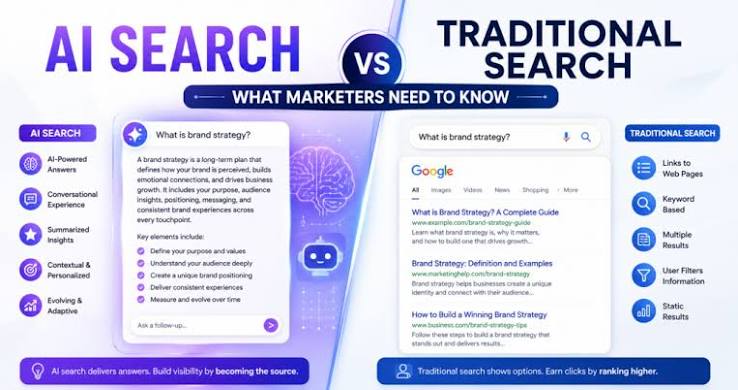
Traditional search is built around the SERP—the search engine results page. You enter keywords like “best budget laptop for video editing,” and Google returns a ranked list of blue links, with sponsored results at the top. The system is transparent: you see exactly which websites appear, and you can jump in and out of them. The trade-off is that you do the work—scanning, clicking, and comparing.
AI search, on the other hand, uses retrieval-augmented generation (RAG) to pull content from the web and then synthesizes it into a direct answer. In Perplexity or ChatGPT, you can ask a full question in natural language: “What’s the best budget laptop for video editing in 2025?” The AI returns a concise, cited response that combines multiple sources. No need to click through a dozen tabs.
That basic shift—from a list of options to a single answer—changes everything about the experience.
Speed vs. Depth: The Time-to-Answer Trade-off
AI search wins on raw speed. A well-formed query can produce a solid answer in seconds, with citations. For instance, ask ChatGPT “Summarize the key differences between OLED and QLED TVs,” and you’ll get a bulleted comparison immediately. Traditional search would require you to open multiple reviews and cross-reference specs yourself.
But speed can come at the cost of depth. Traditional search exposes you to a diversity of perspectives, letting you serendipitously discover a niche blog or a critical review that an AI might have flattened. AI compresses information, which can be great for a quick overview, but it may also lose nuance or over-rely on a few popular sources.
Consider this scenario: You need to find the official opening hours for a local museum. Traditional search gives you the museum’s website as the top result, and you click through to confirm. AI might also get it right, but if it hallucinates the hours, you could show up to a closed door. For time-sensitive, factual queries, traditional search’s direct access to the source is safer.
Control and Refinement: Who’s in the Driver’s Seat?
Traditional search puts you in control. You refine your query with precise keywords:
– “best budget laptop for video editing” → “best budget laptop for video editing under $800” → “best budget laptop for video editing under $800 with 16GB RAM.”
You see the URLs, and you can assess the credibility of each source. The process is iterative, and you always know why a result appeared.
AI search, by contrast, uses conversational context to remember your previous questions. You can say, “What about under $800?” and the AI knows you’re still talking about laptops. This is a huge advantage for multi-step research. But it also requires prompt engineering—you have to learn how to phrase questions clearly to get the best results. Vague questions can lead to broad or useless answers.
For users who struggle with keyword formulation—non-native speakers, people with low literacy, or those with disabilities—AI’s natural language interface is a game-changer. It removes the barrier of guessing the “right” words.
Trust: Sources vs. Citations
Traditional search is transparent about its sources. You see the domain, the snippet, and the page rank. You can judge whether a result comes from a reputable news outlet or a random blog. The system doesn’t “make up” information—it only surfaces what exists.
AI search relies on source citation and the model’s confidence. Perplexity and ChatGPT show numbered references, which is a step in the right direction. But AI can still hallucinate—confidently generate false information, especially on niche topics or recent events. A 2024 study found that AI Overviews in Google returned incorrect information for 27% of queries tested. That’s a trust risk you don’t have with traditional search.
However, AI’s synthesis can also be more useful for complex questions. For “Explain the differences between Keynesian and supply-side economics,” an AI can generate a coherent summary that weaves together multiple sources, while traditional search gives you links to Wikipedia, Investopedia, and a few academic papers—leaving you to do the synthesis.
The Hybrid Reality: Most People Use Both
The truth is, most users aren’t choosing one over the other. They use both, depending on the task:
- AI for synthesis: “Summarize this article,” “Compare these two products,” “Explain this concept.”
- Traditional for verification: Checking official sites, local hours, shopping, and breaking news.
- Traditional for serendipity: When you want to explore broadly and stumble upon unexpected sources.
- AI for follow-ups: When you need to drill down on a topic through a conversation.
A 2025 survey found that 70% of users who tried AI search still used traditional search for at least half of their queries. The key is matching the tool to the job.
The Skeptical View: Echo Chambers, Ads, and Privacy
AI search isn’t without its critics. Three main concerns stand out:
- Echo chamber risk: Because AI models are trained on popular web content, they may over-represent mainstream perspectives and under-represent fringe or minority viewpoints. Traditional search, for all its flaws, at least shows you a messy, diverse web.
- Ad creep: AI search is already monetizing. Perplexity has introduced sponsored follow-up questions, and Google AI Overviews include ads. This could eventually replicate the same ad-driven biases that plague traditional search.
- Privacy: Conversational AI retains your query history and context to provide continuity. That’s a privacy trade-off compared to traditional search, where you can browse anonymously or use incognito mode.
These issues don’t mean AI search is bad—they mean you should be aware of the costs.
What the Data Says About the Shift
Gartner’s prediction of a 25% drop in traditional search volume by 2026 is a big deal. It’s driven by younger users: Gen Z already prefers TikTok and AI chat for discovery. But the shift isn’t a complete replacement. Traditional search remains dominant for transactional and local queries—the stuff of daily life.
For now, the best strategy is to be bilingual in search. Use AI when you need a fast, synthesized answer. Switch to traditional when you need to verify, explore, or find a specific website. The user experience is no longer about one search box—it’s about choosing the right tool for the right moment.
AI search and traditional search are not enemies—they’re different tools for different jobs. AI is faster and more conversational, but it can hallucinate. Traditional search is transparent and reliable, but it’s slower and requires more effort. The smartest approach is to use both, matching the tool to the task. As AI improves and becomes more integrated, the line will blur, but your role as a savvy user is to stay in control of how you seek information.
Summary
- AI search provides direct, synthesized answers via natural language, saving time but risking hallucinations.
- Traditional search offers transparent, source-visible results, giving users control but requiring more manual effort.
- Hybrid usage is common: AI for synthesis and traditional for verification, local queries, and shopping.
- Trust and privacy are key trade-offs: AI relies on citations, while traditional search shows raw URLs; AI retains conversational context, while traditional allows anonymous browsing.
- Task-dependent choice is the smart strategy: use AI for quick explanations and comparisons, traditional for official sources and breaking news.
FAQ
Q: Is AI search faster than traditional search?
A: Yes, for simple factual queries or summaries. AI compresses multiple sources into a single answer, while traditional search requires clicking through links. However, for complex or time-sensitive queries, traditional search may be faster because you can directly access the source.
Q: Can AI search be trusted for accurate information?
A: It depends. AI is generally reliable for general knowledge, but it can hallucinate on niche topics or recent events. Traditional search, by showing you the actual sources, allows you to verify accuracy yourself. Always cross-check AI answers for health, financial, or legal advice.
Q: Will traditional search disappear?
A: No, but it will decline. Gartner predicts a 25% drop in traditional search volume by 2026 as AI chatbots take over more queries. Traditional search will likely remain dominant for transactional and local searches, like buying products or finding store hours.
Q: Is using AI search private?
A: Less so than traditional search. Conversational AI retains your query history and context to provide follow-up answers. If privacy is a concern, use incognito mode or a traditional search engine like DuckDuckGo for sensitive queries.
Q: How can I get the best results from AI search?
A: Be specific and use natural language. Instead of typing “best laptop,” ask “What is the best budget laptop for video editing in 2025?” You can also refine with follow-up questions like “What about under $800?”—the AI remembers context and adjusts its answers.
Leave a Reply